
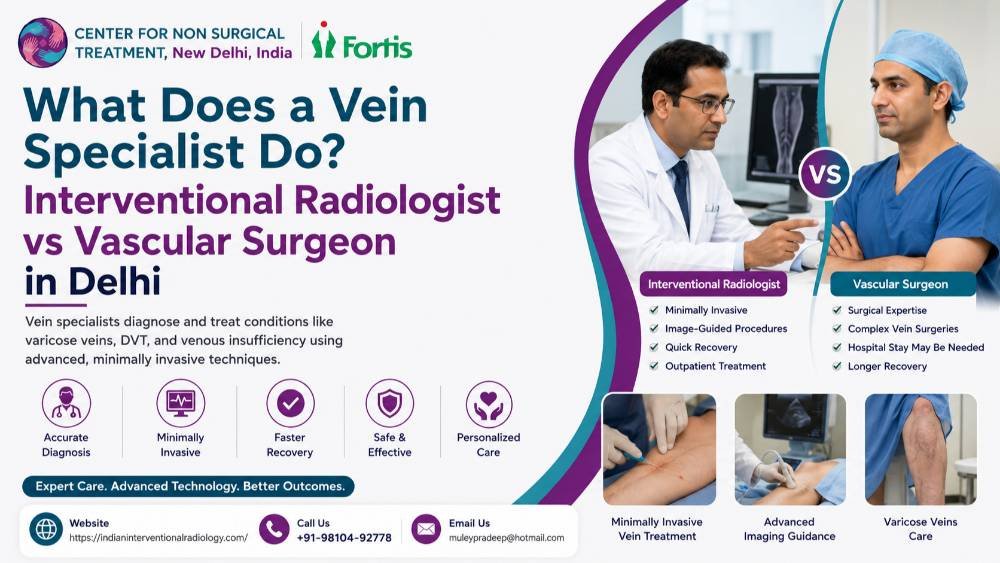
If you have varicose veins, leg swelling, or other vein-related issues, you may have come across terms like "vein specialist," "interventional radiologist," and "vascular surgeon." It can be confusing to understand who does what and which doctor you should see. This guide explains the differences between these specialists, what they treat, and how to choose the right one for your condition.
Why Trust This Guide?
| Trust Signal | Details |
|---|---|
| Updated for 2026 | Latest clinical practices and guidelines |
| Clinical Evidence | References to SVS, SIR, and established guidelines |
| Specialist Reviewer | Reviewed by Dr. Pradeep Muley, Senior Consultant Interventional Radiologist |
| Practical Criteria | Provides checklists and red flags for patient decision-making |
| Transparency | Independent verification of credentials and hospital affiliation |
This guide is based on established clinical guidelines and practical criteria for evaluating vascular specialists. It is written to help patients make informed decisions when choosing a vein specialist.
Last Reviewed: July 2026
Quick Answer: What Does a Vein Specialist Do?
A vein specialist diagnoses and treats conditions affecting the venous system, including varicose veins, chronic venous insufficiency, venous reflux, spider veins and selected venous disorders. Depending on their training, a vein specialist may be an interventional radiologist, vascular surgeon, vascular medicine specialist or another physician with dedicated expertise in venous disease.
For varicose veins, both interventional radiologists and vascular surgeons may provide diagnosis and treatment. Interventional radiologists generally specialise in image-guided minimally invasive procedures, while vascular surgeons are trained in both endovascular treatment and open vascular surgery.
The right specialist is determined by the underlying venous problem, duplex ultrasound findings, anatomy, severity, available treatment options and the physician's experience with that specific condition.
Vein Specialist vs Interventional Radiologist vs Vascular Surgeon: At a Glance
| Aspect | Interventional Radiologist | Vascular Surgeon |
|---|---|---|
| Core expertise | Image-guided minimally invasive procedures | Arterial and venous disease + surgical and endovascular treatment |
| Venous procedures | Ablation, sclerotherapy, embolization and other image-guided treatments | Ablation, phlebectomy, sclerotherapy and other vascular procedures |
| Open surgery | Generally not the focus of IR practice | Available when clinically indicated |
| Imaging expertise | Strong emphasis on image guidance | Varies by practice and training |
| Complex vascular disease | Can manage selected cases | Particularly suited to cases requiring surgical or broader vascular management |
| Appropriate choice | Depends on diagnosis and available expertise | Depends on diagnosis and available expertise |
Key Takeaways
- A vein specialist is a physician with appropriate expertise in diagnosing and treating venous disease.
- Interventional radiologists specialize in image-guided minimally invasive procedures.
- Vascular surgeons are trained in both open vascular surgery and endovascular treatment.
- For varicose veins, the best specialist depends on your diagnosis, duplex findings, treatment options and physician experience.
Who Should I See for Varicose Veins?
For straightforward varicose veins: An interventional radiologist or vascular surgeon with substantial venous experience may be appropriate.
If minimally invasive treatment is being considered: Look for a physician experienced in procedures such as endovenous laser ablation, radiofrequency ablation, sclerotherapy or phlebectomy.
If you have complex vascular disease or may need open surgery: A vascular surgeon may be particularly appropriate because their training includes both open and endovascular vascular procedures.
If embolization is being considered: An interventional radiologist with specific experience in venous embolization may be appropriate.
The key question isn't simply "Which specialty is better?" It's "Which physician has the right experience and treatment capability for my particular venous problem?"
What Is a Vein Specialist?
"Vein specialist" is an umbrella term for doctors who diagnose and treat venous disorders. These specialists have specific medical training and generally fall into two broad categories:
- Interventional Radiologists – Doctors who use image-guided, minimally invasive procedures to treat vein problems without traditional open surgery.
- Vascular Surgeons – Surgeons who treat vein and artery conditions using both minimally invasive techniques and traditional open surgery when needed.
Phlebology refers to the medical field focused on venous disorders. The physician treating venous disease may have training in interventional radiology, vascular surgery, vascular medicine or another specialty with appropriate venous expertise.
A vein specialist should have appropriate training and experience in evaluating venous disease. Depending on the physician's specialty and practice setting, diagnostic duplex ultrasound may be performed by the physician, vascular laboratory staff, or another qualified clinician.
What Does an Interventional Radiologist Do?
An interventional radiologist (IR) is a medical doctor who specializes in performing minimally invasive, image-guided procedures to diagnose and treat diseases. They use advanced imaging techniques like ultrasound, CT, MRI, and fluoroscopy to guide tiny instruments—such as catheters and wires—through the body's blood vessels.
The Society of Interventional Radiology (SIR) describes IR as minimally invasive, image-guided treatment using modalities such as ultrasound, X-ray, CT, MRI and fluoroscopy. Interventional radiologists are specifically trained to use image guidance and minimally invasive techniques to access blood vessels and deliver targeted treatments.
Common Procedures Performed by Interventional Radiologists
- Endovenous ablation – A thin catheter is guided into the affected vein and heat or adhesive is used to seal it shut. Blood is then naturally rerouted to healthier veins.
- Sclerotherapy – A solution is injected directly into small varicose or spider veins causing them to collapse and be reabsorbed by the body.
- Venous stenting – For patients with blockages or narrowing of the pelvic veins, a small metal mesh stent may be placed to keep the vein open.
- Embolization – Blocks off abnormal or damaged blood vessels (used in treating varicose veins, pelvic congestion syndrome, varicocele, and uterine fibroids).
- Angioplasty and stenting – Opens blocked arteries to improve blood flow.
- Thrombectomy – Breaks up or removes blood clots in veins or arteries.
When Might an Interventional Radiologist Be Appropriate?
Depending on the condition and treatment plan, an interventional radiologist may offer:
- Image-guided minimally invasive procedures
- Endovenous treatment for selected venous reflux
- Sclerotherapy for appropriate superficial veins
- Embolization for selected pelvic venous disorders and varicocele
- Same-day or outpatient treatment for many procedures
- Image-guided assessment and procedural planning
Depending on the vein being treated and the procedure, the physician may access the venous system through a small needle or catheter inserted at an appropriate location under image guidance.
What Does a Vascular Surgeon Do?
A vascular surgeon specializes in diagnosing and treating diseases of the blood vessels, including arteries and veins, using open surgical and minimally invasive endovascular techniques.
Common Procedures Performed by Vascular Surgeons
- Bypass surgery – Creates a new pathway for blood flow around a blocked artery.
- Endarterectomy – Removes plaque buildup from arteries to prevent stroke.
- Open aneurysm repair – Repairs life-threatening bulges in blood vessels.
- Vein stripping and ligation – Removes severely damaged veins.
- Endovenous laser ablation (EVLA) and radiofrequency ablation – Same minimally invasive techniques used by interventional radiologists.
- Ambulatory phlebectomy – Removal of superficial varicose veins through tiny incisions.
- Sclerotherapy – Injection treatment for smaller veins.
When Might a Vascular Surgeon Be Appropriate?
Vascular surgeons are trained to manage a broad range of arterial and venous disorders and can perform both open and endovascular procedures when clinically appropriate. They may be appropriate for advanced or severe cases where minimally invasive procedures may not be sufficient. Their training includes both open vascular surgery and endovascular procedures, allowing them to manage patients who may require either approach. The exact procedures offered vary by physician and practice.
Interventional Radiologist vs Vascular Surgeon: Key Differences
Training
- Interventional Radiologists – Complete a radiology residency followed by a fellowship in interventional radiology. Their training focuses on imaging and minimally invasive techniques.
- Vascular Surgeons – Complete a general surgery residency followed by a fellowship in vascular surgery. Their training includes both open surgery and endovascular procedures.
Procedures
- Interventional Radiologists – Primarily perform minimally invasive, image-guided procedures rather than traditional open vascular surgery.
- Vascular Surgeons – Can perform both minimally invasive procedures and open surgery when needed.
Scope of Practice
- Interventional Radiologists – Focus on image-guided interventions. Many of their procedures are unrelated to vascular disorders, though they do treat many venous conditions.
- Vascular Surgeons – Are trained to manage a broad range of arterial and venous disorders.
Which Specialist May Be Appropriate?
| Condition | Who May Be Appropriate |
|---|---|
| Uncomplicated varicose veins | Interventional radiologist or vascular surgeon with venous expertise |
| Venous reflux | Either, depending on expertise and treatment availability |
| Spider veins | Physician experienced in sclerotherapy/vein treatment |
| Pelvic venous disorders | Interventional radiologist with pelvic venous expertise |
| DVT | Depends on severity; vascular medicine, vascular surgery or interventional radiology may be involved |
| Complex venous disease | Specialist/team selected according to anatomy and treatment requirements |
| Disease potentially requiring open vascular surgery | Vascular surgeon |
The key consideration is the physician's specific experience with your venous condition and access to appropriate diagnostic and treatment facilities.
Common Vein Conditions Treated by Specialists
Varicose Veins
Varicose veins are enlarged, swollen, and twisted veins that commonly appear blue or dark purple, most often in the legs. They occur when the valves inside the veins are damaged or weakened, causing blood to flow in the wrong direction and pool in the vein.
Common symptoms include:
- Visible, twisted, bulging veins
- Aching pain, easy leg fatigue, and leg heaviness that worsen as the day progresses
- Swelling in the lower legs, ankles, and feet
- Itching around the veins
- Skin discoloration or ulceration in severe cases
Risk factors:
- Age
- Family history
- Female gender and pregnancy (especially multiple pregnancies)
- Obesity, prolonged standing or sitting
Varicose veins can be associated with complications such as superficial thrombophlebitis, skin changes, venous ulcers and bleeding. More advanced venous disease may also involve other complications.
For those seeking varicose veins treatment in Delhi, minimally invasive options are available.
Spider Veins
Spider veins are fine, visible veins under the skin, usually red or blue, that appear like a spiderweb. They are primarily cosmetic and do not cause serious complications if left untreated. Spider veins can sometimes coexist with underlying venous reflux or larger varicose veins. A clinical evaluation can help determine whether further assessment is appropriate before cosmetic treatment.
Deep Vein Thrombosis (DVT)
DVT is a blood clot that forms in a deep vein, usually in the leg. It can cause pain, swelling, and redness. If a clot breaks loose and travels to the lungs, it can cause a life-threatening pulmonary embolism. DVT is primarily managed according to its location, severity, symptoms and risk of complications. Depending on the case, treatment may involve anticoagulation and, in selected patients, vascular surgery or interventional radiology procedures such as thrombectomy or catheter-directed therapy.
Pelvic Congestion Syndrome (PCS)
Pelvic congestion syndrome is associated with dilated pelvic veins and may cause chronic pelvic pain. Interventional radiologists may treat selected cases using embolization of abnormal pelvic veins. If you are experiencing chronic pelvic pain, you can learn more about pelvic congestion syndrome treatment on our dedicated treatment page.
Varicocele
A varicocele is an enlargement of the veins within the scrotum. Much like varicose veins in the legs, a varicocele occurs when blood pools in the veins due to improper functioning of the valves inside the veins. Varicoceles can cause a dull, aching pain in the scrotum, a feeling of heaviness, and in some cases, infertility. Interventional radiologists treat varicoceles using embolization. For more information, visit our page on varicocele treatment.
AVMs and Vascular Lesions
Arteriovenous malformations (AVMs) and vascular lesions such as hemangiomas can require specialist assessment. Selected lesions may be treated with image-guided techniques such as embolization or other interventions, depending on their type, location and characteristics. For more information, visit our page on AVM and hemangioma treatment.
How Is Venous Disease Diagnosed?
Diagnosis begins with a medical history and physical examination. For suspected chronic venous disease or varicose veins, duplex ultrasound is commonly used to evaluate venous anatomy, blood flow and reflux. Duplex ultrasound is the main non-invasive test used to evaluate venous reflux and anatomy when intervention for varicose veins is being considered.
The Society for Vascular Surgery (SVS) clinical practice guidelines identify duplex scanning as important in the evaluation of varicose veins. The results help the specialist determine whether symptoms are related to superficial venous reflux, deep venous disease or another condition and whether treatment is appropriate.
What Can Duplex Ultrasound Show?
- Venous reflux (blood flowing backward)
- Superficial veins (including the greater saphenous vein)
- Deep veins
- Venous obstruction
- Thrombus (blood clot)
- Vein diameter
- Direction of blood flow
Do all varicose veins require an ultrasound? No. The need for duplex ultrasound depends on the patient's symptoms, clinical findings and the treatment being considered. When venous intervention is being evaluated, duplex ultrasound can provide important information about venous anatomy and reflux.
Varicose Veins vs DVT: Key Differences
| Feature | Varicose Veins | DVT |
|---|---|---|
| Problem | Abnormal superficial venous flow/reflux | Blood clot in a deep vein |
| Typical appearance | Visible enlarged/twisted veins | Usually no visible vein required |
| Common symptoms | Aching, heaviness, swelling | Swelling, pain, tenderness |
| Urgency | Usually non-emergency | Requires prompt medical assessment |
| Diagnosis | Clinical assessment + duplex ultrasound when indicated | Medical assessment + diagnostic testing |
When Should You See a Vein Specialist?
You should see a vein specialist if you have:
- Visible, bulging veins
- Leg pain, heaviness, or swelling
- Skin discoloration near your veins
- Any signs of complications like ulcers or bleeding
When Should Leg Vein Symptoms Be Evaluated Urgently?
Seek urgent medical evaluation if you develop:
- Sudden swelling of one leg
- Sudden leg pain or tenderness
- Unexplained warmth or redness
- Sudden shortness of breath
- Chest pain
- Coughing up blood
- Fainting or severe dizziness
Sudden one-sided leg swelling or pain should not automatically be assumed to be varicose veins. Deep vein thrombosis requires prompt medical assessment. Sudden breathing difficulty, chest pain, coughing blood or fainting may indicate a pulmonary embolism and require immediate emergency medical evaluation.
Treatment Options for Varicose Veins
Conservative Management
- Lifestyle changes – Elevating the legs, avoiding prolonged standing, maintaining a healthy weight, and regular exercise
- Compression stockings – Specially designed socks that improve circulation by applying pressure to the legs
Endovenous and Minimally Invasive Treatments
- Endovenous Laser Ablation (EVLA/EVLT) – Laser energy is used to close off the affected vein
- Radiofrequency Ablation (RFA) – Heat from radiofrequency energy is used to close the vein
- Sclerotherapy – A solution is injected into the vein, causing it to collapse
- VenaSeal – A medical adhesive is used to seal the vein closed
Compared with traditional open vein surgery, selected minimally invasive treatments may offer advantages such as:
- Smaller access sites
- Less postoperative discomfort for many patients
- Earlier return to normal activity in appropriate cases
- Local or tumescent anaesthesia for many procedures
- Avoidance of a traditional surgical incision
Surgical Treatment
- Vein stripping – Surgical removal of the affected vein through small incisions
- Ligation – Tying off the affected vein to prevent blood from flowing through it
- Ambulatory phlebectomy – Removal of superficial varicose veins through tiny incisions
Surgery is generally reserved for selected cases where minimally invasive treatments are not suitable or have not been effective.
How to Choose a Vein Specialist in Delhi
When choosing a vein specialist doctor in Delhi, consider:
- Relevant specialist qualification
- Experience treating your specific venous condition
- Availability of duplex ultrasound
- Experience with minimally invasive venous procedures
- Appropriate hospital or procedure facility
- Follow-up and post-treatment care
- Ability to manage complications or refer for vascular surgery when required
Checklist Before Booking an Appointment
Before booking an appointment, check:
- ☐ Relevant specialist qualification – Look for training in interventional radiology, vascular surgery or vascular medicine
- ☐ Experience with your specific venous condition
- ☐ Duplex ultrasound or appropriate vascular imaging – This is essential for proper diagnosis
- ☐ Experience with the treatment being considered
- ☐ Access to appropriate hospital/procedure facilities
- ☐ Clear explanation of alternatives
- ☐ Post-procedure follow-up
- ☐ Ability to coordinate with vascular surgery or another specialist when required
Before your consultation, bring any previous Doppler/duplex ultrasound reports, medical records, medication list and details of previous vein treatments.
Patients seeking a vein specialist doctor in Delhi can consider an interventional radiologist or vascular surgeon based on their diagnosis and treatment requirements.
Why Consider Dr. Pradeep Muley?
Dr. Pradeep Muley is a Senior Consultant Interventional Radiologist based in New Delhi. He leads the Department of Interventional Radiology at Fortis Hospital, Vasant Kunj, New Delhi.
With 30 years of experience, Dr. Muley has performed more than 20,000 diagnostic and interventional radiological procedures. He specializes in minimally invasive, image-guided procedures for varicose veins and other venous conditions. He offers a range of non-surgical treatment options including radiofrequency ablation, laser treatment, and sclerotherapy, using image-guided minimally invasive techniques appropriate to the patient's condition.
Dr. Muley is also recognised for his expertise in treating pelvic congestion syndrome and varicocele using embolization techniques, as well as AVM and hemangioma treatment.
Dr. Pradeep Muley's Qualifications & Experience
- MBBS
- M.D. (Radio Diagnosis)
- Senior Consultant, Interventional Radiology — Fortis Vasant Kunj
- 30 years of experience
- 20,000+ diagnostic and interventional radiological procedures
For patients seeking a vein specialist doctor in Delhi or varicose veins treatment in Delhi, Dr. Pradeep Muley provides care with a focus on minimally invasive, patient-centred treatment.
Need a Vein Evaluation in Delhi?
If you have varicose veins, persistent leg swelling, visible veins, or symptoms of venous reflux, a specialist evaluation can help determine whether observation, conservative management or a minimally invasive procedure is appropriate.
Book a Vein Consultation in Delhi
Frequently Asked Questions (FAQs)
1. What is a vein specialist called?
"Vein specialist" is a general term for a physician with appropriate expertise in diagnosing and treating venous disease. Depending on their training, they may be an interventional radiologist, vascular surgeon, vascular medicine specialist or another qualified physician with venous expertise. The term phlebology refers to the field focused on venous disorders.
2. When should I see a vein specialist?
You should see a vein specialist if you have visible, bulging veins; leg pain, heaviness, or swelling; skin discoloration near your veins; or any signs of complications like ulcers or bleeding.
3. Which doctor is best for varicose veins?
Both interventional radiologists and vascular surgeons are highly qualified to treat varicose veins. Interventional radiologists focus on minimally invasive, image-guided procedures, while vascular surgeons can also perform open surgery if needed. The best choice depends on your specific condition and treatment needs.
4. What is the difference between a vascular surgeon and an interventional radiologist?
A vascular surgeon is trained in both open surgery and minimally invasive techniques, while an interventional radiologist specializes primarily in minimally invasive, image-guided procedures.
5. Do interventional radiologists perform surgery?
Interventional radiologists primarily perform minimally invasive, image-guided procedures rather than traditional open vascular surgery.
6. Can an interventional radiologist treat varicose veins?
Yes. Interventional radiologists with appropriate venous expertise can diagnose and treat selected venous conditions using image-guided minimally invasive procedures such as endovenous ablation, sclerotherapy and embolization.
7. Should I see a vascular surgeon or interventional radiologist for varicose veins?
Either may be appropriate. The decision should depend on the underlying venous problem, duplex ultrasound findings, treatment options and the specialist's experience with the specific condition.
8. Is varicose vein treatment painful?
Minimally invasive treatments like EVLT and RFA are performed under local anaesthesia and involve minimal discomfort. Recovery varies according to the procedure, number of veins treated, underlying health and individual circumstances.
9. How long does varicose vein treatment take?
Procedure time varies by the treatment, number of veins treated and individual anatomy. Many minimally invasive venous procedures are performed on an outpatient basis, but your specialist can give you a more accurate estimate after evaluation.
10. Can varicose veins come back after treatment?
While treated veins do not return, new varicose veins can develop over time. Healthy activity and weight management may support overall venous health, while compression therapy may be recommended for symptom management in selected patients.
11. What test does a vein specialist use?
A vein specialist may use a clinical examination and, when appropriate, duplex ultrasound to assess venous anatomy, blood flow, reflux, obstruction and thrombus.
12. Can a vein specialist treat leg swelling?
A vein specialist can evaluate leg swelling to determine whether it is related to venous disease, venous reflux, obstruction or another cause. Sudden one-sided swelling requires prompt medical evaluation because DVT is one possible cause.
13. What is chronic venous insufficiency?
Chronic venous insufficiency is a condition in which the veins have difficulty returning blood efficiently toward the heart, often because venous valves do not function properly. Venous reflux can cause blood pooling, leg heaviness, aching and swelling.
14. Can an interventional radiologist treat DVT?
Yes, appropriately trained interventional radiologists may participate in the diagnosis and minimally invasive treatment of selected cases of DVT, including catheter-directed thrombolysis or thrombectomy when clinically appropriate.
15. Can varicose veins be treated without surgery?
Many patients with appropriate anatomy can be treated using minimally invasive techniques such as endovenous ablation, sclerotherapy or phlebectomy. The appropriate option depends on the diagnosis, ultrasound findings and individual circumstances.
16. What should I bring to a vein specialist appointment?
Bring previous Doppler or duplex ultrasound reports, relevant medical records, a list of current medications, previous treatment details and a description of when your symptoms started or what makes them better or worse.
Conclusion
A vein specialist evaluates and treats venous disorders such as varicose veins, venous reflux and other vein-related conditions. Interventional radiologists specialise in image-guided minimally invasive procedures, while vascular surgeons can provide both endovascular and open surgical treatment.
For patients with varicose veins, the appropriate specialist depends on the underlying venous problem, duplex ultrasound findings, treatment options and the physician's experience with that condition.
If you are considering varicose veins treatment in Delhi, a specialist evaluation can help determine whether conservative management, endovenous treatment, sclerotherapy, phlebectomy or another approach is appropriate.
Medical Disclaimer
This article is for general educational purposes and does not replace a medical consultation, diagnosis or individualized treatment plan. Symptoms such as sudden one-sided leg swelling, chest pain or sudden breathing difficulty require prompt medical evaluation. Treatment decisions for venous disease should be based on clinical assessment and, when indicated, appropriate vascular imaging such as duplex ultrasound.