
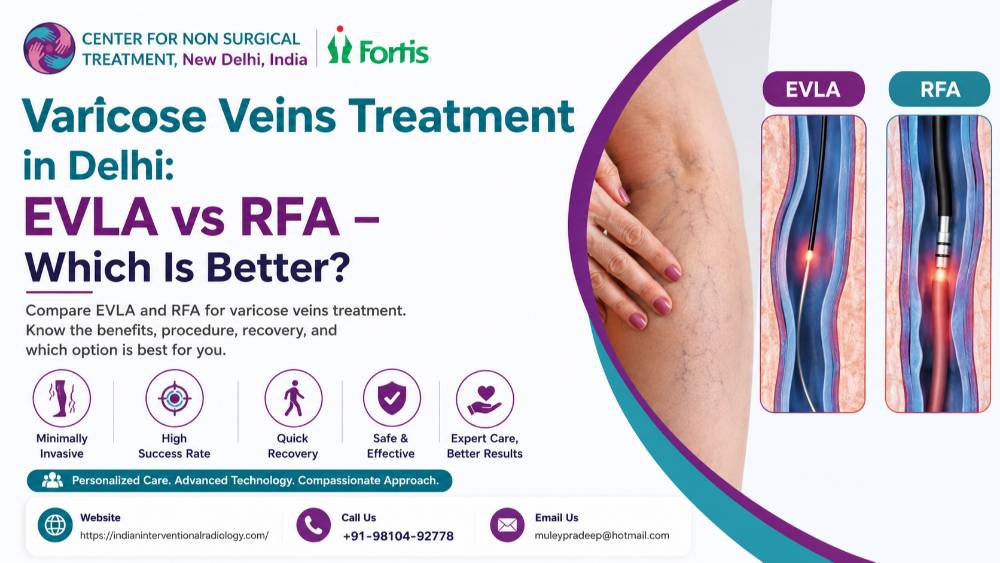
Neither EVLA nor RFA is universally better for varicose veins. Both are established endovenous thermal treatments with high vein-closure rates in appropriately selected patients. RFA may result in less short-term pain and bruising in some comparative studies, while EVLA remains an effective treatment. Duplex ultrasound and individual vein anatomy should guide the choice.
Why Trust This Guide?
| Trust Signal | Details |
|---|---|
| Updated for 2026 | Based on latest clinical guidelines and meta-analyses |
| Clinical Evidence | References NICE, ESVS, SVS and recent comparative studies |
| Specialist Reviewer | Reviewed by Dr. Pradeep Muley, Senior Consultant Interventional Radiologist |
| Evidence-Based Comparison | Presents data from 2024 meta-analysis and 2025 systematic review |
| Practical Guidance | Explains how specialists choose between EVLA and RFA |
This guide is based on established clinical guidelines, peer-reviewed evidence, and practical criteria for evaluating varicose vein treatments. It is written to help patients make informed decisions when considering EVLA or RFA.
Last Reviewed: July 2026
Key Takeaways
- EVLA and RFA are both established treatments for suitable superficial venous reflux.
- Neither procedure is universally better.
- Some studies have reported lower postoperative pain and bruising with RFA.
- Duplex ultrasound is important for confirming reflux and mapping venous anatomy.
- Treatment selection depends on vein anatomy, reflux pattern, symptoms and clinical assessment.
- Visible tributary veins may require additional treatment.
EVLA vs RFA for Varicose Veins: Comparison at a Glance
| Feature | EVLA | RFA |
|---|---|---|
| Energy source | Laser energy | Radiofrequency energy |
| Treatment type | Endovenous thermal ablation | Endovenous thermal ablation |
| Ultrasound guidance | Yes | Yes |
| Access | Small percutaneous access point | Small percutaneous access point |
| Anaesthesia | Usually local/tumescent | Usually local/tumescent |
| Typical setting | Often outpatient/day-care | Often outpatient/day-care |
| Main purpose | Close the refluxing vein | Close the refluxing vein |
| Effectiveness | Established for suitable venous reflux | Established for suitable venous reflux |
| Short-term recovery | Generally rapid | Generally rapid |
| Universal winner? | No | No |
The evidence does not support presenting one technique as universally superior. A 2024 meta-analysis involving 29 studies found broadly similar early and long-term great saphenous vein occlusion rates for RFA and laser ablation, with some differences in postoperative outcomes such as pain and bruising.
What Are Varicose Veins?
Varicose veins are enlarged, twisted superficial veins that most commonly appear in the legs. They develop when the one-way valves inside the veins weaken, allowing blood to flow backward and pool. This condition is known as venous reflux.
Common symptoms include leg aching, heaviness, swelling around the ankles, itching, burning sensations, night cramps, skin discolouration and visibly bulging veins. Some people experience few symptoms, while others find their daily activities significantly affected.
Several factors contribute to venous disease, including increasing age, family history, pregnancy, prolonged standing, excess body weight, reduced mobility and weakened vein valves. The key underlying issue is often venous reflux, which is why treatment planning focuses on identifying the specific veins responsible for this abnormal flow.
How Are Varicose Veins Diagnosed?
Duplex Ultrasound: The Key Test for Treatment Planning
A duplex ultrasound combines imaging with blood-flow assessment. It identifies:
- The location of venous reflux
- Which superficial veins are affected (great saphenous, small saphenous)
- The extent of reflux
- Deep-vein involvement
- Anatomical details relevant to treatment planning
NICE recommends duplex ultrasound to confirm the diagnosis and assess truncal reflux before treatment. NICE recommends offering endothermal ablation for suitable patients with confirmed varicose veins and truncal reflux. If endothermal ablation is unsuitable, ultrasound-guided foam sclerotherapy may be considered, followed by surgery when appropriate.
Treatment planning should not rely on the appearance of visible veins alone; duplex ultrasound is used to confirm venous reflux and map the veins involved.
What Is Endovenous Laser Ablation (EVLA)?
Endovenous Laser Ablation (EVLA or EVLT) uses laser energy to ablate and close a diseased vein from the inside, under ultrasound guidance.
EVLA and RFA are primarily used to treat the underlying refluxing truncal vein. Visible tributary varicose veins may require additional treatment when clinically indicated.
How EVLA Works
- The affected vein is located using ultrasound.
- A small access point is made in the skin.
- A thin laser fibre is positioned inside the vein.
- Local/tumescent anaesthesia is administered.
- Laser energy delivers thermal injury to the vein wall, causing the vein to contract and ultimately close.
- Blood is redirected through other functioning veins in the venous system.
The goal is durable closure of the refluxing vein. Over time, the body gradually remodels the treated vein segment. However, recanalisation or new venous reflux can occur in some patients.
Potential Benefits of EVLA
- Minimally invasive
- Small access point, no large incisions
- Ultrasound-guided precision
- Generally rapid recovery
- Effective for suitable superficial venous reflux
- Can be combined with treatment of symptomatic tributary veins
What Is Radiofrequency Ablation (RFA)?
Radiofrequency Ablation uses radiofrequency energy instead of laser energy to ablate and close the affected vein.
RFA uses controlled radiofrequency thermal energy to ablate and close the refluxing vein. The procedure is performed through a small catheter under ultrasound guidance, usually with tumescent/local anaesthesia. As with EVLA, the goal is durable closure of the refluxing vein while blood is redirected through functioning veins. Recanalisation or new reflux can occur in some patients.
Potential Benefits of RFA
- Minimally invasive
- Ultrasound guided
- Small access point
- Generally rapid recovery
- Established effectiveness for suitable superficial venous reflux
EVLA vs RFA: What Does the Evidence Say?
EVLA and RFA are both established endothermal treatments.
A 2024 systematic review and meta-analysis of 29 studies, including 16 randomized controlled trials and 13 cohort studies, published in the Journal of Vascular Surgery: Venous and Lymphatic Disorders, compared RFA with laser ablation. At 1 month, GSV occlusion was 98.35% with RFA versus 98.04% with laser ablation. At 1 year, occlusion was 93.13% with RFA versus 94.18% with laser ablation, showing broadly comparable effectiveness. The meta-analysis found lower postoperative pain and lower risks of burns and ecchymosis with RFA, while skin pigmentation was more frequent with RFA.
A systematic review published online in December 2025 in BMC Surgery and included in the 2026 volume reported pooled occlusion rates of 94.9% for EVLA and 94.4% for RFA. However, because the review evaluated multiple treatment modalities (EVLA, RFA, MOCA, and cyanoacrylate adhesive) and included heterogeneous studies, these figures should not be interpreted as a direct head-to-head comparison of EVLA versus RFA.
Current comparative evidence does not establish EVLA or RFA as universally superior. Both provide high rates of vein closure in appropriately selected patients, while RFA may have advantages for some short-term outcomes such as postoperative pain, burns and bruising. The choice should still be individualized according to duplex ultrasound findings, vein anatomy, symptoms and clinical factors.
How Strong Is the Evidence?
Comparative studies generally show high effectiveness with both EVLA and RFA, but results vary according to laser wavelength, device technology, treatment protocol, vein characteristics, follow-up duration and study design. Meta-analyses combine studies with different patient populations and techniques, so pooled results should not be treated as a guarantee for an individual patient.
Differences in laser wavelength, treatment protocols, device technology, patient selection and follow-up periods can affect comparative results, which is why pooled findings should be interpreted in clinical context.
What Does the Evidence Mean for Patients?
The available evidence suggests that both EVLA and RFA are effective treatments for suitable superficial venous reflux. Differences between the techniques are more relevant to individual anatomy, procedural factors and short-term side-effect profiles than to a simple "better versus worse" ranking.
In practical terms:
- Both can effectively close the refluxing vein.
- Some studies have reported lower short-term pain or bruising with RFA.
- EVLA remains an established and effective endothermal treatment.
- Neither procedure is automatically appropriate for every vein.
- Duplex ultrasound should guide treatment selection.
- The specialist's experience with the chosen technique also matters.
Risks and Possible Complications of EVLA and RFA
Like all medical procedures, EVLA and RFA have potential risks.
Common or temporary effects:
- Bruising
- Temporary tenderness or soreness
- Tightness along the treated vein
- Local inflammation
Less common complications:
- Skin pigmentation or colour changes
- Nerve irritation
- Burns
- Infection
- Endothermal heat-induced thrombosis (EHIT)
Important thrombotic complications:
- Deep vein thrombosis
- Superficial thrombophlebitis
- Other venous thrombotic events
The likelihood of these risks varies according to the treatment technique, treated vein, patient health and procedural factors. Your specialist should explain individualized risks before treatment.
When EVLA or RFA May Not Be Suitable
Endothermal ablation is not appropriate for every patient. The decision may be affected by vein anatomy, reflux pattern, previous venous procedures, access considerations, medical history and other findings on duplex ultrasound.
When endothermal treatment is unsuitable, other options such as ultrasound-guided foam sclerotherapy or surgery may be considered. NICE recommends treatment according to suitability rather than applying one procedure to every patient.
When Might a Specialist Prefer EVLA or RFA?
The choice between EVLA and RFA is individualized rather than based on a universal ranking. A specialist may consider the diameter, course and accessibility of the target vein, the reflux pattern, previous treatment, the equipment available, and their experience with the technique. Patient-specific factors and duplex ultrasound findings remain central to the decision.
| Clinical consideration | How it may influence treatment |
|---|---|
| Vein diameter | May influence the choice of device, fibre/catheter and treatment parameters |
| Vein tortuosity | Can affect catheter/fibre access and positioning |
| Vein location | Important for thermal safety and nerve proximity |
| Reflux pattern | Helps determine which vein requires treatment |
| Previous treatment | May change anatomy and available treatment options |
| Device availability | Different systems have different technical characteristics |
| Clinician experience | Familiarity with the selected technique is relevant |
| Patient factors | Medical history and individual risks influence suitability |
There is no single anatomical measurement that automatically determines whether EVLA or RFA should be used. The specialist combines duplex findings, clinical examination and procedural considerations to select the most appropriate option.
How Specialists Choose Between EVLA and RFA
Several factors guide the decision:
- Duplex Ultrasound Findings – Identifies the source and extent of reflux.
- Which Vein Is Affected – Great saphenous, small saphenous or other veins have different anatomical considerations.
- Vein Anatomy – Diameter, tortuosity and location influence planning.
- Your Symptoms – Pain, swelling, heaviness or skin changes guide necessity.
- Previous Treatment – Prior procedures may alter the approach.
- Overall Health – Medical history, mobility and medications matter.
- Specialist Expertise – The procedure should be performed by an appropriately trained clinician experienced in ultrasound-guided venous intervention.
The decision pathway follows a clear pattern:
Visible varicose veins → Clinical assessment → Duplex ultrasound → Confirm reflux → Assess vein anatomy → Determine treatment suitability → Discuss EVLA vs RFA → Select appropriate treatment → Follow-up
Recovery After EVLA or RFA
Recovery is generally shorter than after conventional vein-stripping surgery, but the actual recovery period varies by patient, treated vein and procedure. Many endovenous procedures are performed as outpatient or day-care treatments, allowing suitable patients to return home the same day.
| Recovery Consideration | EVLA | RFA |
|---|---|---|
| Treatment setting | Often outpatient/day-care | Often outpatient/day-care |
| Walking | Usually encouraged according to clinician instructions | Usually encouraged according to clinician instructions |
| Early symptoms | Soreness, bruising or tightness may occur | Soreness, bruising or tightness may occur |
| Return to routine | Varies by patient and procedure | Varies by patient and procedure |
| Follow-up | As advised by treating team | As advised by treating team |
Your doctor will provide individual instructions regarding walking, exercise, compression and follow-up. Your return to work or other activities should follow the treating specialist's advice.
Can Varicose Veins Come Back?
The goal is durable closure of the treated vein, but treatment does not prevent new venous disease from developing elsewhere. New varicose veins can develop after treatment, and more than one treatment session may sometimes be required.
Possible reasons for future visible veins include:
- New venous reflux
- Disease in another vein
- Progression of chronic venous disease
- Recanalisation in some cases
- Development of new tributary veins
Follow-up is therefore important when recommended by your specialist.
What Are the Alternatives?
Some asymptomatic cases may not need intervention. Treatment depends on symptoms and clinical findings. Compression therapy may have a role for symptom relief or when intervention is not suitable. Other interventions such as ultrasound-guided foam sclerotherapy or surgery may be considered depending on anatomy and circumstances.
NICE explicitly distinguishes interventional treatment from non-interventional management and states that compression hosiery should not routinely be offered as treatment unless interventional treatment is unsuitable.
What Happens If Varicose Veins Are Left Untreated?
Not every varicose vein requires intervention. However, symptomatic or progressive disease can sometimes lead to:
- Skin pigmentation
- Venous eczema
- Superficial thrombophlebitis
- Bleeding from varicose veins
- Venous leg ulcers
NICE recommends referral to a vascular service for symptomatic varicose veins, lower-limb skin changes, superficial vein thrombosis with suspected incompetence, and venous leg ulcers.
If you have bleeding, significant swelling, skin breakdown or a non-healing wound, seek medical evaluation promptly.
When Should Varicose Veins Be Evaluated Urgently?
Important: Sudden shortness of breath, chest pain, coughing up blood or fainting can require emergency medical attention.
Seek emergency medical attention for:
- Sudden shortness of breath
- Chest pain
- Coughing up blood
- Fainting
Seek prompt medical assessment for:
- Persistent bleeding from a varicose vein
- Sudden significant leg swelling
- Severe new leg pain
- An open or non-healing ulcer
Do not rely on online information to diagnose these symptoms. Contact a medical professional or seek urgent/emergency medical care.
Varicose Veins Treatment in Delhi with Dr. Pradeep Muley
For patients considering minimally invasive venous treatment in Delhi, Dr. Pradeep Muley is a Senior Consultant Interventional Radiologist at Fortis Vasant Kunj.
The Fortis profile lists Dr. Pradeep Muley as a Senior Consultant Interventional Radiologist with 30 years of experience and more than 20,000 diagnostic and interventional radiological procedures performed. His clinical work includes minimally invasive, image-guided procedures across vascular and non-vascular conditions.
Fortis Flt. Lt. Rajan Dhall Hospital, Vasant Kunj is located in South Delhi and has a dedicated interventional radiology department. Patients considering treatment in Delhi can review the doctor's credentials, hospital affiliation and available treatment options before scheduling a consultation.
Patients considering image-guided venous procedures can discuss diagnosis, treatment options, expected benefits, risks and follow-up requirements with the specialist before deciding on treatment.
If you want to understand the broader treatment options, learn more about varicose vein treatment and varicose veins treatment in Delhi.
Who Treats Varicose Veins?
A vascular specialist, vascular surgeon or appropriately trained interventional radiologist may evaluate and treat varicose veins, depending on the patient's venous anatomy, symptoms and the procedures available. Duplex ultrasound is used to identify venous reflux and guide treatment planning.
For image-guided minimally invasive venous procedures, an appropriately trained interventional radiologist may provide evaluation and treatment.
What to Bring to Your Varicose Veins Consultation
Bringing the right information helps the specialist understand your situation:
- Previous Doppler or duplex ultrasound reports
- Records of any previous vein treatments
- A current list of all medications you take
- Relevant medical history details
- Information about previous surgeries
- Any history of blood clots
- A written list of your main symptoms and when they occur
What Happens During a Varicose Veins Consultation?
Step 1: Clinical Assessment
The doctor reviews your symptoms, previous treatment, medical history and visible vein changes.
Step 2: Venous Ultrasound
A duplex ultrasound may be performed to identify reflux and map the affected veins.
Step 3: Treatment Discussion
Depending on the findings, possible options may include:
- Endovenous laser ablation
- Radiofrequency ablation
- Ultrasound-guided foam sclerotherapy
- Treatment of tributary veins
- Conservative management
- Other procedures when clinically indicated
Step 4: Personalised Treatment Plan
The recommended approach is based on your anatomy, symptoms, ultrasound findings and overall health.
Step 5: Follow-Up
Follow-up allows the treating team to assess recovery and the response to treatment.
A consultation can help determine whether your symptoms are related to venous reflux and whether treatment is appropriate.
Need to Know Whether You Have Venous Reflux?
A duplex ultrasound and specialist evaluation can identify the affected veins and help determine whether treatment is appropriate.
Book a Varicose Vein Consultation
Frequently Asked Questions
1. Is EVLA or RFA more effective for varicose veins?
Not universally. Both EVLA and RFA are established endothermal treatments. Research suggests broadly comparable effectiveness, while some short-term outcomes may differ. The appropriate treatment depends on ultrasound findings, vein anatomy, symptoms and specialist assessment.
2. Which is more comfortable or less painful, EVLA or RFA?
Some studies have reported less postoperative pain or bruising with RFA, but individual experiences vary. Your doctor should discuss the expected benefits and risks of the recommended procedure.
3. Is laser treatment for varicose veins safe?
Endovenous laser ablation is an established minimally invasive treatment for suitable patients. Like every medical procedure, it has potential risks and should be performed after appropriate clinical and ultrasound assessment.
4. Is RFA a non-surgical treatment?
RFA is a minimally invasive endothermal procedure. It does not involve conventional vein stripping through large surgical incisions.
5. Do I need a Doppler ultrasound before varicose vein treatment?
A duplex ultrasound is generally important for confirming venous reflux and planning treatment. NICE specifically recommends duplex ultrasound for diagnosis and treatment planning.
6. Can I walk after laser or RFA treatment?
Walking is commonly encouraged after endovenous treatment, but your exact activity instructions should come from your treating team.
7. How long does recovery take after EVLA or RFA?
Recovery is generally faster than conventional vein stripping, but the exact timeline varies according to the procedure, treated veins, symptoms and individual health.
8. Can varicose veins return after laser treatment?
The treated vein is intended to remain closed, but new reflux or varicose veins can develop in other veins. Follow-up helps identify any further venous problems.
9. Do all varicose veins need treatment?
No. Some varicose veins are asymptomatic and may be managed conservatively. Treatment decisions depend on symptoms, complications, venous reflux and the individual's clinical circumstances.
10. Can EVLA and RFA be combined with other varicose vein treatments?
Depending on the venous anatomy and treatment plan, endovenous ablation may be combined with treatment of symptomatic tributary veins or other clinically appropriate procedures. The decision is based on duplex ultrasound findings and specialist assessment.
11. What test determines whether I need laser or RFA?
Duplex ultrasound is the key investigation used to confirm venous reflux, identify the affected veins and help plan treatment. The choice between EVLA and RFA is then based on the ultrasound findings, anatomy, symptoms and clinical assessment.
12. Does EVLA or RFA remove visible varicose veins?
EVLA and RFA primarily treat the underlying refluxing vein. Visible tributary varicose veins may require additional treatment, such as phlebectomy or ultrasound-guided foam sclerotherapy, depending on the clinical assessment and treatment plan.
13. Do I need treatment if my varicose veins do not hurt?
Not necessarily. Some people have visible varicose veins without troublesome symptoms or complications. Whether treatment is appropriate depends on clinical findings, symptoms, skin changes, complications and duplex ultrasound results.
14. What is the difference between EVLA and EVLT?
EVLA and EVLT generally refer to the same type of endovenous laser treatment. EVLA means Endovenous Laser Ablation, while EVLT is a commonly used term associated with endovenous laser treatment. The exact terminology may vary by clinician, device or source.
15. Which is newer, EVLA or RFA?
Both EVLA and RFA are established endovenous thermal treatments. The choice should not be based simply on which technology is newer. Duplex ultrasound findings, vein anatomy, clinical circumstances and the treating specialist's experience are more important when selecting a procedure.
16. Which treatment is better for large varicose veins?
Neither treatment is automatically better for large varicose veins. The choice depends on the vein's anatomy, diameter, reflux pattern, accessibility and duplex ultrasound findings. A specialist may recommend EVLA, RFA or another treatment depending on the individual venous anatomy.
17. Is EVLA or RFA better for the great saphenous vein?
Both EVLA and RFA are established options for treating great saphenous vein reflux. The choice depends on duplex ultrasound findings, vein anatomy, treatment history and clinician expertise rather than the vein name alone.
18. Is RFA safer than EVLA?
RFA is not universally safer than EVLA. Both are established endothermal treatments with potential benefits and complications. Some comparative studies have found lower rates of certain short-term complications with RFA, while other outcomes are similar. The appropriate option depends on the individual's anatomy, duplex ultrasound findings and clinical assessment.
19. How is EVLA different from RFA?
EVLA uses laser energy to heat and close the refluxing vein, while RFA uses controlled radiofrequency energy for the same overall purpose. Both are ultrasound-guided endothermal treatments used for suitable superficial venous reflux.
20. How is the treatment plan decided?
The treatment plan depends on the symptoms, duplex ultrasound findings, affected veins, reflux pattern, medical history and suitability for endovenous or other treatment options. A consultation is needed to determine which approach is appropriate for an individual patient.
Evidence & Clinical Guidelines
This article is informed by established clinical guidance and peer-reviewed evidence relating to varicose vein diagnosis, duplex ultrasound, endovenous thermal ablation and comparative EVLA/RFA outcomes.
Key references include:
- NICE Guideline CG168: Varicose veins: diagnosis and management — Duplex ultrasound and treatment recommendations
- Jiang W, Liang Y, Long Z, Hu M, Yang H, Qin X. Endovenous radiofrequency ablation vs laser ablation in patients with lower extremity varicose veins: A meta-analysis. J Vasc Surg Venous Lymphat Disord. 2024
- Clinical effectiveness and patient-reported outcomes of endovenous ablation and surgical stripping in varicose vein management: a systematic review. BMC Surgery. 2026
- 2022 ESVS Guidelines on the Management of Chronic Venous Disease — The current ESVS guideline cited here; an updated guideline is in development.
- 2023 SVS/AVF/AVLS Clinical Practice Guidelines for Management of Varicose Veins
- Fortis Healthcare — Dr. Pradeep Muley profile
Not Sure Whether EVLA or RFA Is Suitable?
Discuss your ultrasound findings and treatment options with a qualified specialist.
Book a Varicose Vein Consultation in Delhi
Laser vs RFA: The Bottom Line
If you are searching for varicose veins treatment in Delhi, there is no universal rule that laser is better than RFA or that RFA is better than laser.
Both treatments can effectively ablate and close refluxing superficial veins in appropriately selected patients.
The right choice should be based on:
- Duplex ultrasound findings
- Location and anatomy of the affected veins
- Severity of venous reflux
- Symptoms
- Previous treatment
- Overall health
- Specialist assessment
The first step is therefore not choosing laser or RFA. The first step is finding out exactly which veins are causing the problem.
About Dr. Pradeep Muley
Dr. Pradeep Muley is a Senior Consultant Interventional Radiologist at Fortis Vasant Kunj, New Delhi. The Fortis profile reports 30 years of experience and more than 20,000 diagnostic and interventional radiological procedures performed.
His clinical work includes minimally invasive, image-guided procedures across vascular and non-vascular conditions, including Leg Pain (PAD) Treatment, Varicocele Treatment in Delhi, and AVM & Hemangioma Treatment.