
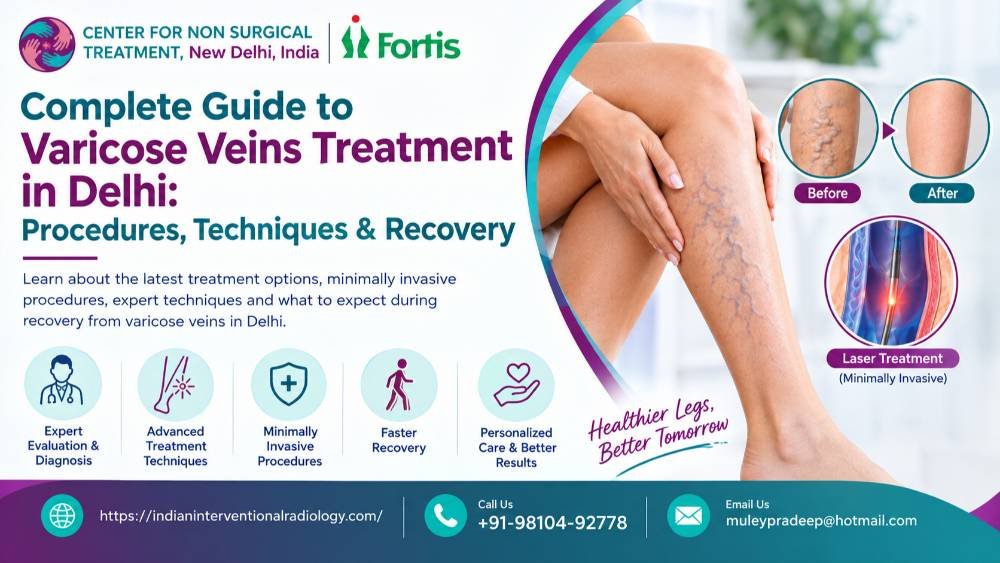
Varicose veins treatment in Delhi has undergone remarkable transformation over the past decade. Gone are the days of hospitalisation, general anaesthesia, and extended recovery periods. Today’s approach emphasises precision, speed, and minimal tissue disruption. Whether you’re experiencing mild cosmetic concerns or significant symptoms affecting your quality of life, Delhi’s interventional radiologists offer sophisticated solutions matched to your specific situation.
Understanding Your Varicose Veins Treatment Options
Each patient presents unique anatomy and symptom patterns. Effective varicose veins treatment in Delhi begins with matching your individual circumstances to the most appropriate intervention.
Radiofrequency Ablation (RFA) Treatment: The Gold Standard
Why Specialists Prefer This Approach
RFA represents the most commonly performed varicose veins treatment in Delhi today, and for good reason. The technique combines effectiveness, safety, and predictable outcomes.
The Procedure Explained
Under ultrasound guidance, an interventional radiologist introduces a thin catheter (approximately 1 millimetre diameter) into the affected vein through a tiny puncture. This catheter doesn’t require sutures. Once positioned correctly, radiofrequency energy heats the vein wall to approximately 120 degrees Celsius, causing the inner lining to collapse and seal shut.
The sealed vein no longer allows blood to flow backward. Your body naturally reabsorbs the closed vein over subsequent months, whilst healthy veins assume the circulation role.
Practical Details: - Duration: 45-60 minutes - Anaesthesia: Local only - Hospital stay: None—outpatient procedure - Compression: Stockings worn for 7-14 days - Activity: Light walking encouraged immediately
Recovery Timeline
| Timeline | Activities | Expectations |
|---|---|---|
| 0-24 hours | Light walking, normal movement | Mild discomfort managed with paracetamol |
| Days 2-7 | Desk work, light housework | Bruising, mild swelling likely |
| Week 2-3 | Gradual activity increase | Most symptoms resolving |
| Week 3-4 | Full activity clearance | Return to gym, sports cleared |
Success Rates: Clinical studies demonstrate 95-98% success rates for symptom relief, with recurrence affecting fewer than 5% of properly treated veins.
Endovenous Laser Treatment (EVLT): Precision Heat Therapy
Advantages of Laser Treatment
EVLT represents another premium varicose veins treatment in Delhi, particularly effective for certain vein types and anatomical situations.
How EVLT Differs from RFA
Rather than radiofrequency energy, EVLT employs laser light at specific wavelengths. The laser fibre delivers energy directly into the vein lumen, heating it from within. The effect resembles RFA—vein wall collapse and closure—but uses different energy delivery.
Key Characteristics: - Procedure time: 30-45 minutes - Wavelength commonly used: 1470 nanometres - Puncture size: Smaller than RFA (0.6mm laser fibre) - Discomfort: Comparable to RFA - Immediate walking: Encouraged
Advantages Over RFA: - Potentially quicker procedure - Smaller entry puncture - Effective across broader vein diameter range - Excellent cosmetic outcomes
Post-Treatment Expectations: Bruising with EVLT tends to be slightly more pronounced than RFA, occasionally lasting 10-14 days. Most patients tolerate this trade-off for the procedure’s other benefits.
Sclerotherapy: Injection-Based Treatment
Best Used for Spider Veins and Small Varicose Veins
Sclerotherapy offers a distinct approach suited to specific situations, particularly spider veins and small tributary veins not causing significant symptoms.
The Mechanism
A specialised sclerosing solution is injected directly into the target vein using a very fine needle. This chemical irritates the vein lining, causing inflammation and eventual closure. The vein hardens, shrinks, and fades over weeks.
Treatment Specifics: - Multiple small injections typically required - Sessions spaced 4-6 weeks apart - Number of sessions: Usually 3-5 for complete results - No downtime whatsoever - Bruising: Minimal to none
Suitable Veins: - Spider veins (1-3mm diameter) - Tributary veins contributing to cosmetic concerns - Small remaining veins after RFA or EVLT
Limitations: Less effective for large trunk veins. Requires multiple sessions. Progressive results rather than immediate closure.
Traditional Vein Stripping: Historical Context
Why Modern Specialists Rarely Recommend This
Vein stripping—surgical removal of the vein—represents the older approach, now rarely employed in Delhi’s modern interventional practices.
The Procedure: - General anaesthesia required - Surgical incisions at groin and knee/ankle - Vein physically stripped (removed) from the leg - Hospitalisation often necessary - Recovery: 2-4 weeks
Modern Thinking: Why subject patients to general anaesthesia, scarring, and extended recovery when minimally invasive options deliver superior results? Most Delhi specialists offer stripping only when other methods are medically inappropriate.
Pre-Treatment Preparation: Getting Ready for Varicose Veins Treatment
One Week Before Treatment
- Cease aspirin and anticoagulant medications (consult your specialist about timing)
- Stay well hydrated
- Avoid excessive sun exposure
- Wear comfortable, loose-fitting clothing
- Arrange transportation—you can drive after treatment but shouldn’t immediately
Day of Treatment
- Wear loose, comfortable clothing
- Eat a normal breakfast
- Bring your compression stocking
- Leave jewellery and valuables at home
- Plan 2-3 hours for the appointment
During the Procedure: What Actually Happens
Arrival and Setup (15-20 minutes) You’ll change into a procedural gown, and the nursing team will mark the affected vein with you standing. This marking guides the interventional radiologist.
Ultrasound Assessment (10-15 minutes) The radiologist performs detailed ultrasound scanning to confirm vein location, measure diameter, and plan catheter placement precisely.
Local Anaesthesia Administration (5-10 minutes) Local anaesthetic is carefully injected along the vein pathway. Unlike general anaesthesia, you remain fully conscious and communicative throughout.
Catheter Placement and Treatment (30-45 minutes) Using ultrasound guidance, the radiologist introduces the catheter through a tiny puncture (no sutures needed). Once positioned, energy delivery begins. You’ll feel pressure and warmth but no pain. You can communicate with the radiologist about any sensations.
Post-Treatment Wrapping (10-15 minutes) Your leg is wrapped with bandages and a compression stocking is applied. Final ultrasound confirms successful vein closure.
After Your Varicose Veins Treatment: Recovery Protocol
Immediate Post-Procedure (First 2-4 hours)
- Rest in the recovery area with leg elevated
- The care team monitors your comfort
- Compression stocking remains in place
- Pain is typically minimal—paracetamol usually suffices
- Most patients leave within 2-4 hours
First 48 Hours
- Wear compression stocking continuously
- Walk regularly—at least 10-15 minutes every 2-3 hours
- Avoid strenuous activity, gym, or intense exercise
- Light bruising and swelling are completely normal
- Mild tightness along the treated vein is expected
Days 3-14
- Continue compression stocking during waking hours
- Walking for 30+ minutes daily is beneficial
- You can return to desk work immediately after treatment
- Avoid heavy lifting (anything over 5kg)
- No swimming or submersion in water
- Bruising gradually fades
- Itching along the treated vein occasionally occurs—this is normal
Weeks 3-4
- Most swelling resolves
- Bruising significantly improves
- Compression stocking can usually be discontinued
- Gym activities and sports are typically cleared
- Most patients report symptom relief within days
Important Restrictions During Recovery
Avoid These Activities
- Air travel within 2 weeks (clot risk)
- Prolonged sitting (>4 hours)
- Sauna or hot baths (1-2 weeks)
- Intense exercise or gym (week 1)
- Heavy lifting (first 2-3 weeks)
- Direct sun exposure to treated leg
- Certain medications (discuss with your specialist)
Walking is Your Best Recovery Tool
Contrary to intuition, complete rest isn’t beneficial. Walking supports circulation, reduces clot risk, and actually accelerates healing. Aim for 30-45 minutes of comfortable walking daily during recovery.
Post-Treatment Follow-Up: Ensuring Success
Standard Follow-Up Protocol
Most specialists schedule follow-up ultrasound at 1-2 weeks post-treatment to confirm: - Successful vein closure - Absence of blood clots - Normal blood flow in remaining veins
When to Contact Your Specialist
Seek immediate advice if you experience: - Severe calf pain or swelling (clot concern) - Signs of infection (increasing redness, warmth, pus) - Chest pain or shortness of breath - Persistent high fever - Skin discolouration or ulceration
Managing Post-Treatment Symptoms
Bruising and Discolouration
Bruising is completely normal and fades progressively. Arnica supplements may provide mild support, though evidence is limited. Most bruising resolves within 2-3 weeks.
Swelling
Leg elevation, compression stockings, and walking all reduce swelling. Avoid standing stationary for long periods initially.
Tightness or Hardness Along Treated Vein
This represents normal healing. The vein is transitioning from open vessel to scar tissue. It typically softens over weeks.
Itching
Occasional itching as nerves adjust is normal. Moisturiser and cool compresses help.
Long-Term Outcomes: What Happens Years After Treatment
The Positive Picture
After successful varicose veins treatment in Delhi: - Symptoms typically remain resolved for years - Treated vein stays closed (95%+ success rate) - Appearance improves significantly - Quality of life improvements persist
Can New Varicose Veins Develop?
Yes, but this isn’t treatment failure. Patients with genetic venous insufficiency may develop new problem veins elsewhere over time. This represents disease progression rather than recurrence of treated veins. Additional treatment addresses new veins when necessary.
Lifestyle Support
Maintaining exercise, appropriate weight, and avoiding prolonged static positions supports long-term outcomes.
Frequently Asked Questions About Varicose Veins Treatment
1. How much does varicose veins treatment cost?
Costs vary by treatment type, vein extent, and facility. RFA and EVLT typically range from ₹50,000-₹150,000 per leg. Insurance coverage depends on medical necessity determination. Sclerotherapy costs less but requires multiple sessions.
2. Will treated veins reopen?
Recurrence of the treated vein is uncommon (2-5%). However, new varicose veins can develop elsewhere due to underlying venous disease. This isn’t failure—it’s disease progression.
3. Can I exercise immediately after treatment?
Light walking is encouraged immediately. Gym-level exercise should wait 3-4 weeks. Consult your specialist about your specific exercise plans.
4. Do the veins stay closed permanently?
Generally yes, if properly treated by an experienced specialist. The closed vein doesn’t reopen. New veins may develop over time due to genetic factors.
5. Is varicose veins treatment effective for cosmetic concerns?
Absolutely. Aesthetic outcomes are excellent. Veins fade significantly as the body reabsorbs them.
6. Can I return to work immediately?
Desk work can resume immediately. Jobs involving prolonged standing should wait 1-2 weeks.
7. What if only one leg is affected?
Treat the affected leg. The other remains untouched unless future symptoms develop.
8. Are there any permanent side effects?
Serious permanent complications are rare (less than 1%) with experienced specialists. Most patients report no long-term issues.
9. Can pregnant women receive treatment?
Treatment is typically deferred until after pregnancy and breastfeeding complete. Discuss individual circumstances with your specialist.
10. How do I choose between RFA and EVLT?
Both are excellent. Your specialist recommends based on vein characteristics, anatomy, and their expertise. Ask which procedure they specialise in—expertise matters more than equipment.
The Bottom Line on Varicose Veins Treatment in Delhi
Modern varicose veins treatment in Delhi has become safe, effective, and convenient. Whether you choose RFA, EVLT, or sclerotherapy, you’re selecting from time-tested techniques with proven success. The key to optimal outcomes: selecting an experienced interventional radiologist who customises treatment to your unique circumstances.