
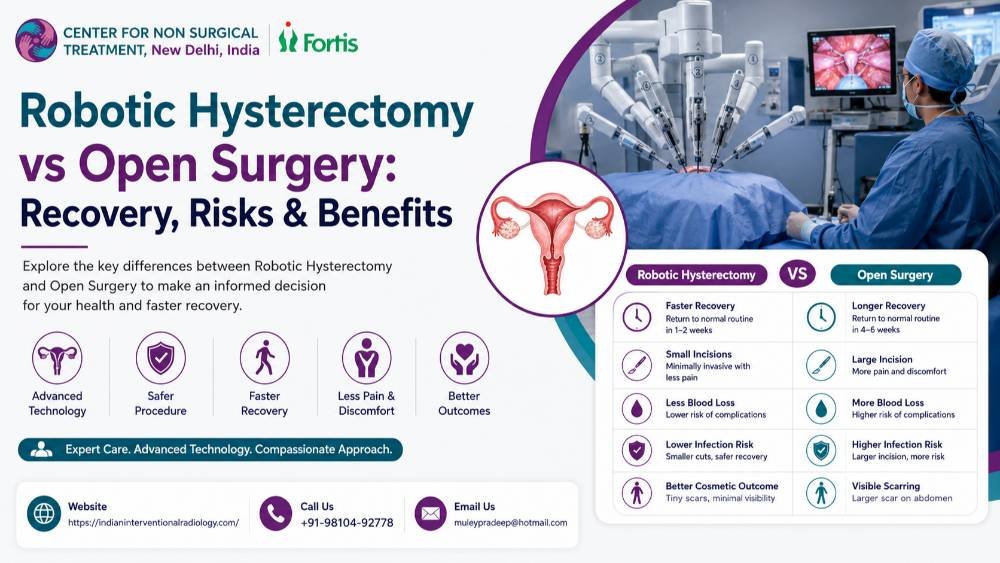
If your doctor has recommended a hysterectomy, you may be wondering whether robotic hysterectomy or open abdominal surgery is the better option. The main difference is that robotic hysterectomy is a minimally invasive approach performed through small incisions, while open hysterectomy uses a larger abdominal incision.
For appropriately selected patients, minimally invasive hysterectomy generally offers a shorter hospital stay, less postoperative pain and faster recovery than open abdominal hysterectomy. However, robotic surgery is not automatically the best option for everyone. The appropriate surgical route depends on the reason for hysterectomy, uterine size and anatomy, previous surgery, other pelvic conditions, cancer status when relevant, surgeon expertise and available hospital resources.
Why Trust This Guide?
| Trust Signal | Details |
|---|---|
| Updated for 2026 | Latest clinical guidelines and surgical practices |
| Clinical Evidence | References to ACOG, Mayo Clinic, UCLH, MedlinePlus |
| Specialist Reviewer | Reviewed by Dr. Pradeep Muley, Senior Consultant Interventional Radiologist |
| Evidence-Based | Includes ACOG Committee Opinion on robotic surgery |
| Practical Guidance | Provides clear comparisons and decision-making frameworks |
This guide is based on established clinical guidelines, peer-reviewed evidence, and practical experience in gynecologic surgery. It is written to help patients make informed decisions about their surgical options.
Last Reviewed: July 2026
Quick Answer: Robotic vs Open Hysterectomy
What is the difference between robotic and open hysterectomy?
Robotic hysterectomy is a minimally invasive procedure where a surgeon uses a robotic system to perform the surgery through several small incisions. The surgeon controls the robotic instruments from a console, with enhanced 3D vision and precise instrument control. Open hysterectomy uses a single larger incision in the abdomen to remove the uterus.
Which is better?
For many patients who are suitable candidates, a minimally invasive hysterectomy—including robotic-assisted laparoscopic surgery—can offer a shorter hospital stay, less postoperative pain and faster recovery than open abdominal hysterectomy. However, robotic surgery is not automatically the best option for everyone. The appropriate approach depends on the reason for hysterectomy, uterine size and anatomy, other pelvic conditions, cancer status when relevant, previous surgery, surgeon expertise and available hospital technology.
Important: Robotic hysterectomy should not automatically be considered better than conventional laparoscopic or vaginal hysterectomy. For appropriate patients, the main evidence-based advantage is the minimally invasive route compared with open abdominal surgery. Robotic assistance is one way of performing minimally invasive surgery, and the best route depends on the patient's anatomy, diagnosis and the surgeon's expertise.
Robotic-assisted hysterectomy is a minimally invasive laparoscopic approach in which the surgeon controls robotic instruments from a console. Other options may include conventional laparoscopy or vaginal hysterectomy. A qualified gynecologic surgeon should determine which route is safest and most appropriate for the individual patient.
Important: This comparison is primarily intended for hysterectomy decisions involving benign conditions such as fibroids, adenomyosis, endometriosis or abnormal uterine bleeding. Hysterectomy for suspected or confirmed cancer requires a separate specialist assessment.
Key Takeaways
- Robotic hysterectomy is a minimally invasive laparoscopic procedure performed with robotic assistance.
- Open hysterectomy uses a larger abdominal incision and generally requires a longer recovery.
- For appropriately selected patients, minimally invasive hysterectomy generally offers shorter hospitalization and faster recovery than open abdominal surgery.
- Robotic surgery is not automatically better than conventional laparoscopy or vaginal hysterectomy.
- Vaginal hysterectomy is preferred when feasible, according to ACOG.
- The best surgical route depends on diagnosis, uterine size, pelvic anatomy, previous surgery, surgical complexity and surgeon expertise.
Robotic Hysterectomy vs Open Abdominal Hysterectomy: At a Glance
| Factor | Robotic-Assisted Hysterectomy | Open Abdominal Hysterectomy |
|---|---|---|
| Surgical approach | Minimally invasive, robot-assisted laparoscopy | Abdominal surgery through a larger incision |
| Incisions | Several small abdominal incisions | One larger abdominal incision |
| Hospital stay | Usually shorter, depending on recovery | Usually longer |
| Postoperative pain | Generally less | Generally greater |
| Blood loss | May be lower in appropriately selected patients | May be higher |
| Recovery | Generally faster | Generally slower |
| Scarring | Several small scars | Larger abdominal scar |
| When used | When minimally invasive surgery is appropriate | When minimally invasive surgery is unsuitable or insufficient |
| Main deciding factors | Diagnosis, anatomy, surgeon expertise and resources | Disease complexity, anatomy and surgical requirements |
Which Has a Faster Recovery: Robotic or Open Hysterectomy?
For appropriately selected patients, robotic-assisted hysterectomy generally allows faster recovery than open abdominal hysterectomy because it uses smaller abdominal incisions and avoids the larger abdominal wall incision required for open surgery. Minimally invasive hysterectomy is generally associated with shorter hospitalization and faster return to normal activities than abdominal hysterectomy. However, recovery varies according to the extent of surgery, the patient's health, complications and the type of work or activity being resumed.
Quick answer: Robotic hysterectomy generally has a faster recovery than open abdominal hysterectomy when both approaches are clinically feasible.
Is Robotic Hysterectomy Safer Than Open Surgery?
Neither approach is universally safer for every patient. In appropriately selected patients, minimally invasive hysterectomy generally has advantages such as shorter hospitalization and faster recovery compared with open abdominal hysterectomy. However, open surgery may be the safer option when the disease is extensive, anatomy makes minimally invasive surgery unsuitable, or the required procedure cannot be safely completed through minimally invasive techniques.
Key point: The safest hysterectomy route is the one that allows the surgeon to treat the patient's condition effectively while minimizing surgical risk.
Robotic vs Conventional Laparoscopic Hysterectomy: Is Robotic Better?
Not necessarily. Both are minimally invasive approaches. Robotic surgery may provide the surgeon with enhanced visualization, instrument articulation and ergonomic advantages, but current evidence does not establish that robotic hysterectomy is universally superior to conventional laparoscopic hysterectomy. The American College of Obstetricians and Gynecologists (ACOG) notes that randomized trials have not demonstrated clear superiority of robotic surgery for benign gynecologic conditions. ACOG's Committee Opinion states that the role of robotic assistance for execution of laparoscopic hysterectomy has not been clearly determined and more studies are needed to determine clinical use.
What Is a Hysterectomy?
A hysterectomy is surgery to remove the uterus. Depending on your condition, your surgeon may also remove the cervix, fallopian tubes, or ovaries. The surgical route should be recommended by the gynecologic surgeon responsible for your hysterectomy after reviewing your diagnosis, examination, imaging, medical history and surgical risks.
Why Is a Hysterectomy Recommended?
Common reasons include:
- Uterine fibroids — non-cancerous growths causing heavy bleeding or pain
- Endometriosis — endometrial-like tissue growing outside the uterus and causing inflammation and pain
- Adenomyosis — endometrial-like tissue growing into the muscular wall of the uterus, which can cause heavy bleeding and pelvic pain
- Uterine prolapse — the uterus slipping down into the vagina
- Cancer — uterine, cervical, or ovarian cancer
- Chronic pelvic pain — pain not responding to other treatments
- Heavy or irregular periods — affecting quality of life
What Is Robotic-Assisted Hysterectomy?
A robotic hysterectomy is a minimally invasive procedure where the surgeon uses a robotic system to assist in the surgery. The surgeon sits at a console in the operating room and controls robotic arms with surgical tools through several small abdominal incisions. During a robotic hysterectomy, the surgeon typically makes several small incisions in the lower belly, which provides access for the robotic instruments.
How It Works
The robotic system provides:
- Enhanced 3D vision — highly detailed, magnified view of the surgical area
- Greater precision — wristed instruments that mimic the surgeon's movements
- Better dexterity — improved control in tight spaces
Potential Advantages
- Smaller incisions — less pain and trauma
- Potentially less blood loss — minimally invasive hysterectomy may involve less blood loss than open abdominal hysterectomy in appropriately selected patients
- Shorter hospital stay — often shorter than open surgery
- Faster recovery — generally faster than open surgery
- Less scarring — minimal visible scars
Potential Limitations
- Greater resource requirements — robotic surgery requires specialised equipment and trained surgical teams, and availability varies between hospitals
- Higher equipment and resource requirements — robotic surgery requires a robotic platform, specialised equipment and trained operating-room personnel. Costs can vary substantially between hospitals and healthcare systems
- Surgeon training — requires specialised training
What Is Open Abdominal Hysterectomy?
An open hysterectomy involves a larger incision in the lower abdomen. The surgeon removes the uterus through this opening. The exact incision size depends on the surgical technique and individual patient.
Why Can Open Surgery Take Longer to Recover From?
Open abdominal hysterectomy requires a larger abdominal incision and therefore involves more abdominal wall healing than minimally invasive approaches. This can contribute to greater postoperative discomfort, a longer hospital stay and a longer return to normal activities. Individual recovery varies according to the extent of surgery and the patient's overall health.
Potential Advantages
- Suitable when minimally invasive surgery is not appropriate
- Useful for extensive or complex disease when required
- May be necessary if minimally invasive surgery cannot safely accomplish the procedure
- Does not require robotic equipment
Potential Limitations
- Longer hospital stay — usually longer than minimally invasive approaches
- Longer recovery — generally longer than minimally invasive surgery
- More pain — larger incision causes more discomfort
- Potentially greater risk of wound-related complications, blood loss and longer postoperative recovery compared with minimally invasive approaches
- Noticeable scarring — larger abdominal scar
Robotic vs Laparoscopic vs Vaginal vs Open Hysterectomy
| Approach | Description | Key Considerations |
|---|---|---|
| Vaginal hysterectomy | Uterus removed through the vagina | No abdominal incisions; may be preferred when anatomically feasible |
| Laparoscopic hysterectomy | Minimally invasive surgery using small incisions and laparoscopic instruments | Surgeon controls instruments directly |
| Robotic-assisted hysterectomy | Minimally invasive surgery using a robotic system | Surgeon controls robotic instruments from a console |
| Open abdominal hysterectomy | Uterus removed through a larger abdominal incision | May be necessary when minimally invasive surgery is unsuitable |
According to the American College of Obstetricians and Gynecologists (ACOG), vaginal hysterectomy is the preferred route whenever feasible. Evidence demonstrates that, in general, vaginal hysterectomy is associated with better outcomes and fewer complications than laparoscopic or abdominal hysterectomy. When vaginal hysterectomy is not appropriate or feasible, laparoscopic hysterectomy is generally preferred over open abdominal hysterectomy because minimally invasive approaches are associated with shorter hospitalization and faster recovery. Robotic-assisted hysterectomy is one form of laparoscopic surgery, but current evidence does not establish that robotic assistance is superior to conventional laparoscopy for every patient. The final route should be selected according to the patient's anatomy, diagnosis, surgical requirements and surgeon expertise.
Robotic vs Open Hysterectomy Recovery
| Recovery factor | Robotic Hysterectomy | Open Abdominal Hysterectomy |
|---|---|---|
| Incision | Several small incisions | One larger abdominal incision |
| Hospital stay | Usually shorter | Usually longer |
| Early discomfort | Generally less | Generally greater |
| Return to light activities | Often sooner | Often later |
| Return to work | Depends on recovery and job demands | Often takes longer |
| Heavy lifting | Follow surgeon's restrictions | Follow surgeon's restrictions |
| Overall recovery | Generally faster than open surgery | Generally slower than minimally invasive surgery |
Important: Recovery timelines are individual. The complexity of surgery, complications, general health and type of work can significantly affect recovery.
Which Hysterectomy Route Is Right for You?
There is no universally best hysterectomy route. The decision depends on the patient's condition, uterine size and mobility, pelvic anatomy, previous surgery, extrauterine disease, cancer status where relevant, surgeon expertise, available equipment and patient preferences.
Who May Be a Candidate for Robotic Hysterectomy?
Robotic hysterectomy may be considered when:
- Minimally invasive abdominal surgery is appropriate for the patient
- Other minimally invasive approaches such as vaginal hysterectomy are not feasible
- The surgeon determines that robotic assistance may be beneficial for the specific anatomy
- The hospital has appropriate equipment and an experienced surgical team
Robotic surgery is not automatically required simply because minimally invasive surgery is appropriate. Conventional laparoscopy or vaginal hysterectomy may provide equally appropriate or preferable options depending on the case.
When Might Open Surgery Be Recommended?
Open hysterectomy remains an important option when a minimally invasive approach is not appropriate or cannot safely accomplish the required surgery. Factors may include the extent of disease, anatomy, the need for extensive tissue removal, emergency circumstances, available surgical expertise or conversion from a minimally invasive procedure when necessary.
Robotic Hysterectomy Recovery: What to Expect
How Long Does Robotic Hysterectomy Recovery Take?
Recovery after robotic hysterectomy varies depending on the procedure, the patient's health, the reason for surgery and the type of activity being resumed.
Recovery varies considerably. Some patients resume light activities within a few weeks, while returning to work, exercise and unrestricted activity can take longer. Recovery depends on the extent of surgery, complications, general health and the type of work or activity being resumed. According to University College London Hospitals (UCLH), both traditional laparoscopic hysterectomy and robotic hysterectomy are preferred to open hysterectomy as the recovery time is quicker, and the hospital stay is shorter. UCLH advises patients to plan for around six weeks away from work after robotic hysterectomy, while noting that some people may return sooner and others may need longer depending on their job and recovery.
Mayo Clinic notes that a full recovery might take 3 to 4 weeks. Even if you feel recovered, it's important not to lift anything heavy—more than 20 pounds (9.1 kilograms)—until six weeks after surgery.
Your operating surgeon's instructions should take priority over general recovery estimates.
First Few Days
- Walking is generally encouraged as advised by the care team
- Pain and abdominal discomfort are expected
- Activity is gradually increased
- Driving should wait until the surgeon says it is safe
First Few Weeks
- Energy may gradually improve
- Light daily activities may become easier
- Work return depends on the procedure and job demands
Around 4-6 Weeks and Beyond
- Many patients continue to regain strength and stamina
- Restrictions on lifting and sexual activity should be followed according to the surgeon's instructions
- Recovery can take longer after complications or more extensive surgery
Open Hysterectomy Recovery: What to Expect
How Long Does Open Hysterectomy Recovery Take?
Open abdominal hysterectomy generally requires a longer recovery because of the larger abdominal incision. Your surgeon will provide an individualized timeline based on the operation performed, complications, overall health and type of work.
General Recovery Timeline
- Hospital stay: Usually longer than minimally invasive surgery
- Initial recovery: Typically longer than minimally invasive approaches
- Return to work: Depends on the procedure and job demands
- Lifting restrictions: Should be followed according to the surgeon's instructions
- Full recovery: May take several weeks to months
What Factors Affect Hysterectomy Recovery?
- Surgical route — minimally invasive vs open surgery
- Extent of surgery — whether ovaries or other organs are removed
- Cancer vs benign disease — cancer surgery may be more extensive
- Complications — any complications during or after surgery
- Age and general health — overall health affects recovery speed
- Physical demands of work — desk job vs physically demanding job
- Surgeon's instructions — individualised recovery guidance
Risks and Possible Complications
All surgeries carry risks. Your surgeon will discuss these with you before the procedure.
Potential risks include:
- Infection
- Bleeding or blood loss
- Blood clots in the legs or lungs
- Damage to the bladder and other nearby organs
- Adverse reaction to anaesthesia
- Complications related to the specific surgical approach
According to Mayo Clinic, risks of a robotic hysterectomy include heavy bleeding, blood clots in the legs or lungs, infection, and damage to the bladder and other nearby organs. The risk profile depends on the indication, anatomy, surgical complexity, surgeon experience and whether a minimally invasive approach is appropriate.
Robotic assistance does not eliminate the risks associated with hysterectomy. Complications can still include bleeding, infection, blood clots, injury to the bladder, bowel or ureters, anaesthesia-related complications and complications related to the underlying condition.
When Should You Contact Your Doctor After Surgery?
Contact your doctor if you experience:
- Fever
- Heavy bleeding
- Increasing abdominal pain
- Difficulty urinating
- Nausea or vomiting
- Redness or discharge from incisions
- Shortness of breath or chest pain
- Leg pain or swelling
Seek urgent medical attention for severe shortness of breath, chest pain, fainting, heavy bleeding or other severe symptoms. Follow the emergency instructions provided by your surgical team.
Are There Alternatives to Hysterectomy?
Hysterectomy is not the only treatment for every condition that may lead to uterine surgery. Depending on the diagnosis, age, symptoms, fertility goals and imaging findings, alternatives may include medication, uterine artery embolization, myomectomy, hormonal treatment or other condition-specific therapies.
For example, uterine artery embolization (UAE) is an established minimally invasive treatment option for selected patients with symptomatic uterine fibroids. UAE is performed by a specially trained doctor called an interventional radiologist. During UAE, the interventional radiologist makes a small needle puncture in the groin and inserts a catheter to inject an embolic agent that blocks blood flow to the fibroids.
MedlinePlus notes that uterine artery embolization is a procedure to treat fibroids without surgery. It is a minimally invasive procedure that allows quick recovery in contrast to surgery, which may take up to several weeks.
Depending on the diagnosis, alternatives or uterus-preserving treatments may include:
- Medication — hormonal therapy, pain management
- Myomectomy Surgery in Delhi — surgical removal of fibroids while preserving the uterus
- Uterine Fibroid Treatment — minimally invasive uterine artery embolization
- Adenomyosis Treatment in Delhi — medical, conservative or selected interventional approaches depending on symptoms, imaging and treatment goals
What Happens Before a Hysterectomy?
Potential evaluation may include:
- Medical and surgical history
- Pelvic examination
- Ultrasound or other imaging when indicated
- Blood tests
- Review of medications
- Assessment of anemia when relevant
- Discussion of fertility and ovarian preservation
- Discussion of risks and alternatives
- Anaesthesia assessment
Your doctor may recommend specific tests based on your individual situation.
Questions to Ask Your Surgeon Before Hysterectomy
- Why do I need a hysterectomy?
- What other treatments are available?
- Which surgical routes are appropriate for me?
- Why do you recommend robotic, laparoscopic, vaginal or open surgery?
- Will my cervix be removed?
- Will my ovaries or fallopian tubes be removed?
- What will recovery look like for my type of work?
- What complications should I know about?
- Could the operation need to be converted to open surgery?
- Who will perform the operation?
- How experienced is the surgical team with this procedure?
- What follow-up care will I need?
Hysterectomy and Fibroid Treatment Options in Delhi
Patients in Delhi may have access to hospitals offering robotic, laparoscopic, vaginal and open hysterectomy. Availability depends on hospital infrastructure, surgical team expertise and the patient's clinical requirements. If you are considering hysterectomy treatment in Delhi, it is important to discuss all appropriate options with your treating gynecologic surgeon.
If your hysterectomy has been recommended because of uterine fibroids or adenomyosis, understanding uterus-preserving and minimally invasive alternatives may also be useful. You can learn more about uterine fibroid treatment in Delhi and adenomyosis treatment in Delhi before discussing your surgical options with your gynecologist.
About Dr. Pradeep Muley and Interventional Treatment Options
Dr. Pradeep Muley is a Senior Consultant Interventional Radiologist in New Delhi with more than 30 years of experience in image-guided minimally invasive procedures. His clinical practice includes image-guided minimally invasive treatment options for selected patients with uterine fibroids and adenomyosis, depending on their diagnosis and imaging findings.
For patients with fibroids or adenomyosis who are considering alternatives to hysterectomy, an interventional radiology consultation can help determine whether a uterus-preserving image-guided treatment may be appropriate. This assessment depends on the diagnosis, symptoms, imaging findings and individual treatment goals.
Contact Dr. Pradeep Muley to schedule a consultation and discuss your treatment options.
Discuss Whether a Uterus-Preserving Treatment May Be Appropriate
If you have fibroids or adenomyosis and are considering hysterectomy, an interventional radiology consultation may help determine whether a minimally invasive, uterus-preserving treatment is appropriate for your diagnosis and imaging findings.
Bring your ultrasound or MRI reports, previous medical records and current medication list to your consultation.
Request a Consultation
Frequently Asked Questions (FAQs)
1. What is a robotic hysterectomy?
A robotic hysterectomy is a minimally invasive procedure where a surgeon uses a robotic system to remove the uterus through several small incisions. The surgeon controls the robotic instruments from a console with enhanced 3D vision and precise control.
2. Is robotic hysterectomy better than open surgery?
For appropriately selected patients, robotic hysterectomy can offer advantages over open abdominal hysterectomy, including smaller incisions, less postoperative pain, shorter hospitalization and faster recovery. However, robotic surgery is not automatically better for everyone. The safest approach depends on the diagnosis, uterine size, pelvic anatomy, previous surgery and surgeon expertise.
3. Is robotic hysterectomy always better than vaginal hysterectomy?
No. When vaginal hysterectomy is feasible and appropriate, it may be preferred because it is minimally invasive without abdominal incisions. The best route depends on the patient's anatomy, diagnosis and surgeon's assessment.
4. Is robotic hysterectomy the same as laparoscopic hysterectomy?
No. Both are minimally invasive approaches, but robotic hysterectomy uses a robotic surgical platform controlled by the surgeon. Conventional laparoscopic hysterectomy uses laparoscopic instruments controlled directly by the surgeon.
5. How long does robotic hysterectomy recovery take?
Recovery after robotic hysterectomy varies depending on the procedure, the patient's health, the reason for surgery and the type of activity being resumed. Light daily activities may become comfortable within a few weeks, while return to work, exercise, heavy lifting and full recovery can take longer. Your operating surgeon's instructions should take priority over general recovery estimates.
6. How many days do you stay in hospital after robotic hysterectomy?
Hospital stay after robotic hysterectomy varies. Some patients may go home the same day, while others stay overnight or longer depending on the operation and recovery. UCLH notes that discharge is usually after one to three nights. Your surgical team will determine when discharge is safe.
7. Can robotic hysterectomy be performed for a large uterus?
Sometimes. An enlarged uterus does not automatically rule out minimally invasive surgery, but uterine size, mobility, pathology, pelvic anatomy and surgeon experience all influence the decision. In some patients, robotic or conventional laparoscopic surgery may be feasible; in others, open surgery may be safer or more appropriate.
8. Can I keep my ovaries during a hysterectomy?
In many cases, the ovaries can be retained during hysterectomy, depending on age, diagnosis, cancer risk and the reason for surgery. If both ovaries are removed before natural menopause, surgical menopause occurs because ovarian hormone production falls abruptly. Your surgeon should discuss ovarian preservation and its benefits and risks with you before surgery.
9. What are the alternatives to hysterectomy?
Depending on your condition, alternatives may include medication, myomectomy (fibroid removal while preserving the uterus), uterine artery embolization, or other conservative treatments. Your doctor can help you understand which options are appropriate for your situation.
10. When is open hysterectomy necessary?
Open hysterectomy may be recommended when minimally invasive surgery is not appropriate or cannot safely accomplish the required surgery. Factors may include extensive disease, anatomy, emergency circumstances or lack of available surgical expertise.
11. How soon can I return to work after hysterectomy?
Return to work depends on the surgical route, your job demands and your recovery. Desk jobs may allow earlier return than physically demanding jobs. Your surgeon will provide personalised guidance.
12. What complications can occur after hysterectomy?
Possible complications include infection, bleeding, blood clots, injury to surrounding organs, anaesthesia reactions and complications specific to the surgical approach. Your surgeon will discuss risks with you before the procedure.
13. Does hysterectomy stop periods permanently?
Yes. After the uterus is removed, menstrual periods stop permanently. If the ovaries are retained, however, they may continue producing hormones until natural menopause.
14. Can I have a robotic hysterectomy if I have had previous abdominal surgery?
Previous abdominal surgery does not automatically rule out robotic hysterectomy, but it can affect surgical planning. The surgeon will assess your surgical history, adhesions and anatomy to determine whether robotic surgery is appropriate.
15. What should I bring to my hysterectomy consultation?
Bring any previous ultrasound or MRI reports, medical records, a list of current medications, previous treatment details, and a description of your symptoms and their impact on your daily life.
16. Is robotic hysterectomy less painful than open surgery?
Robotic hysterectomy generally causes less postoperative pain than open abdominal hysterectomy because it is performed through smaller incisions. However, pain varies between patients and depends on the extent of surgery and individual recovery.
17. Does robotic hysterectomy leave scars?
Yes. Robotic hysterectomy involves several small abdominal incisions, which leave small scars. The number and location of incisions depend on the surgical technique and individual procedure.
18. Can a hysterectomy be done without abdominal incisions?
Yes. Vaginal hysterectomy removes the uterus through the vagina and does not require abdominal incisions. When it is feasible and appropriate, ACOG identifies vaginal hysterectomy as the preferred route.
Bottom Line: Robotic vs Open Hysterectomy
For appropriately selected patients, robotic-assisted hysterectomy generally offers the recovery advantages of minimally invasive surgery compared with open abdominal hysterectomy, including smaller incisions, shorter hospitalization and faster recovery. However, robotic surgery is not automatically superior to conventional laparoscopic or vaginal hysterectomy. The safest approach depends on the patient's diagnosis, anatomy, surgical complexity and the surgeon's expertise.
Medical Disclaimer
This article is for general educational purposes and does not replace a medical consultation, diagnosis or individualized treatment plan. Hysterectomy decisions should be made in consultation with a qualified gynecologic surgeon based on your specific condition, anatomy and treatment goals.
Cancer is different: When hysterectomy is being considered for suspected or confirmed gynecologic cancer, the surgical approach depends on the cancer type, stage, location, need for lymph-node or other tissue assessment, and the multidisciplinary treatment plan. The information in this article about benign conditions should not be applied to cancer surgery without specialist advice.