
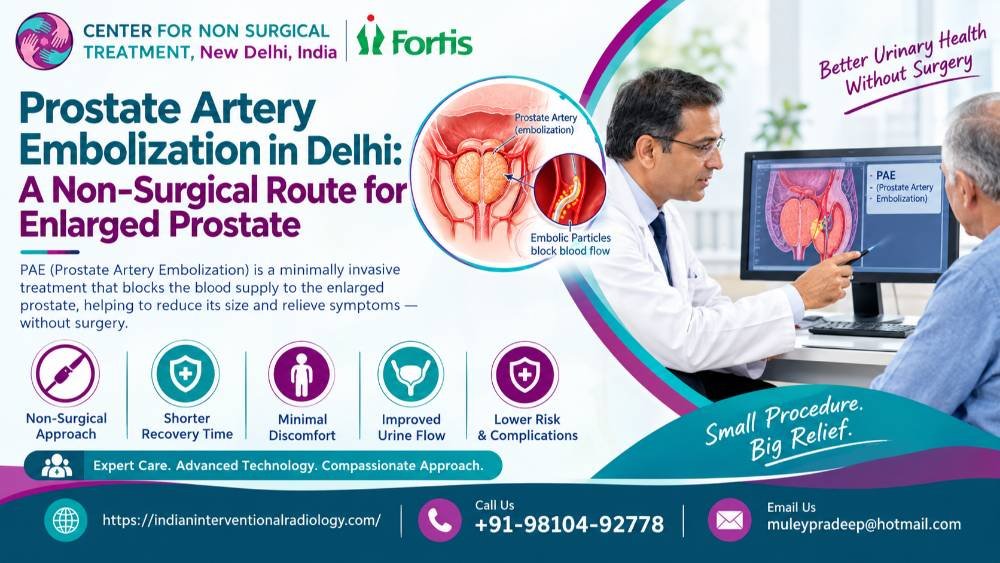
Prostate artery embolization (PAE) is a minimally invasive treatment for benign prostatic hyperplasia (BPH). An interventional radiologist blocks part of the blood supply to the enlarged prostate through a small puncture in the wrist or groin. The gland gradually shrinks, urine flow improves, and no cutting or scope is passed through the urethra.
Who is it for?
Men with moderate to severe urinary symptoms from an enlarged prostate who have not improved on tablets, or who prefer to avoid surgery. PSA testing and prostate imaging come first to rule out cancer.
Is it safe and effective?
PAE is generally well tolerated, and erections are usually preserved. Risks include urinary infection, pelvic discomfort and, rarely, injury to nearby organs. TURP and laser surgery have longer track records, so the choice should be individual.
Why Trust This Guide?
| Trust Signal | Details |
|---|---|
| Updated for 2026 | Reviewed in October 2026 against current patient-information guidance |
| Local Expertise | Based on interventional radiology practice at Fortis Hospital, Vasant Kunj, New Delhi |
| Industry References | NHS, Mayo Clinic, NICE, Urology Care Foundation, Society of Interventional Radiology (SIR) |
| Patient-Focused Approach | Organised around the questions patients commonly raise before treatment |
| Content Standards | Risks and limits stated openly, with no guaranteed outcomes |
This guide is written in plain language for patients and families. It explains what a treatment can and cannot do, and it should be read alongside advice from your own doctor. It is general information and does not replace personal medical advice.
Last Reviewed: October 2026
Introduction
Getting up three times a night and waiting for a weak stream are common after 50, and many men put up with them for years. Medicines help some men, while surgery worries others.
This guide explains how the procedure compares with TURP and laser treatment, and what recovery usually looks like.
Understanding an enlarged prostate
The prostate is a walnut-sized gland sitting below the bladder, with the urethra running through its centre. After about 40, it tends to grow. By the time men reach their sixties, many notice that the growing gland squeezes the urine channel. That is BPH, and it is not cancer.
Common symptoms include:
- a weak or stop-start stream
- needing to pass urine several times at night
- a sudden, urgent need to go
- the feeling that the bladder never empties
- in some men, complete inability to pass urine, which needs urgent care
Our dedicated page on enlarged prostate treatment covers the condition in more detail.
How prostate artery embolization works
The prostate relies on small arteries for its blood. The doctor guides a thin catheter, using live X-ray, into the prostatic arteries on each side and releases microscopic particles that partly block them. Deprived of some blood flow, the gland softens and shrinks over weeks to months, so pressure on the urethra eases.
The procedure takes about one to three hours, is done with local anaesthetic and light sedation, and typically involves one night in hospital or a same-day discharge, depending on your health.
Who may benefit
PAE is worth discussing if you:
- have moderate to severe urinary symptoms despite tablets
- cannot tolerate or do not want long-term BPH medicines
- prefer to avoid surgery because of age, heart disease or blood thinners
- wish to protect ejaculation, which can be affected by some operations
- have a large prostate that makes other procedures harder
A prostate MRI or ultrasound, a PSA blood test and a urine flow test come first. Prostate cancer must be reasonably excluded before treating BPH, and a CT angiogram may be used to map the arteries.
Prostate artery embolization compared with other BPH treatments
| Treatment | Approach | Anaesthesia | Hospital stay | Ejaculation affected | Notes |
|---|---|---|---|---|---|
| Medicines (alpha-blockers, 5-ARIs) | Tablets | None | None | Sometimes | First-line; symptoms may persist |
| Prostate artery embolization | Catheter via artery | Local and sedation | 0 to 1 night | Rarely | No cutting; effect builds gradually |
| TURP | Scope and electrical loop | Spinal or general | 1 to 3 days | Often | Long track record |
| Laser enucleation (HoLEP) | Scope and laser | General or spinal | 1 to 2 days | Often | Suitable for very large glands |
None of these is perfect for everyone. A urologist and interventional radiologist working together can help you weigh them up, and our overview of laser and TURP options shows how treatment is discussed at the clinic.
What recovery looks like
Most men resume light activity within a few days. Some notice a burning sensation when passing urine, mild blood in the urine or semen, or low-grade fever in the first week. Improvement usually becomes clear over four to twelve weeks as the gland shrinks. Drink plenty of water, avoid heavy lifting for a short time and attend your follow-up.
Risks and limits
Possible effects include urinary tract infection, temporary pelvic discomfort, bruising where the catheter went in and, rarely, injury to nearby organs if particles stray from their target. Some men need further treatment later if symptoms return. PAE may not shrink the prostate as much as surgical removal, and the choice should reflect your priorities rather than a one-size answer.
Why Delhi patients choose a specialist team
Dr. Pradeep Muley at Fortis Hospital, Vasant Kunj, is an interventional radiologist whose practice centres on non-surgical care. The Centre For Non-Surgical Treatment reviews your reports, explains realistic outcomes and coordinates with your urologist. If you are also dealing with scrotal swelling or pain, ask about varicocele embolization, another treatment the team performs through a small puncture. Educational clips are available on the video page.
Trusted Sources for Further Reading
- NHS: Benign prostate enlargement
- Mayo Clinic: BPH
- NICE: Lower urinary tract symptoms in men
- Urology Care Foundation
- Society of Interventional Radiology
Expert Tip
Before choosing PAE, ask for a PSA test, a urine flow test and prostate imaging. These confirm benign enlargement as the cause, and a prostate MRI or CT angiogram helps the doctor plan which arteries to treat.
Reviewed By
Interventional radiology specialists at the Centre For Non-Surgical Treatment, New Delhi, with practical experience in image-guided, minimally invasive treatment. This content is reviewed periodically to reflect current best practice and service information.
Frequently Asked Questions (FAQs)
1. What is prostate artery embolization?
It is a catheter-based treatment that reduces blood flow to an enlarged prostate so it shrinks gradually, easing pressure on the urethra without surgery.
2. Is PAE a good alternative to TURP?
For some men, yes, especially those who want to avoid anaesthesia risks or protect ejaculation. TURP still has the longer track record, so the decision depends on your case.
3. Does prostate artery embolization affect sexual function?
Studies suggest erections are generally preserved, and ejaculation problems are less frequent than after surgery. No treatment can promise zero effect.
4. How long does it take to see results?
Some men feel better within weeks, but the full benefit usually appears over one to three months as the prostate shrinks.
5. Is the procedure painful?
You are comfortable during the procedure. Afterwards, mild pelvic discomfort and burning on urination can last a few days and respond to medicines.
6. Can PAE treat a man who has a urinary catheter?
Many men with catheters have been treated, and a good number can eventually do without it, but results vary. Your assessment will clarify the odds.
7. Will the prostate grow back?
Embolized tissue does not simply regrow, yet the prostate may enlarge again with age. Follow-up helps catch this early.
8. Do I still need a PSA test?
Yes. A PSA test and sometimes an MRI are done beforehand to rule out cancer, and regular checks remain sensible afterwards.
9. What does prostate artery embolization cost?
Cost depends on hospital category, imaging needs and length of stay. The clinic can provide a personalised estimate after your consultation.
10. Can I travel from abroad for PAE?
Yes. International patients can share reports and scans beforehand, and a plan can be prepared before you travel.
Conclusion
PAE shrinks an enlarged prostate by reducing its blood supply, with no cutting and a short recovery. It suits selected men, and a joint view from your urologist and interventional radiologist helps you choose well.
If you are looking for prostate artery embolization in Delhi, the Centre For Non-Surgical Treatment offers specialist, image-guided care at Fortis Hospital, Vasant Kunj, New Delhi. Clinic hours are Monday to Saturday, 8:00 AM to 5:00 PM, and international patients can share reports for remote review before travelling.
Ready to discuss your options? Call or WhatsApp +91-98104-92778 or contact the clinic to book your consultation.
This article is for general information and does not replace personal medical advice.