
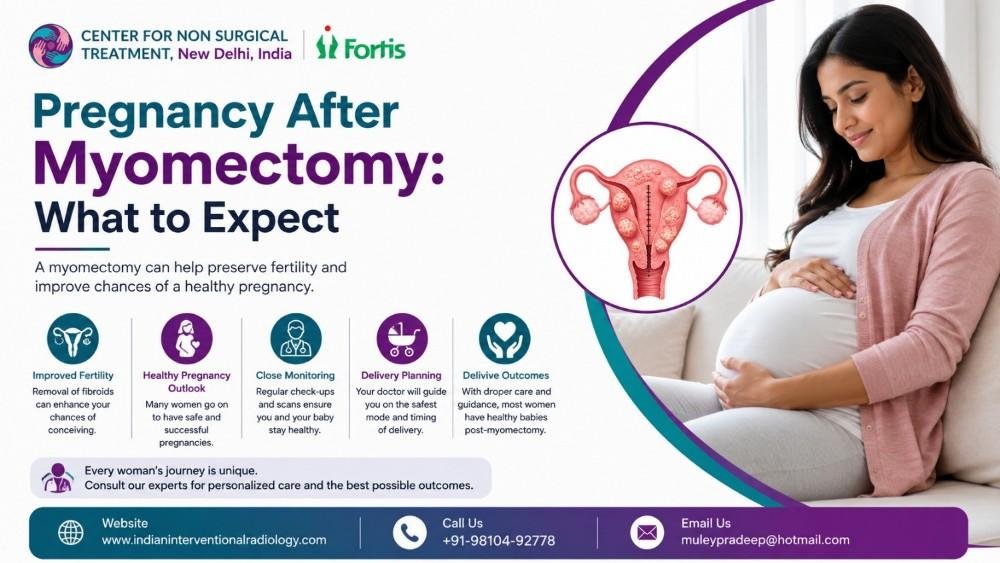
Let me start by acknowledging what you are probably feeling right now. You have been through a myomectomy -- a surgery that removed those fibroids that were causing you so much trouble. Maybe you had heavy bleeding that left you exhausted, or pain that made everyday life difficult. Maybe you had been trying to conceive for months or years, and fibroids were standing in your way.
Now the fibroids are gone. Your uterus is still there. And you are thinking about the future. Can you get pregnant now? Will the pregnancy be safe? What about the scar on your uterus -- will it hold? How long should you wait?
I have seen so many women go through this exact same worry. And I want to tell you what I have learned from years of helping women like you.
If you are looking for myomectomy surgery in Delhi or the best doctors for myomectomy surgery in Delhi, this guide will help you understand what comes next.
What Is a Myomectomy and Why Does It Matter for Pregnancy?
A myomectomy is a fertility-preserving surgery where we remove uterine fibroids (leiomyomas) and rebuild the uterus, keeping the uterus and ovaries in place. The goal is twofold: relieve symptoms like heavy bleeding, pelvic pressure, pain, or infertility, and preserve your ability to conceive and carry a pregnancy in the future.
Think of it like this. Your uterus is like a house. Fibroids are like unwanted additions -- maybe an extra room that takes up space, or a wall that blocks the hallway. Myomectomy removes those additions. The house stays. The foundation stays. And you can still live in it and grow your family.
Myomectomy is different from hysterectomy, where the entire uterus is removed. Women who have a myomectomy are able to continue to have menstrual periods and become pregnant after the procedure.
How Long Should You Wait Before Trying to Conceive?
This is the question I hear most often. And the answer is: it depends.
Most doctors recommend waiting at least 3 to 6 months before trying to conceive. The optimal interval between myomectomy and pregnancy is often considered to be 3-6 months after laparoscopic myomectomy, as it is necessary to wait for the uterine wall to heal.
But the healing process is not the same for everyone. How long your uterus needs to fully recover depends on several factors:
| Factor | Why It Matters |
|---|---|
| How deep the fibroids were | Deeper fibroids mean more stitches in the uterine wall |
| How much of the uterine wall was repaired | More repair means more healing time |
| The type of surgery you had | Hysteroscopic is fastest; open (abdominal) takes longest |
| How well your recovery has progressed | Everyone heals at their own pace |
A study found that the median time to conception after myomectomy was 16 months, with a 6-month waiting period included. The mean duration between the operation and pregnancy was 9.2 months (range 4 to 24 months, median 8.5 months).
Recommended Waiting Periods by Surgery Type:
| Type of Myomectomy | Recommended Wait Time |
|---|---|
| Hysteroscopic | 3 months |
| Laparoscopic / Robotic | 3-6 months |
| Open (Abdominal) | 6-12 months |
Waiting can feel hard, especially when you are already feeling ready. But giving your body enough time to heal properly lowers the risk of complications during pregnancy. There is no universally agreed-upon minimum interval between myomectomy and conception, and recent evidence suggests conception can occur safely even within weeks of surgery. However, a population-based cohort study found that a time interval of 6 to 12 months was associated with lower risks of gestational hypertensive disorders and neonatal death compared with less than 6 months or 12 months or more, especially for women over 35.
For a case report on optimal interval (3-6 months) and uterine rupture risks, visit Cureus -- Pregnancy Achieved One Month After Laparoscopic Myomectomy.
Can You Actually Get Pregnant After a Myomectomy?
Yes. And the numbers are encouraging.
Laparoscopic myomectomy is associated with high postoperative pregnancy and live birth rates, minimal complications, and promising obstetric outcomes.
Postoperative pregnancy rates range from 44% to 62% across studies. In one study, 70.05% of patients conceived, with a live birth rate of 78%. Minimally invasive myomectomy techniques yield favorable fertility outcomes compared to traditional abdominal myomectomy.
Women who have a myomectomy are able to become pregnant after the procedure. If fibroids were distorting your uterine cavity before the procedure, removing them often improves your chances by restoring a healthier environment for implantation.
Some women conceive naturally. Others go through assisted reproductive techniques. Both paths remain possible after surgery. If you are having difficulty conceiving, your doctor can check for scar tissue using a procedure called hysteroscopy, which allows them to look inside your uterus and remove any adhesions if needed.
For research showing high postoperative pregnancy rates (44-62%) and rare uterine rupture (<1%), visit PMC -- Laparoscopic Myomectomy and Pregnancy Outcomes: A Narrative Review.
What Are the Risks of Pregnancy After Myomectomy?
Let me be honest with you. Pregnancy after myomectomy does carry some risks. But the good news is that these risks are generally low, and most women go on to have healthy pregnancies and deliveries.
Uterine Rupture
This is the most serious concern. Uterine rupture is an infrequent yet sometimes fatal complication of a subsequent vaginal birth attempt following a previous uterine surgery.
The overall incidence of uterine rupture after myomectomy is 0.6%. Among women who experienced a trial of labor after myomectomy (TOLAM), the incidence is even lower -- 0.4%. A study found that uterine rupture after myomectomy was observed only in the laparoscopic surgery group at 1.0%. The risk of uterine rupture during pregnancy after laparoscopic myomectomy is estimated to be less than 1%.
A previous uterine scar is the major risk factor for uterine rupture. Risk factors include fibroid size, elevated BMI, and placental abnormalities.
For research showing overall uterine rupture incidence of 0.6% and 0.4% for TOLAM, visit PubMed -- Spontaneous Uterine Rupture After Myomectomy.
Other Potential Complications
| Complication | Risk Level |
|---|---|
| Placenta accreta spectrum (PAS) | Highest in hysteroscopic group (5.2%) |
| Placenta previa | No significant difference across groups |
| Placental abruption | No significant difference across groups |
| Preterm delivery | Elevated in women with myomectomies |
| Gestational hypertension/preeclampsia | Highest in hysteroscopic group (17.5%) |
| Blood loss at delivery | Increased compared to women with fibroids in situ |
Pregnancies after myomectomy are associated with potential perinatal complications, including increased risks of uterine rupture and placental abnormalities, such as placenta previa and placenta accreta spectrum (PAS) disorders.
For a study on risks including uterine rupture, placental abnormalities, and preterm delivery, visit BMC Pregnancy and Childbirth -- Perinatal Complications After Myomectomy.
Will You Need a C-Section?
Most likely, yes. Many women who have had a myomectomy will need a planned cesarean delivery.
The most common mode of delivery after myomectomy is cesarean section. Women with myomectomies have increased elective cesarean delivery rates.
But here is what is interesting: The incidence of uterine rupture is very low (0.4%) in the group of women who experienced a trial of labor after myomectomy (TOLAM). Uterine rupture may not be significantly influenced by a TOLAM, so this option could be considered in pregnant women as feasible and relatively safe.
That said, your doctor will likely recommend a planned C-section if:
- Your uterine wall was deeply cut during surgery
- You had a large or complex myomectomy
- There is concern about the strength of your uterine scar
- You have other risk factors
How Will Your Pregnancy Be Monitored?
Because pregnancy after myomectomy is considered higher risk, you will need closer monitoring throughout your pregnancy.
| Trimester | What to Expect |
|---|---|
| First Trimester | Early ultrasound to confirm viability and location |
| Second Trimester | Regular ultrasounds to check uterine wall thickness and fetal growth |
| Third Trimester | More frequent visits; monitoring for signs of uterine rupture or preterm labor |
| Throughout | Watch for abdominal pain, contractions, or bleeding |
Pregnancy in patients with fibroids or previous myomectomy should be considered as high risk, requiring a maternal-fetal medicine specialist. Careful monitoring and early planning help most women move through pregnancy safely and deliver healthy babies.
Tips for a Healthy Pregnancy After Myomectomy
Here is what you can do to give yourself the best chance of a healthy pregnancy:
Before You Conceive
- Wait the recommended time -- Give your uterus time to heal properly
- Get a follow-up ultrasound -- Make sure your uterus has healed well
- Optimize your health -- Maintain a healthy weight, eat well, and take prenatal vitamins
- Discuss your plan with your doctor -- Make sure everyone is on the same page
During Pregnancy
- Choose your healthcare provider carefully -- Find a doctor experienced with pregnancies after myomectomy
- Attend all prenatal appointments -- Do not skip any check-ups
- Report any unusual symptoms immediately -- Abdominal pain, bleeding, or contractions should be checked right away
- Balanced nutrition, steady weight gain, regular movement, enough sleep, and managing stress all support both uterine health and your baby's growth throughout pregnancy
- Plan your delivery -- Discuss with your doctor whether you will have a planned C-section or attempt a trial of labor
For a guide on balanced nutrition, monitoring, and healthy pregnancy planning, visit Thomson Medical -- Pregnancy After Myomectomy: What to Expect and How to Plan.
The Role of Dr. Pradeep Muley in Your Journey
When it comes to myomectomy for fibroids surgery in Delhi or finding the best doctor for uterine fibroids in Delhi, choosing the right specialist makes all the difference.
Expert in Fibroid Care
Dr. Pradeep Muley is a Senior Consultant Interventional Radiologist with decades of experience in treating fibroids and preserving fertility. He offers a range of options, from non-surgical Uterine Artery Embolization to surgical myomectomy, depending on what is best for you.
Dr. Muley often assesses each case individually to choose the optimal approach, balancing safety and fertility preservation. He has performed more than 20,000 diagnostic and interventional radiological procedures and has spent over thirty years helping women with fibroid problems right here in Delhi.
World-Class Training
Dr. Pradeep Muley's qualifications include:
- Fellow Interventional Radiology, Singapore General Hospital, Singapore
- Visiting Associate, Neurointerventional Radiology, Iowa University Hospitals, USA
- Visiting Fellow, Neurointerventional Radiology, Johns Hopkins Medical Institutions, USA
- Lecturer, Vascular & Interventional Radiology, KEM Hospital, Mumbai, India
- Neuroradiology, All India Institute of Medical Sciences (AIIMS), New Delhi, India
Patient-Centric Care
At Indian Interventional Radiology, the focus is on providing safe, effective, and long-term relief. Using modern techniques, Dr. Muley focuses on reducing recovery time, minimizing pain, and ensuring faster healing.
You can schedule a consultation or contact us to begin your journey toward motherhood.
Frequently Asked Questions (FAQs)
1. How long after myomectomy can I try to get pregnant?
Most doctors recommend waiting 3 to 6 months after laparoscopic myomectomy and 6 to 12 months after open myomectomy. The waiting period allows your uterus to heal properly and reduces the risk of complications. A time interval of 6 to 11 months is associated with lower risks of gestational hypertensive disorders and neonatal death, especially for women over 35.
2. Does myomectomy improve fertility?
Yes. Myomectomy can significantly improve fertility, especially if fibroids were distorting the uterine cavity. Postoperative pregnancy rates range from 44% to 62% across studies.
3. What are the risks of pregnancy after myomectomy?
The main risks include uterine rupture (0.6%), placental abnormalities, and preterm delivery. However, with proper monitoring and care, most women have successful pregnancies.
4. Will I need a C-section after myomectomy?
Most likely. The most common mode of delivery after myomectomy is cesarean section. However, a trial of labor after myomectomy (TOLAM) may be possible in some cases, with a uterine rupture rate of just 0.4%.
5. How is pregnancy monitored after myomectomy?
Pregnancy after myomectomy is considered high risk and requires closer monitoring, including regular ultrasounds to check uterine wall thickness and fetal growth.
6. Can I have a vaginal delivery after myomectomy?
In some cases, yes. A trial of labor after myomectomy (TOLAM) has a very low uterine rupture rate of 0.4%. However, most doctors recommend a planned C-section.
7. How soon can I conceive after laparoscopic myomectomy?
The optimal interval is often considered to be 3-6 months after laparoscopic myomectomy.
8. What is the success rate of pregnancy after myomectomy?
Pregnancy rates after myomectomy range from 44% to 62%. In one study, 70.05% of patients conceived, with a 78% live birth rate.
9. Who is the best doctor for myomectomy surgery in Delhi?
Dr. Pradeep Muley is a Senior Consultant Interventional Radiologist with decades of experience in fibroid treatment and fertility preservation. He offers personalized care and has helped thousands of women.
10. Can fibroids come back after myomectomy?
Yes. Fibroids can recur after myomectomy. However, myomectomy remains the best option for women who want to preserve their fertility. Regular follow-up is important.
Final Thoughts
Pregnancy after myomectomy is not only possible -- it is common. With proper planning, careful monitoring, and the right medical team, most women go on to have healthy pregnancies and deliver healthy babies.
The key is to be patient. Give your uterus time to heal. Wait the recommended time before trying to conceive. Choose a doctor who understands your situation and will monitor you closely throughout your pregnancy.
If you are in Delhi or the NCR region and looking for myomectomy surgery in Delhi or the best doctors for myomectomy surgery in Delhi, Dr. Pradeep Muley at Indian Interventional Radiology is your trusted partner. With decades of experience, advanced technology, and a patient-first approach, he provides world-class care tailored to your needs.
Your dream of becoming a mother is still possible. Don't give up. Book a consultation today and take the next step.
Contact Information
Dr. Pradeep Muley
Senior Consultant Interventional Radiologist
Indian Interventional Radiology
Fortis Hospital, Vasant Kunj, New Delhi, India
Phone: +91-98104-92778
Email: muleypradeep@hotmail.com
Contact Us for more information or to schedule your appointment.