
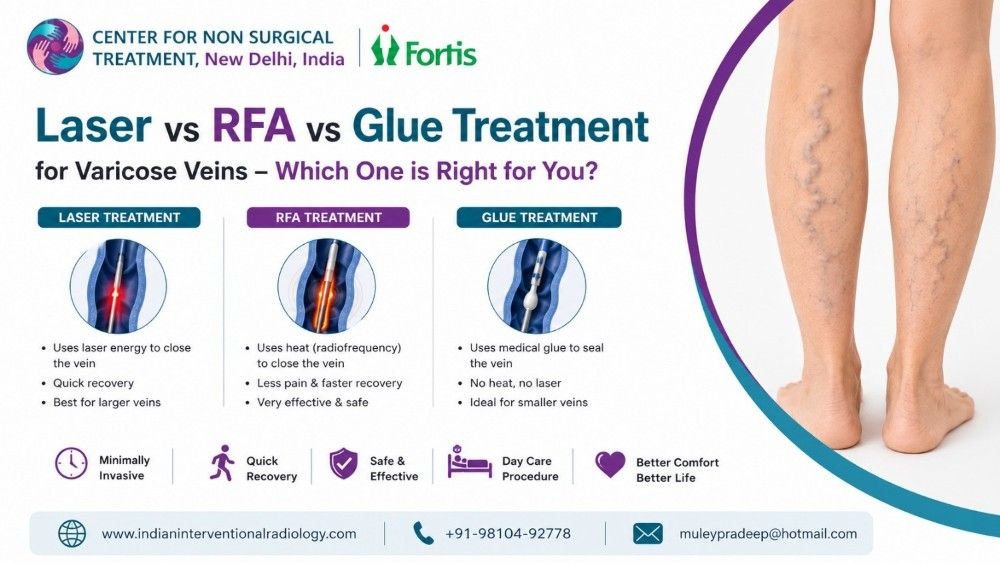
Varicose veins affect millions of people worldwide. They cause pain, swelling, heaviness, and sometimes even serious complications if left untreated. The good news is that today you have multiple treatment options that do not require surgery. Three of the most advanced and popular non-surgical treatments are Endovenous Laser Ablation (EVLA) , Radiofrequency Ablation (RFA) , and Glue Treatment (Cyanoacrylate Closure) .
If you are looking for a varicose veins specialist doctor in Delhi, you have probably come across these terms. But what do they actually mean? How do they compare? And which one is the best choice for you?
This guide will help you understand the differences between Laser, RFA, and Glue treatment for varicose veins in simple, easy‑to‑understand language. By the end, you will know exactly what to expect from each procedure and how to make an informed decision with the help of a trusted vein specialist doctor in Delhi like Dr. Pradeep Muley .
Understanding Varicose Veins
Before we compare the treatments, let us quickly understand what varicose veins are and why they develop.
Varicose veins are enlarged, swollen, and twisted veins that typically appear blue or dark purple just beneath the skin. They most commonly occur in the legs and feet. The leg veins contain tiny valves that help blood flow in one direction—toward your heart. When these valves become weak or damaged, blood flows backward and pools in the veins, causing them to stretch, swell, and twist.
According to estimates, 15 to 20 percent of the population in India is suffering from varicose vein disease today. Women suffer from this condition four times more than men.
Common Symptoms
- Pain that comes and goes
- Swelling, especially at the end of the day
- Heaviness and fatigue in the legs
- Prominent and dilated veins
- Skin pigmentation
- Itching or irritation
- Muscle cramps at night
Who is at Risk?
Certain professions and lifestyle factors increase your risk. Computer professionals, receptionists, security guards, traffic policemen, and people doing desk jobs are among the worst sufferers. Obesity, lack of exercise, pregnancy, prolonged standing or sitting, and hormonal changes are also major risk factors.
If left untreated, varicose veins can lead to serious complications including bleeding from superficial veins, venous pigmentation, venous stasis dermatitis, and non‑healing ulcers on the legs.
The Three Non-Surgical Treatment Options
All three treatments—Laser (EVLA), RFA, and Glue—are minimally invasive procedures that close off the diseased vein. Once the vein is closed, blood is naturally rerouted to healthier veins, and the symptoms improve. However, each works differently and has its own set of advantages.
Let us look at each one in detail.
1. Endovenous Laser Ablation (EVLA)
Endovenous Laser Ablation is one of the most widely used and trusted treatments for large varicose veins. It uses focused laser energy to close the damaged vein from the inside.
How It Works
A thin laser fiber is inserted into the affected vein under ultrasound guidance. The laser is activated and slowly withdrawn along the vein. The laser energy heats the vein wall, causing it to collapse and seal shut. The procedure is performed under local anesthesia, and most patients resume normal activities the same day.
Success Rates
EVLA has an excellent track record. Studies show that EVLA achieves high occlusion rates of 94.9% , comparable to surgical stripping at 92.0%. At one year after the procedure, occlusion rates vary between 77% and 99% . EVLA is also considered the most cost‑effective therapeutic option for varicose veins.
Advantages
- Minimally invasive with no surgical incisions
- Performed under local anesthesia
- Excellent long‑term results
- Little to no scarring
- Quick recovery—most patients return to normal activities the same day
Considerations
- Some patients may experience bruising or mild discomfort after the procedure
- Requires tumescent anesthesia (injecting numbing fluid around the vein)
- Slightly longer recovery compared to some non‑thermal methods
EVLA is particularly effective for larger, straighter veins that need precision.
2. Radiofrequency Ablation (RFA)
Radiofrequency Ablation is another advanced thermal ablation technique. It works similarly to EVLA but uses radiofrequency energy instead of laser energy.
How It Works
A catheter is inserted into the diseased vein under ultrasound guidance. Radiofrequency energy is delivered through the catheter, heating the vein wall and causing it to collapse and seal shut.
Success Rates
RFA is equally effective as EVLA. Studies show that RFA achieves occlusion rates of 94.4% , comparable to EVLA and surgical stripping. At one month, the occlusion rate of the great saphenous vein is 98.35% for RFA. Both RFA and EVLA demonstrate similar efficacy in terms of early and long‑term occlusion rates.
Advantages
- Gentle heat‑based solution with excellent patient comfort
- Less postoperative pain and bruising compared to EVLA
- Good tolerance with durable outcomes
- Minimally invasive with quick recovery
Considerations
- Requires tumescent anesthesia
- Some risk of heat‑induced nerve injury (though lower than older techniques)
- May have slightly higher long‑term recurrence risk compared to EVLA in some studies
RFA is often preferred for patients who want a gentle procedure with excellent comfort during and after treatment.
3. Glue Treatment (Cyanoacrylate Closure)
Glue treatment, also known as cyanoacrylate adhesive closure, is a non‑thermal, non‑tumescent (NTNT) technique. This means it does not use heat and does not require numbing injections around the vein.
How It Works
A specially formulated medical adhesive (glue) is delivered into the diseased vein through a thin catheter under ultrasound guidance. The glue immediately seals the vein closed. Blood is then naturally rerouted to healthier veins.
Success Rates
Glue treatment is highly effective. One study found that the rate of permanently closed treated veins reached 92% , which does not differ from the results of endovenous thermal ablation like EVLA. Cyanoacrylate glue has shown an overall tendency of higher success rates and lower complication rates compared with foam and liquid sclerotherapy.
Advantages
- No heat – eliminates the risk of heat‑induced nerve injury
- No tumescent anesthesia – no need for multiple numbing injections around the vein
- Ability to treat longer vein segments
- Shorter procedure time
- Faster recovery – patients can return to work on day 1
- Lower pain scores – average pain score of 1.2/10 compared to 3.8/10 for EVLA
Considerations
- Slightly lower occlusion rates (88.7%) compared to thermal methods
- Long‑term data is still emerging compared to EVLA and RFA
- May not be suitable for very large veins (over 10 mm)
Glue treatment offers the ultimate convenience with no heat and no stockings. It is an excellent option for patients who want a completely heat‑free, needle‑free experience.
Comparison Table: Laser vs RFA vs Glue Treatment
| Feature | EVLA (Laser) | RFA | Glue Treatment |
|---|---|---|---|
| Energy Type | Laser (thermal) | Radiofrequency (thermal) | Medical adhesive (non-thermal) |
| Tumescent Anesthesia | Required | Required | Not required |
| Heat Used | Yes | Yes | No |
| Occlusion Rate | 94.9% | 94.4% | 88.7% – 92% |
| Procedure Time | 45–60 minutes | 45–60 minutes | Shorter |
| Pain Score | 3.8/10 | Lower than EVLA | 1.2/10 |
| Return to Work | 1.31 days | 1.56 days | 1.04 days |
| Nerve Injury Risk | Low | Low | Very low (no heat) |
| Best For | Larger, straighter veins | Patients wanting gentle heat-based solution | Patients wanting no heat, no needles, faster recovery |
Which Treatment is Right for You?
Choosing the right treatment depends on several factors. Here are some general guidelines:
Choose EVLA (Laser) If:
- You have large, straight varicose veins
- You want a well‑established treatment with decades of proven results
- You are looking for a cost‑effective option
- You do not mind tumescent anesthesia
Choose RFA If:
- You want a gentle heat‑based procedure
- You prefer less postoperative pain and bruising
- You want excellent patient comfort during the procedure
- You have veins that are suitable for radiofrequency energy
Choose Glue Treatment If:
- You want no heat and no tumescent anesthesia
- You want the fastest recovery and return to work
- You want minimal pain during and after the procedure
- You have veins within 5‑10 mm in diameter
- You want to avoid the risks associated with thermal energy
Important Note
The best way to determine which treatment is right for you is to consult an experienced varicose veins specialist doctor in Delhi. A thorough duplex ultrasound will map your veins and help identify the most appropriate course of action.
Why Choose Dr. Pradeep Muley for Varicose Veins Treatment in Delhi?
When it comes to varicose veins treatment in Delhi, choosing the right doctor is crucial. Dr. Pradeep Muley is a highly experienced Senior Consultant Interventional Radiologist who has performed more than 20,000 diagnostic and interventional radiological procedures.
Unmatched Qualifications
Dr. Pradeep Muley‘s academic qualifications include:
- Fellow Interventional Radiology, Singapore General Hospital, Singapore
- Visiting Associate, Neurointerventional Radiology, Iowa University Hospitals, USA
- Visiting Fellow, Neurointerventional Radiology, Johns Hopkins Medical Institutions, USA
- Lecturer, Vascular & Interventional Radiology, KEM Hospital, Mumbai, India
- Neuroradiology, All India Institute of Medical Sciences (AIIMS), New Delhi, India
- Consultant Interventional Radiologist, KIMS Hospital, Trivandrum, Kerala, India
Pioneer in Non-Surgical Treatments
Dr. Pradeep Muley is a pioneer in DELHI & NCR for Non‑surgical treatment of various conditions. The Department of Interventional Radiology , established by Dr. Pradeep Muley, is specifically designed with two well‑equipped and modern Cath‑labs for all diagnostic and interventional procedures.
Trusted by Thousands
With over 2,475,000 happy patients, 198 hospitals, and 30 cities served, Dr. Pradeep Muley is one of the most trusted names for varicose veins treatment in Delhi.
Comprehensive Care
At Indian Interventional Radiology , the focus is on providing safe, effective, and long‑term relief. The team offers customized therapies and treatments with guaranteed results. From thorough consultation and duplex ultrasound to treatment and follow‑up, the team takes care of you at every stage.
You can schedule a consultation or contact us to begin your journey toward healthier legs.
Frequently Asked Questions (FAQs)
1. Which is better: Laser, RFA, or Glue treatment for varicose veins?
There is no single “best” treatment for everyone. EVLA (Laser) and RFA are thermal methods with excellent long‑term results and occlusion rates above 94%. Glue treatment is a non‑thermal option with less pain, no need for tumescent anesthesia, and faster recovery. The best choice depends on your specific vein condition, preferences, and the recommendation of your varicose veins specialist doctor in Delhi.
2. Is Glue treatment better than Laser for varicose veins?
Glue treatment offers advantages like no heat, no tumescent anesthesia, less pain (1.2/10 vs 3.8/10 for EVLA), and faster return to work. However, EVLA has slightly higher occlusion rates (94.9% vs 88.7% for non‑thermal methods) and more long‑term data available. Both are excellent options; the choice depends on your individual needs.
3. Does Glue treatment for varicose veins require anesthesia?
No. One of the biggest advantages of glue treatment is that it does not require tumescent anesthesia (the multiple numbing injections around the vein that are needed for laser and RFA). This makes the procedure more comfortable for many patients.
4. Which treatment has the fastest recovery?
Glue treatment generally offers the fastest recovery. One study showed that patients returned to work in 1.04 days with glue, compared to 1.31 days for EVLA and 1.56 days for RFA. 95% of glue patients returned to work on day 1, compared to 75% for EVLA and 50% for RFA.
5. Is Laser treatment for varicose veins painful?
EVLA is performed under local anesthesia, so you will not feel pain during the procedure. Some patients may experience mild discomfort or a sensation of heat. Post‑procedure pain scores for EVLA average around 3.8 out of 10, which is generally well‑tolerated.
6. Can varicose veins come back after treatment?
The treated veins are permanently closed and will not return. However, new varicose veins can develop over time in other veins, especially if you have underlying risk factors. Maintaining a healthy lifestyle can help prevent new veins from forming. Studies show recurrence rates for EVLA are around 4.96% .
7. How do I know if I need to see a vein specialist?
You should see a vein specialist doctor in Delhi if you experience persistent leg pain, swelling, heaviness, visible twisted veins, skin discoloration, or if your varicose veins are affecting your quality of life. Early treatment can prevent complications like venous ulcers.
8. Are these treatments covered by insurance?
Many health insurance plans cover medically necessary varicose vein treatments. It is best to check with your insurance provider about coverage details. The team at Indian Interventional Radiology can assist you with the necessary documentation.
9. What happens if varicose veins are left untreated?
Untreated varicose veins can lead to serious complications, including bleeding, skin pigmentation, venous eczema (venous stasis dermatitis), and non‑healing ulcers on the legs. In severe cases, they can significantly impact your mobility and quality of life.
10. Why should I choose Dr. Pradeep Muley for varicose vein treatment?
Dr. Pradeep Muley is a highly experienced Senior Consultant Interventional Radiologist with over 20,000 procedures performed. He has trained at prestigious institutions including Johns Hopkins and AIIMS. He is a pioneer in Delhi & NCR for non‑surgical treatments and offers advanced, personalized, non‑surgical care.
Final Thoughts
Varicose veins are a common condition that affects millions of people, but you do not have to live with the pain and discomfort. Modern medicine offers several highly effective non‑surgical treatments—EVLA (Laser), RFA, and Glue treatment—each with its own advantages.
- EVLA (Laser) offers excellent long‑term results and is highly cost‑effective
- RFA provides a gentle heat‑based solution with excellent patient comfort
- Glue treatment offers the ultimate convenience with no heat, no needles, and the fastest recovery
The best treatment for you depends on your specific condition, preferences, and the expert recommendation of a qualified varicose veins specialist doctor in Delhi.
If you are in Delhi or the NCR region and looking for the best varicose veins doctor in Delhi, Dr. Pradeep Muley at Indian Interventional Radiology is your trusted partner in vein care. With decades of experience, advanced technology, and a patient‑first approach, he provides world‑class varicose veins treatment in Delhi that is tailored to your needs.
Don‘t wait for your condition to worsen. Book a consultation today and take the first step toward healthier, pain‑free legs.
Contact Information
Dr. Pradeep Muley
Senior Consultant Interventional Radiologist
Indian Interventional Radiology
Fortis
Hospital, Vasant Kunj, New Delhi, India
Phone: +91‑98104‑92778
Email: muleypradeep@hotmail.com
Contact Us for more information or to schedule your appointment.