
Let me start with a story. My cousin and his wife had been trying for a baby for three years. Three years of hope, disappointment, and countless doctor visits. They had done everything right. They had changed their diets, tracked ovulation cycles, and followed every piece of advice they could find. Nothing worked. The tests showed his wife was perfectly healthy. But my cousin's semen analysis kept coming back abnormal -- low sperm count, poor motility, and high DNA fragmentation.
After months of frustration, they finally saw a specialist who asked a simple question: "Have you ever been checked for a varicocele?" My cousin had never even heard the word before. A quick physical exam and ultrasound later, the diagnosis was clear. He had a large varicocele on his left side.
The good news? It was treatable. After a varicocele repair, his sperm parameters improved significantly. Eight months later, they were expecting their first child.
This story is not unique. If you are searching for the best varicocele treatment in Delhi, you are likely dealing with similar concerns. Whether you have been trying for a baby without success or are worried about that dull ache in your scrotum, understanding how varicocele affects fertility is the first step toward finding the right solution.
What Exactly Is a Varicocele?
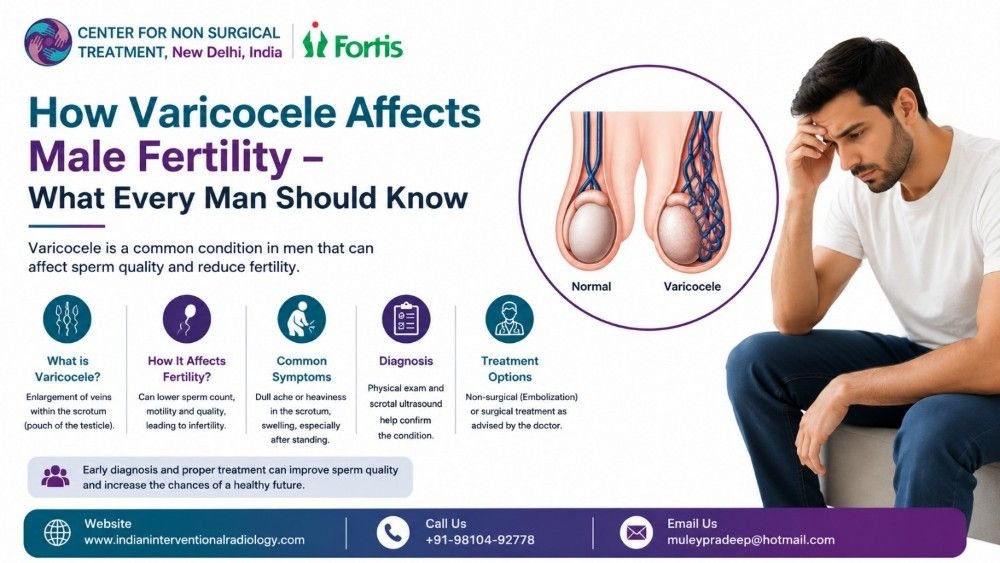
Let me explain in simple terms. Inside your scrotum, there is a network of veins that carries blood away from your testicles. These veins contain tiny one-way valves that ensure blood flows in the right direction -- upward toward your heart.
Sometimes, these valves stop working properly. Blood starts flowing backward and pooling in the veins, causing them to stretch and enlarge. This creates a tangled network of blood vessels that you can often feel. It looks and feels like a "bag of worms."
A varicocele is essentially a varicose vein of the testicle. It is a relatively common condition, affecting approximately 10 to 15 percent of all men. It tends to occur most often in young men, usually during the second or third decade of life. It is most common on the left side, although it can happen on both sides.
For comprehensive information on varicocele symptoms and treatment, visit Mayo Clinic -- Varicocele Overview.
The Varicocele-Fertility Connection -- Why Should You Be Concerned?
Here is the most important thing to understand: varicocele is one of the most common and treatable causes of male infertility.
The numbers are striking. Varicocele is found in:
- Over 15% of the general male population
- Up to 35% of men presenting with infertility
- 25--35% of men with primary infertility
- Almost 40% of infertile males
- 50--80% of men with persistent infertility
In one study, as many as 40% of men who were subfertile were found to have a varicocele. This means if you are struggling to conceive, there is a significant chance that a varicocele could be contributing to the problem.
But here is the encouraging part: varicocele is treatable. Research indicates that 50--70% of men facing fertility challenges experience notable improvements in sperm quality and/or quantity following varicocele repair.
How Does Varicocele Affect Sperm Quality?
Varicocele can harm your fertility through several different mechanisms. Let me break them down one by one.
1. Increased Testicular Temperature
Your testicles need to be slightly cooler than your body temperature for healthy sperm production. This is why they hang outside your body. When blood pools in the veins due to a varicocele, it raises the temperature inside the testicle.
Higher intratesticular temperatures have been reported in men with varicocele and fertility difficulties. Studies have linked scrotal and testicular hyperthermia to decreased spermatogenic function. When the temperature goes up, sperm production goes down.
2. Increased Oxidative Stress
This is perhaps the most significant factor. Oxidative stress occurs when there is an imbalance between harmful molecules called reactive oxygen species (ROS) and the body's ability to neutralize them.
In men with varicocele, there is a significant increase in oxidative stress. Studies have shown that patients with varicocele are characterized by high levels of oxidative stress, reduced total sperm count and motility, abnormal sperm morphology, and increased DNA fragmentation.
The impact of this oxidative stress is severe. It can:
- Damage sperm DNA
- Impair sperm concentration and motility
- Increase sperm DNA fragmentation
- Damage sperm chromatin
Research has highlighted inflammation and oxidative stress as key contributing factors in varicocele-induced infertility. Patients with varicocele are characterized by high levels of oxidative stress, reduced total sperm count and motility, abnormal sperm morphology, and increased DNA fragmentation.
For detailed research on oxidative stress and varicocele, visit PubMed -- Relationship between oxidative stress, varicocele and infertility.
3. Hormonal and Metabolic Disruption
Varicoceles can also disrupt the hormonal environment of your testicles. The abnormal blood flow can cause:
- Hypoxia -- reduced oxygen supply to the testicular tissue
- Metabolite reflux -- backflow of toxic substances from the kidneys and adrenal glands
- Pressure-induced disturbance of testicular convective transport
These factors can upset the testicular hormonal environment and impair spermatogenesis. In some cases, varicocele can lead to arrest of spermatogenesis at the spermatid or primary spermatocyte stage.
4. Sperm DNA Fragmentation
Sperm DNA fragmentation (SDF) has been identified as a key factor in varicocele-related infertility. High levels of DNA fragmentation mean that even if sperm count and motility look normal, the genetic material inside the sperm may be damaged, making fertilization difficult or leading to miscarriage.
Excessive sperm DNA breaks result from the oxidative stress cascade and are commonly found in the ejaculates of men with varicocele and fertility-related issues.
Varicocele can lead to infertility through multiple mechanisms, including impaired venous drainage with elevation of reactive oxygen species levels, mounting scrotal temperature, accumulation of metabolites, testicular hypoxia, and immunological effects.
What Do Semen Analysis Results Show?
When a man with varicocele undergoes a semen analysis, the results often show:
| Parameter | What Happens | Why It Matters |
|---|---|---|
| Sperm Count | Significantly reduced | Fewer sperm means lower chance of fertilization |
| Sperm Motility | Impaired movement | Sperm cannot swim effectively to reach the egg |
| Sperm Morphology | Higher proportion of abnormally shaped sperm | Abnormal shape affects the sperm's ability to penetrate the egg |
| Sperm DNA Fragmentation | Increased levels | Damaged DNA can prevent fertilization or cause miscarriage |
| Semen Volume | Significantly lower | Less seminal fluid can affect sperm transport |
Studies have shown that adolescent males with varicocele exhibit significantly lower semen volume, total sperm count, and morphology scores compared to healthy controls.
Do All Varicoceles Affect Fertility?
Here is an important point: not all varicoceles cause fertility problems. Many men with varicoceles father children without difficulty. The impact on fertility depends on several factors:
- Size of the varicocele -- Larger varicoceles (Grade 2 and 3) are more likely to affect fertility than smaller ones (Grade 1)
- Duration -- How long the varicocele has been present
- Individual health differences
- Presence of other co-factors -- Varicocele may act as a "cofactor" that, when combined with other factors, causes infertility
Varicoceles do not always need treatment, but symptomatic ones or those in patients who are interested in fertility need to be considered by experts providing varicocele therapy.
It is estimated that 10% to 20% of men diagnosed with a varicocele experience difficulty fathering a child. Among men with fertility problems, the prevalence is significantly higher.
Varicocele Grades -- How Severe Is Yours?
Medical professionals use a grading system to classify varicoceles based on their size and detectability:
| Grade | What It Means | Fertility Impact |
|---|---|---|
| Grade 1 | Smallest form, detectable only during straining | Usually minimal impact |
| Grade 2 | Can be felt without straining | Moderate impact possible |
| Grade 3 | Veins are both visible and palpable | Highest impact on fertility |
Grade 1 may not need treatment. Grade 2 and 3 usually do, especially if you have pain or fertility problems.
How Is Varicocele Diagnosed?
If you suspect you might have a varicocele, the diagnostic process is straightforward:
Physical Examination
A healthcare professional can often identify a varicocele during a routine physical check-up. Larger varicoceles may cause the scrotum to appear irregular or lumpy, often described as having a texture similar to a "bag of worms".
Doppler Ultrasound
If symptoms are less obvious, a colour flow Doppler ultrasound is performed. This imaging test can:
- Confirm the diagnosis
- Measure the diameter of the veins
- Assess blood flow patterns
- Help grade the severity of the varicocele
Treatment Options for Varicocele
If you have been diagnosed with a varicocele and it is affecting your fertility, you have two main treatment options: Microsurgery and Embolization.
Option 1: Varicocele Microsurgery
This is a surgical procedure where the doctor makes a small incision in the groin and uses a microscope to tie off the bad veins. It is considered the gold standard for fertility improvement.
How It Works:
- A small cut is made in the groin area
- Using a microscope, the surgeon identifies and ligates (ties off) the dilated veins
- Healthy arteries and lymph vessels are preserved
Fertility Outcomes:
- Significant improvement in sperm concentration within 3--6 months
- Significant improvement in sperm motility
- Significant improvement in total motile count
- Greater improvement in semen quality compared to embolization
Success Rates:
- Substantial improvements in semen parameters and the chance of achieving a pregnancy
- Superior short-term improvement in sperm parameters
For comparative research on microsurgery outcomes, visit Asian Journal of Andrology -- Outcomes following varicocele treatment.
Option 2: Varicocele Embolization
This is a non-surgical, minimally invasive procedure performed by an interventional radiologist. A small catheter is inserted through a vein in the neck or groin, and embolic agents (coils or special liquid) are placed to block the abnormal blood flow.
Varicocele embolization treatment in Delhi is a contemporary and non-surgical procedure that is very successful and has fast healing.
Advantages:
- No surgical incision
- Under local anaesthetic conditions
- Short hospital stay
- Minimal pain and scarring
- Faster recovery than surgery
Fertility Outcomes:
- Showed no significant change in sperm parameters in some studies
- Exploratory outcomes because of limited sample size and should be interpreted with caution
- Less reproductive benefit compared to microsurgery
For research on embolization outcomes, visit BMC Urology -- Microsurgical varicocelectomy vs embolization.
Varicocele Embolization vs Microsurgery -- What the Research Says
Here is a clear comparison based on recent studies:
| Factor | Microsurgery | Embolization |
|---|---|---|
| Sperm Concentration | Significant improvement | No significant change |
| Sperm Motility | Significant improvement | No significant change |
| Total Motile Count | Significant improvement | No significant change |
| Recurrence Rate | <1% | Higher |
| Pain Relief | Better | Similar |
| Fertility Improvement | Superior | Exploratory data |
A study comparing microsurgical varicocelectomy versus percutaneous angioembolization found that microsurgical varicocelectomy was more effective than angioembolization in improving semen quality among infertile men within the 3--6 month postoperative period.
Another study concluded that both approaches were effective, with microsurgery offering better pain relief and improvements in motility and morphology, while embolization provided a shorter operative time.
For official guidelines on varicocele treatment, visit AUA/ASRM Guideline -- Diagnosis and Treatment of Infertility in Men.
Why Choose Dr. Pradeep Muley for Varicocele Treatment in Delhi?
When it comes to the best varicocele surgery doctors in Delhi, choosing the right specialist makes all the difference.
Pioneer in Varicocele Embolization
Dr. Pradeep Muley is a pioneer in varicocele embolization surgery in Delhi. He is a Senior Consultant Interventional Radiologist with an outstanding reputation:
- Performed more than 20,000 diagnostic and interventional radiological procedures
- 30 years of experience in the field
- Pioneer in DELHI & NCR for Non-surgical treatment
World-Class Training
Dr. Pradeep Muley's qualifications are truly impressive:
- Fellow Interventional Radiology, Singapore General Hospital, Singapore
- Visiting Associate, Neurointerventional Radiology, Iowa University Hospitals, USA
- Visiting Fellow, Neurointerventional Radiology, Johns Hopkins Medical Institutions, USA
- Lecturer, Vascular & Interventional Radiology, KEM Hospital, Mumbai, India
- Neuroradiology, All India Institute of Medical Sciences (AIIMS), New Delhi, India
Advanced Facilities
The Department of Interventional Radiology, established by Dr. Pradeep Muley, is specifically designed with two well-equipped and modern Cath-labs for all diagnostic and interventional procedures.
Patient-Centric Care
At Indian Interventional Radiology, the focus is on providing safe, effective, and long-term relief. The team offers customized treatment plans based on your specific symptoms and fertility goals.
You can schedule a consultation or contact us to begin your journey toward relief.
Frequently Asked Questions (FAQs)
1. How does varicocele affect male fertility?
Varicocele affects fertility through multiple mechanisms: increased testicular temperature, elevated oxidative stress, hormonal disruption, testicular hypoxia, and sperm DNA fragmentation. These factors can reduce sperm count, impair motility, increase abnormal sperm morphology, and damage sperm DNA.
2. What percentage of infertile men have varicocele?
Varicocele is found in up to 35% of men with primary infertility and almost 40% of infertile males. Among men with persistent infertility, the prevalence can be as high as 50--80%.
3. Can varicocele cause low sperm count?
Yes. Varicocele can significantly reduce sperm count. Studies have shown that varicocele is independently associated with impaired spermatogenesis, particularly azoospermia and oligozoospermia (low sperm count).
4. Does varicocele treatment improve fertility?
Yes. Research indicates that 50--70% of men facing fertility challenges experience notable improvements in sperm quality and/or quantity following varicocele repair. Varicocele repair can result in substantial improvements in semen parameters and the chance of achieving a pregnancy.
5. Which treatment is better for fertility -- microsurgery or embolization?
Microsurgery is better for fertility. Studies show that microsurgical varicocelectomy significantly improves sperm concentration, motility, and total motile count within 3--6 months, while embolization showed no significant change in these parameters. Microsurgery was more effective than angioembolization in improving semen quality among infertile men.
6. How long does it take to see fertility improvement after varicocele treatment?
Most studies report significant improvement in sperm parameters within 3--6 months after microsurgical varicocelectomy.
7. Can a varicocele cause azoospermia (no sperm)?
Yes. Varicocele has been associated with azoospermia. In some cases, varicocele repair can result in the return of motile sperm to the ejaculate, potentially avoiding the need for surgical sperm retrieval.
8. Is varicocele embolization effective for fertility?
The evidence on embolization and fertility is less clear. Some studies have shown no significant change in sperm parameters after embolization. More research is needed, as embolization outcomes have been reported as exploratory data because of limited sample size.
9. Who is the best doctor for varicocele treatment in Delhi?
Dr. Pradeep Muley is a pioneer in varicocele embolization with over 20,000 procedures performed. He has trained at prestigious institutions including Johns Hopkins and AIIMS. He offers advanced, personalized care with a focus on non-surgical, minimally invasive solutions.
10. How do I know if I have a varicocele?
Common signs include a dull, aching pain in the scrotum that worsens with standing or sitting for long periods, visible or palpable dilated veins (feeling like a "bag of worms"), testicular shrinkage, and fertility issues. A physical examination and Doppler ultrasound can confirm the diagnosis.
Final Thoughts
Varicocele is one of the most common and treatable causes of male infertility. If you have been struggling to conceive, or if you have noticed symptoms like scrotal pain or testicular shrinkage, do not ignore it. Early diagnosis and appropriate treatment can make a significant difference.
Here is the bottom line:
| Your Priority | Best Option |
|---|---|
| Fertility improvement | Microsurgery (gold standard) |
| Fastest recovery | Embolization |
| No scars/no cuts | Embolization |
| Lowest recurrence rate | Microsurgery |
| Pain relief | Both are effective |
If you are in Delhi or the NCR region and looking for the best varicocele treatment in Delhi, Dr. Pradeep Muley at Indian Interventional Radiology is your trusted partner. With decades of experience, advanced technology, and a patient-first approach, he provides world-class care tailored to your needs.
Don't suffer in silence. Don't ignore the signs. Book a consultation today and take the first step toward building your family.
Contact Information
Dr. Pradeep Muley
Senior Consultant Interventional Radiologist
Indian Interventional Radiology
Fortis Hospital, Vasant Kunj, New Delhi, India
Phone: +91-98104-92778
Email: muleypradeep@hotmail.com
Contact Us for more information or to schedule your appointment.