
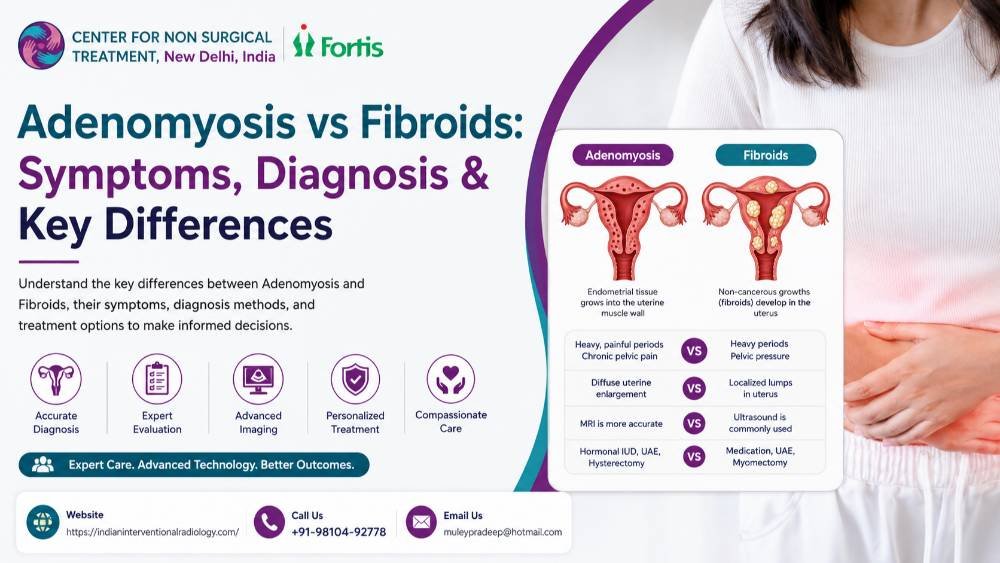
If you have been experiencing heavy periods, severe pelvic pain, or a constant feeling of pressure in your lower abdomen, you may be wondering what is going on. Two of the most common conditions that cause these symptoms are adenomyosis and uterine fibroids. They share many similarities, yet they are fundamentally different in how they develop, how they affect your body, and how they are treated.
This guide will help you understand the difference between adenomyosis and fibroids, explain the symptoms, diagnosis, and treatment options, and help you feel more confident when speaking with your doctor.
Why Trust This Guide?
| Trust Signal | Details |
|---|---|
| Updated for 2026 | Latest clinical guidelines and treatment options |
| Clinical Evidence | References to Mayo Clinic, Cleveland Clinic, Johns Hopkins, BMJ Best Practice |
| Specialist Reviewer | Reviewed by Dr. Pradeep Muley, Senior Consultant Interventional Radiologist |
| Practical Guidance | Provides clear comparisons and treatment pathways |
| Transparency | Balanced discussion of treatment options and specialist roles |
This guide is based on established clinical guidelines and practical criteria for evaluating and treating adenomyosis and fibroids. It is written to help patients make informed decisions about their care.
Last Reviewed: July 2026
What Is the Difference Between Adenomyosis and Fibroids?
Adenomyosis and uterine fibroids are different benign uterine conditions. Fibroids are well-defined growths of uterine smooth muscle that form distinct masses, while adenomyosis occurs when endometrial tissue is present within the muscular wall of the uterus.
Adenomyosis is more commonly associated with painful periods, heavy menstrual bleeding and chronic pelvic pain. Fibroids can also cause heavy bleeding, but larger or strategically located fibroids may additionally cause pelvic pressure, urinary symptoms, bowel symptoms or fertility problems.
Symptoms alone cannot reliably distinguish adenomyosis from fibroids. Transvaginal ultrasound is generally a first-line imaging test, while MRI can provide additional characterization when ultrasound is inconclusive or when detailed assessment is needed.
Adenomyosis vs Fibroids at a Glance
| Feature | Adenomyosis | Fibroids |
|---|---|---|
| What is it? | Endometrial-type tissue growing into the uterine muscle wall | Non-cancerous tumours of muscle and fibrous tissue |
| Location | Within the uterine muscle (diffuse or focal) | Inside the uterine cavity, within the wall, or outside the uterus |
| Appearance | Diffuse thickening of the uterus; ill-defined borders | Well-defined, round or oval masses with clear borders |
| Pain | Often severe, cramp-like pain, especially during periods | Pain varies; often pressure-related |
| Bleeding | Heavy periods with clots; longer menstrual cycles | Heavy bleeding possible, but pattern varies |
| Pelvic Pressure | Less common | Common, especially with larger fibroids |
| Frequent Urination | Less common | More common |
| Fertility Impact | May affect implantation; linked to miscarriage | May block tubes or distort the uterus |
| Typical Age | More commonly diagnosed in 30s–40s | Can occur throughout reproductive years |
What Are Uterine Fibroids?
Uterine fibroids, also known as leiomyomas, are non-cancerous growths that develop from the muscle tissue of the uterus. They are the most common benign tumours in women of reproductive age.
How Common Are Fibroids?
Fibroids are extremely common during the reproductive years. Their reported prevalence varies according to age, population and diagnostic method, and many fibroids cause no symptoms.
Types of Fibroids
Fibroids are classified by their location:
| Type | Location |
|---|---|
| Intramural | Within the uterine wall (most common) |
| Submucosal | Growing into the inner cavity of the uterus |
| Subserosal | Growing outward from the outer surface of the uterus |
| Pedunculated | Attached by a stalk, either inside or outside the uterus |
Symptoms of Fibroids
Many women with fibroids have no symptoms at all. However, when symptoms do occur, they may include:
- Heavy or prolonged menstrual bleeding
- A feeling of pressure or fullness in the pelvis
- Frequent urination
- Constipation or bloating
- Lower back or leg pain
- Pain during sexual intercourse
- Enlarged uterus
What Causes Fibroids?
The exact cause is unknown, but research suggests that hormones (estrogen and progesterone) and genetics play a significant role. Fibroids tend to grow during the reproductive years and shrink after menopause.
What Is Adenomyosis?
Adenomyosis is a condition where endometrial-type tissue is present within the muscular wall of the uterus (the myometrium). This causes the uterus to become enlarged, thickened, and tender.
The Mayo Clinic notes that adenomyosis shares similar symptoms with other uterine conditions, including uterine fibroids, endometriosis and endometrial polyps.
How Common Is Adenomyosis?
Adenomyosis is also common, though its true prevalence is difficult to determine because many women have no symptoms. It is more commonly diagnosed in women during their reproductive years, often in their 30s and 40s, especially those who have had children.
Types and Patterns of Adenomyosis
Adenomyosis may be described as:
- Diffuse adenomyosis — adenomyotic tissue is distributed through a larger portion of the myometrium.
- Focal adenomyosis — disease is concentrated in a specific area of the uterine muscle.
- Adenomyoma — focal adenomyosis can sometimes form a mass-like lesion known as an adenomyoma, which may resemble a fibroid on imaging.
Symptoms of Adenomyosis
Symptoms can vary from mild to severe and may include:
- Severe menstrual cramps (dysmenorrhea) — often described as sharp, stabbing, or cramping pain
- Heavy or prolonged menstrual bleeding with large clots
- Chronic pelvic pain, even outside of your menstrual cycle
- Pain during sexual intercourse (dyspareunia)
- Enlarged, tender uterus that may be painful to touch
- Fatigue or anaemia caused by significant blood loss
What Causes Adenomyosis?
The exact cause is not fully understood. However, certain factors may increase the risk:
- Previous uterine surgery (such as a C-section or D&C)
- Having given birth
- Prolonged oestrogen exposure
- Chronic inflammation of the uterine lining
- Older age (approaching menopause)
Adenomyosis vs Fibroids: Causes and Risk Factors
| Factor | Adenomyosis | Fibroids |
|---|---|---|
| Exact cause | Not fully understood | Not fully understood |
| Hormonal influence | Yes | Yes |
| Genetic factors | May contribute | Important role |
| Previous uterine surgery | Associated risk factor | Not a primary cause |
| Reproductive age | Common | Common |
| After menopause | Often improves | Often shrink |
Adenomyosis vs Fibroids: Symptoms Comparison
| Symptom | Adenomyosis | Fibroids |
|---|---|---|
| Heavy periods | Common | Common |
| Severe period cramps | Common | Possible |
| Chronic pelvic pain | Common | Possible |
| Pelvic pressure | Possible | Common with larger fibroids |
| Frequent urination | Less typical | More common with large fibroids |
| Constipation | Less typical | Possible with large fibroids |
| Enlarged uterus | Common, often diffuse | Possible, depending on fibroid size/number |
| Pain during sex | Possible/common | Possible |
| Anaemia from heavy bleeding | Possible | Possible |
| Fertility effects | Possible | Depends strongly on location and size |
These patterns are not diagnostic. A woman can have both adenomyosis and fibroids, and symptoms can overlap substantially.
How Can You Tell Adenomyosis From Fibroids?
You usually cannot tell the difference from symptoms alone. Both conditions can cause heavy menstrual bleeding and pelvic pain.
- A pattern of painful periods, chronic pelvic pain and a diffusely enlarged or tender uterus may raise suspicion for adenomyosis.
- A pattern of heavy bleeding combined with pelvic pressure, urinary symptoms or bowel symptoms may suggest fibroids, particularly when imaging shows one or more distinct uterine masses.
However, these patterns overlap. Transvaginal ultrasound and, when necessary, MRI are used to determine whether adenomyosis, fibroids or both are present.
Can You Have Adenomyosis and Fibroids at the Same Time?
Yes. Adenomyosis and uterine fibroids can occur together. When both conditions are present, symptoms may overlap and determining which condition is contributing most to heavy bleeding, pain or pressure can be challenging. Transvaginal ultrasound and, when appropriate, MRI can help characterize the uterus and guide treatment planning.
How Are Adenomyosis and Fibroids Diagnosed?
Accurate diagnosis is essential because the treatment for adenomyosis and fibroids can be very different.
Medical History and Examination
Your doctor may ask about:
- Menstrual bleeding pattern and heaviness
- Pain severity and timing
- Cycle length
- Pelvic pressure
- Urinary or bowel symptoms
- Fertility history
- Previous uterine procedures
A pelvic examination may reveal uterine size, tenderness and other findings.
Transvaginal Ultrasound
Ultrasound is usually the first test. It is widely available and cost-effective.
- Fibroids appear as round or oval-shaped masses with clear borders.
- Adenomyosis can be harder to spot, especially when it is diffuse. The uterus may appear enlarged without a distinct mass.
According to BMJ Best Practice, transvaginal ultrasound is the preferred first-line imaging investigation for adenomyosis.
What Does Adenomyosis Look Like on Ultrasound?
Possible ultrasound features include:
- A bulky or enlarged uterus
- Heterogeneous myometrial appearance
- Irregular or poorly defined areas within the myometrium
- Changes in the junctional region
- Myometrial cystic or echogenic features
What Do Fibroids Look Like on Ultrasound?
Fibroids commonly appear as well-defined masses within or arising from the uterine muscle, although their appearance can vary depending on their type, size and degeneration.
MRI
MRI can provide additional detail when ultrasound findings are inconclusive, when adenomyosis needs further characterization, or when detailed mapping of the uterus is important for treatment planning.
The Cleveland Clinic notes that MRI more accurately defines the size, location, and extent of disease and may better differentiate fibroids from adenomyosis.
The Johns Hopkins Medicine resource explains that adenomyosis is a condition where tissue that normally lines the uterus grows into the muscular wall of the uterus, enlarging the uterus, while uterine fibroids are non-cancerous growths in the uterus.
Adenomyosis vs Fibroids: Fertility
Both adenomyosis and fibroids may be associated with fertility problems, but their effects can differ.
- Adenomyosis has been associated with impaired reproductive outcomes, although the effect varies between individuals.
- Fibroids may affect fertility depending on their size, number and location. Fibroids that distort the uterine cavity are particularly relevant when evaluating fertility.
If pregnancy is a priority, treatment should be planned with consideration of reproductive goals. A gynaecologist or fertility specialist may be involved, depending on the individual's circumstances.
Treatment Options
Treatment depends on your symptoms, the severity of your condition, your age, and your fertility goals.
Treatment for Fibroids
Options for fibroids include:
- Observation — If you have no symptoms, no treatment may be needed.
- Medication — Hormonal therapies (like the LNG-IUS, oral contraceptives) can help control bleeding.
- Minimally Invasive Procedures — Uterine Artery Embolization (UAE/UFE) is a non-surgical option that blocks the blood supply to fibroids, causing them to shrink.
- Surgery — Myomectomy (removal of fibroids) preserves the uterus. Hysterectomy (removal of the uterus) is a definitive treatment.
Treatment for Adenomyosis
Treatment for adenomyosis includes:
- Hormonal Therapy — The levonorgestrel intrauterine device (LNG-IUS) may be used to manage heavy menstrual bleeding and symptoms in appropriate patients.
- Pain Relief — NSAIDs can help manage pain.
- Uterine Artery Embolization (UAE) — A minimally invasive option that can significantly improve symptoms while preserving the uterus.
- Surgery — Hysterectomy is the definitive treatment for adenomyosis because it removes the uterus, but it is not appropriate or necessary for everyone. Treatment decisions depend on symptoms, reproductive goals and individual circumstances.
When Is UAE Considered?
Uterine artery embolization (UAE) is a minimally invasive treatment option that may be considered for selected patients with symptomatic adenomyosis or fibroids. It can preserve the uterus, but treatment decisions should be individualized, particularly when future pregnancy is important. Patients considering pregnancy should discuss the potential benefits, limitations and fertility implications with their treating specialists.
Which Specialist Treats Adenomyosis and Fibroids?
- A gynaecologist can evaluate symptoms, hormonal treatment, fertility concerns and surgical options.
- An interventional radiologist can evaluate whether a minimally invasive procedure such as uterine artery embolization is appropriate.
- A fertility specialist may be important when pregnancy is a priority.
- In complex cases, coordinated care between these specialists may provide the most comprehensive treatment plan.
Adenomyosis Treatment in Delhi
If you have been diagnosed with adenomyosis and are looking for adenomyosis treatment in Delhi, you have options.
Indian Interventional Radiology provides advanced, minimally invasive treatments for adenomyosis and fibroids. Under the care of experienced interventional radiologists, including Dr. Pradeep Muley, patients can access Uterine Artery Embolization (UAE) — a non-surgical, uterus-preserving procedure that can significantly reduce symptoms.
Learn more about uterine adenomyosis treatment in Delhi and adenomyosis treatment in Delhi.
About Dr. Pradeep Muley
Dr. Pradeep Muley is a Senior Consultant Interventional Radiologist in New Delhi with clinical experience in image-guided minimally invasive procedures, including uterine artery embolization for uterine fibroids and adenomyosis. He is associated with Fortis Hospital, Vasant Kunj, New Delhi.
His practice focuses on image-guided, uterus-preserving treatment options where clinically appropriate. Treatment decisions are individualized according to the patient's diagnosis, symptoms, imaging findings, medical history and reproductive goals.
Contact Dr. Pradeep Muley to schedule a consultation and explore your treatment options.
Frequently Asked Questions (FAQs)
1. What is the main difference between adenomyosis and fibroids?
The main difference is that fibroids are benign tumours of muscle tissue that form distinct masses, while adenomyosis is the growth of endometrial-type tissue into the uterine muscle wall, causing diffuse thickening of the uterus.
2. Can adenomyosis and fibroids occur together?
Yes. It is possible to have both conditions at the same time.
3. Which is more painful — adenomyosis or fibroids?
Adenomyosis is often associated with significant menstrual pain and chronic pelvic pain, while fibroids may cause pressure, heaviness, bleeding or pain depending on their size and location. However, symptoms overlap, so pain severity alone cannot reliably distinguish adenomyosis from fibroids.
4. How are adenomyosis and fibroids diagnosed?
Diagnosis typically begins with a pelvic ultrasound. If the ultrasound is inconclusive, an MRI may be recommended.
5. Can adenomyosis be treated without surgery?
Yes. Non-surgical options include hormonal therapy (like the LNG-IUS) and Uterine Artery Embolization (UAE), a minimally invasive procedure that preserves the uterus.
6. Can fibroids be treated without surgery?
Yes. Options include medication to control symptoms and Uterine Artery Embolization (UAE/UFE) to shrink fibroids without surgery.
7. Do adenomyosis or fibroids affect fertility?
Both conditions can affect fertility. Adenomyosis may affect implantation and increase the risk of miscarriage. Fibroids may block fallopian tubes or distort the uterine cavity.
8. When should I see a doctor for adenomyosis or fibroids?
You should see a doctor if you experience heavy menstrual bleeding, severe pelvic pain, prolonged periods, or symptoms of anaemia (such as fatigue or weakness). Early diagnosis can help you access the most appropriate treatment.
9. What type of doctor treats adenomyosis?
A gynaecologist can evaluate adenomyosis and discuss medical and surgical treatment options. An interventional radiologist may be involved when a minimally invasive procedure such as UAE is being considered. A fertility specialist may also be involved when pregnancy is a priority.
10. Can adenomyosis look like a fibroid?
Yes. Focal adenomyosis or an adenomyoma can sometimes appear as a mass-like lesion and may be confused with a fibroid on ultrasound. MRI can provide additional characterization when the diagnosis is uncertain.
11. Can adenomyosis be seen on ultrasound?
Yes. Transvaginal ultrasound can identify several imaging features associated with adenomyosis and is generally the first-line imaging investigation. MRI may be used when ultrasound findings are inconclusive or further characterization is needed.
12. Can fibroids and adenomyosis cause the same symptoms?
Yes. Both can cause heavy menstrual bleeding and pelvic pain. Fibroids may additionally cause pressure, urinary or bowel symptoms depending on their size and location, while adenomyosis is often associated with painful periods and chronic pelvic pain. Symptoms alone cannot reliably distinguish the two conditions.
13. Does adenomyosis always require treatment?
No. Treatment depends on symptoms and their impact on quality of life. Many women with adenomyosis have no symptoms and may not require treatment.
14. Is hysterectomy the only cure for adenomyosis?
Hysterectomy is the definitive treatment for adenomyosis because it removes the uterus, but it is not appropriate or necessary for everyone. Many women find significant relief with non-surgical options like UAE and hormonal therapy, allowing them to preserve their uterus.
Conclusion
Adenomyosis and fibroids are two common conditions that can cause similar symptoms, but they are very different in how they develop and how they are treated. Understanding the difference is the first step toward getting the right diagnosis and the most effective treatment.
If you are experiencing heavy periods, severe pelvic pain, or other symptoms, do not ignore them. A proper evaluation — including a pelvic ultrasound and, if needed, an MRI — can help your doctor determine whether you have adenomyosis, fibroids, or both.
For women seeking adenomyosis treatment in Delhi, Dr. Pradeep Muley and the team at Indian Interventional Radiology offer advanced, uterus-preserving treatments like Uterine Artery Embolization (UAE). Schedule a consultation today to explore your options.
Medical Disclaimer
This article provides general educational information and does not replace a medical examination, diagnosis, or individualized treatment plan. Always consult with a qualified healthcare professional for advice regarding your specific condition.