
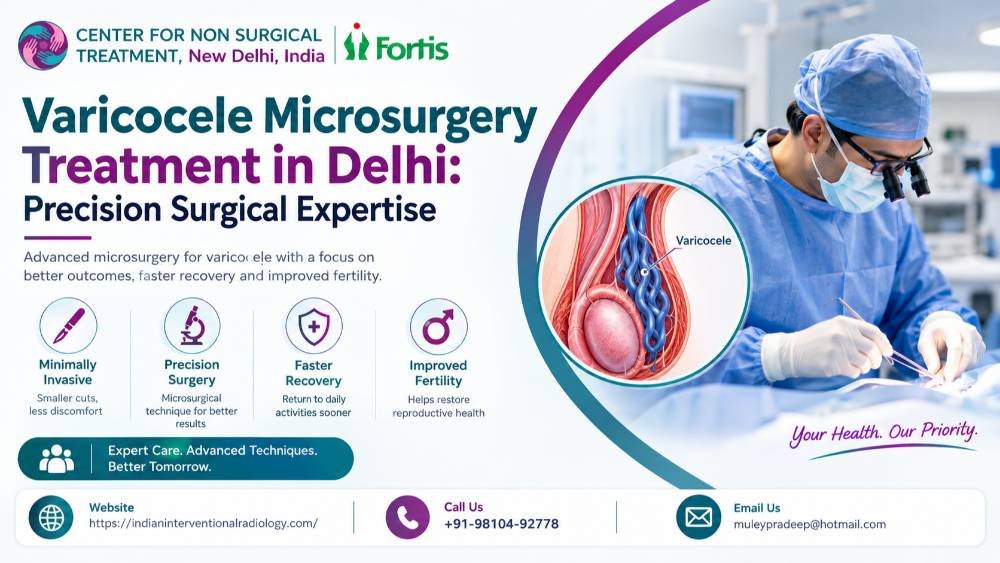
Varicocele—abnormal enlargement of testicular veins—affects approximately 15% of men, yet remains frequently underdiagnosed and undertreated. For men experiencing infertility concerns, pain, or testicular shrinkage, varicocele microsurgery treatment in Delhi offers a proven solution with remarkable success rates.
Understanding Varicocele: Anatomy and Impact
What Is Varicocele?
Varicocele develops when valves in testicular veins fail, allowing blood to pool and dilate the veins. This creates a “bag of worms” appearance on physical examination. The condition most commonly affects the left testis, though bilateral involvement occurs in approximately 10% of cases.
Why Varicocele Matters
The clinical significance of varicocele extends beyond cosmetic appearance:
Impact on Fertility: - Present in 35% of men with primary infertility - Present in 80% of men with secondary infertility - Impairs spermatogenesis (sperm production) - Reduces sperm motility and morphology - Decreases testicular volume over time
Testicular Damage Mechanisms: - Elevated scrotal temperature from venous congestion - Reactive oxygen species generation - Impaired hormone production - Oxidative stress affecting sperm cells
Symptomatic Presentations: - Scrotal pain (worse standing, relieved lying down) - Visible veins - Testicular volume loss - Infertility concerns
Varicocele Microsurgery Treatment: Why Microsurgery Excels
Varicocele microsurgery treatment in Delhi represents the gold standard approach, superior to conventional surgical techniques through precision and safety.
Microsurgery Advantages
Optical Magnification: - Operating microscope providing 6-40x magnification - Superior visualisation of small vessels - Distinction between arteries and veins - Recognition of lymphatic vessels
Precision Vessel Identification: The critical advantage of varicocele microsurgery treatment is identifying and preserving arteries and lymphatics whilst ligating only dilated veins. Conventional techniques cannot distinguish these structures reliably.
Microsurgical approach delivers superior outcomes through anatomical precision.
Indications for Varicocele Microsurgery Treatment
Not every man with varicocele requires surgery. Careful patient selection optimises outcomes.
Absolute Indications: - Infertility with documented semen abnormalities - Progressive testicular atrophy - Significant pain affecting quality of life - Bilateral varicocele with fertility concerns
Relative Indications: - Adolescent with risk factors for progression - Compensated infertility (normal semen parameters but known varicocele) - Requests for fertility optimisation
When Surgery Isn’t Recommended: - Asymptomatic varicocele without fertility concerns - Varicocele in men with female-factor infertility solely - Severe underlying male-factor infertility unrelated to varicocele
Pre-Operative Evaluation: Comprehensive Assessment
Diagnostic Confirmation
Clinical Examination: - Valsalva manoeuvre (improves vein visibility) - Prone and standing positioning - Bilateral testicular comparison
Imaging Confirmation: - Colour Doppler ultrasound (standard) - Reverse flow detection during Valsalva - Vein diameter measurement - Testicular size assessment - Contralateral side assessment
Semen Analysis: Essential for infertile men to quantify impact: - Sperm concentration - Motility assessment - Morphology evaluation - Volume measurement - Semen culture if infection suspected
General Assessment: - Blood pressure and cardiac status - Complete blood count - Coagulation profile - Allergy history - Medication review
Varicocele Microsurgery Procedure: Operative Details
Surgical Approach Selection
Inguinal Approach (Most Common): - Small groin incision (1-2cm) - Excellent vessel access - Lower complication rates - Preferred for primary varicoceles - Reduced blood loss
Subinguinal Approach: - Incision below inguinal ligament - Excellent small vessel visualisation - Particularly useful for previous failure - Slightly longer operative time
High Retroperitoneal Approach: - Upper abdominal access - Used for high-grade varicoceles - Generally less common
Operative Procedure (Inguinal Approach)
Anaesthetic and Positioning (15-20 minutes): - General or spinal anaesthesia - Supine position - Sterile field preparation - Operative microscope positioning
Incision and Exposure (10-15 minutes): - Small groin incision following surgical lines - Careful tissue dissection - Spermatic cord identification - Microsurgical exposure setup
Vessel Identification (15-25 minutes): - Magnified examination of cord structures - Venous dilation identification - Arterial recognition and preservation - Lymphatic vessel identification
Selective Vein Ligation (20-30 minutes): - Individual dilated vein ligation - Careful knot placement - Arteries deliberately avoided - Lymphatics preserved - Systematic approach ensuring completeness
Wound Closure (10-15 minutes): - Meticulous fascial closure - Skin approximation (sutures or skin adhesive) - Dressing application - Minimal scarring through careful technique
Total Operative Time: 60-90 minutes
Recovery from Varicocele Microsurgery Treatment
Immediate Post-Operative Period (0-24 Hours)
Recovery Room Observations: - Pain assessment - Scrotal swelling evaluation - Bleeding check - Ambulation as tolerated
Home Discharge: - Most patients discharged same day - Clear post-operative instructions provided - Pain management prescribed - Follow-up appointment scheduled
First Week Recovery
Pain Management: - Paracetamol and ibuprofen typically sufficient - Prescription analgesics rarely needed - Pain minimal compared to conventional approach - Ice packs help reduce swelling
Activity Restrictions: - Light walking only - Avoid heavy lifting (>5kg) - No strenuous exercise - Desk work permissible if comfortable
Wound Care: - Keep incision clean and dry - Shower safe (avoid bathing) - No swimming - Check for excessive bleeding or drainage
Scrotal Support: - Supportive underwear beneficial - Reduces pain and swelling - Worn for 1-2 weeks
Weeks 2-4 Recovery
Progressive Normalcy: - Swelling significantly reduced - Pain minimal - Energy returning - Normal daily activities resume
Activity Expansion: - Gradual return to normal exercise - Light stretching and walking - Sexual activity permissible - Return to work (depends on job type)
Timeline Variability: Recovery speed varies individually. Minimally invasive microsurgery results in faster recovery than conventional approaches.
Weeks 5-8 Recovery
Return to Full Activity: - Most restrictions lifted - Exercise and sports cleared - Full activity typically by week 6-8 - Complete healing by 3 months
Fertility Outcomes: The Central Question
Men considering varicocele microsurgery treatment often ask: “Will my fertility improve?”
Semen Parameter Improvement
Typical Improvements (observable 3-6 months post-surgery): - Sperm concentration: 50-70% show improvement - Motility: 60-80% demonstrate increased movement - Morphology: 40-50% show morphological improvement - Overall semen quality: 75-80% improvement rate
Pregnancy Outcomes
In Couples Pursuing Pregnancy Post-Surgery: - Natural pregnancy achievement: 40-60% - Time to pregnancy: typically 6-12 months - Better outcomes when performed before extensive infertility duration - Improved IVF success rates even without natural conception
Variables Affecting Outcomes
Positive Predictors: - Younger age (<35 years) - Shorter infertility duration (<2 years) - Significant semen parameter abnormalities initially - Normal female partner fertility - High-grade varicoceles
Limiting Factors: - Long-standing infertility (>5 years) - Severe underlying male-factor infertility - Azoospermia (zero sperm count) - Female-factor infertility also present
Complications: Transparent Discussion
Like any surgical procedure, varicocele microsurgery carries potential complications, though rates are dramatically lower with microsurgical technique.
Uncommon Complications (<2% with microsurgery): - Scrotal/groin pain (usually resolves) - Swelling/bruising (temporary) - Infection (rare with antibiotics) - Bleeding requiring intervention (very rare)
Artery Injury (<1% microsurgery; 5-10% conventional): - Accidental arterial ligation - Loss of testicular blood supply - Prevented through microsurgical identification - If occurs, immediate recognition and repair essential
Hydrocele (<1% microsurgery; 10-15% conventional): - Fluid accumulation around testis - Usually self-limiting - Occasionally requires drainage - Prevented through lymphatic preservation in microsurgery
Recurrence (2-5% microsurgery; 10-15% conventional): - Varicocele returns - Suggests incomplete initial treatment - Repeat surgery possible if necessary - Less common with microsurgical approach
Frequently Asked Questions
1. When should I seek semen analysis after surgery?
Typically 3-4 months post-surgery allows adequate time for spermatogenesis recovery.
2. Is varicocele microsurgery treatment guaranteed to improve fertility?
No guaranteed outcomes exist in medicine. However, 75-80% show semen improvement, and 40-60% achieve natural pregnancy.
3. Will I feel pain after varicocele microsurgery treatment?
Most experience minimal discomfort. Compared to conventional surgery, pain is significantly less.
4. Can I participate in sports immediately after surgery?
No. Return to contact sports requires 2-4 weeks. Full activity clearance at 6-8 weeks.
5. How long until I can resume sexual activity?
Most can resume within 2-3 weeks post-operatively. Discuss specific timing with your surgeon.
6. What if I have bilateral varicoceles?
Both typically treated during the same operation or staged depending on surgeon preference.
7. Is varicocele microsurgery treatment covered by insurance?
Generally yes, if medically indicated. Check your specific policy.
8. What’s the success rate for recurrent varicocele?
Repeat surgery for recurrence carries success rates similar to primary surgery (90-95%).
9. Can I adopt alternative treatments instead of surgery?
Antioxidant therapy has limited evidence. Varicocele tends to worsen without intervention if symptomatic.
10. How do I choose a surgeon skilled in varicocele microsurgery?
Look for urologists specialising in male infertility with high surgical volume. Ask about complication rates.
The Bottom Line: Precision Surgical Excellence
Varicocele microsurgery treatment in Delhi, performed by experienced microsurgical specialists, represents the gold standard for treating this common male fertility problem. The precision of microsurgical technique delivers superior outcomes with minimal complications, offering realistic potential for fertility improvement.
About the Author: Dr Pradeep Muley brings extensive experience in microsurgical procedures, combining precision technique with compassionate patient care for optimal outcomes.
Disclaimer: This article provides educational information only. Always consult qualified urologists and fertility specialists for individual assessment and treatment planning.