
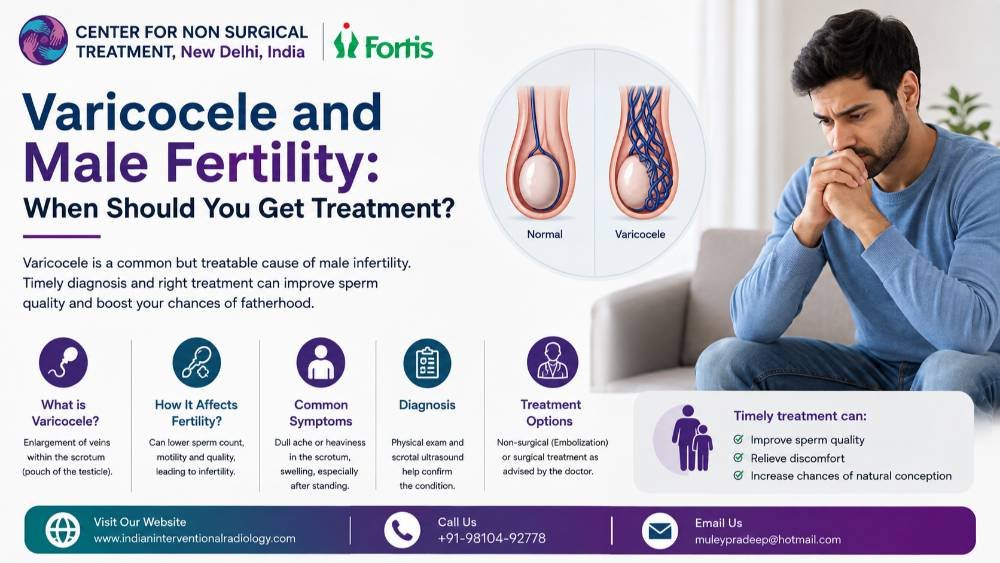
If you have been diagnosed with a varicocele and are trying to conceive, you are probably asking yourself an important question: Do I really need treatment? It is a fair question. Not every varicocele affects fertility, and not every varicocele needs to be treated.
This guide explains when varicocele repair may be appropriate, how embolization compares with microsurgical varicocelectomy, what tests are used before treatment, and what current AUA/ASRM, EAU, GAF and WHO guidance says.
Why Trust This Guide?
| Trust Signal | Details |
|---|---|
| Updated for 2026 | Latest clinical guidelines and treatment evidence |
| Clinical Evidence | References to AUA/ASRM, EAU, GAF, WHO 2025 guidelines |
| Specialist Reviewer | Reviewed by Dr. Pradeep Muley, Senior Consultant Interventional Radiologist |
| Evidence-Based | Includes systematic reviews and meta-analysis data |
| Practical Guidance | Provides clear decision frameworks and treatment comparisons |
This guide is based on established clinical guidelines, peer-reviewed evidence, and practical experience in treating varicocele. It is written to help patients make informed decisions about their treatment options.
Last Reviewed: July 2026
When Should a Varicocele Be Treated for Male Fertility?
A varicocele does not automatically require treatment. For men trying to conceive, treatment is generally considered when a clinically palpable varicocele, infertility and abnormal semen parameters are present after other important causes of infertility have been evaluated.
The AUA/ASRM guideline recommends considering surgical varicocelectomy in men attempting to conceive who have a palpable varicocele, infertility and abnormal semen parameters, except azoospermic males. The EAU similarly recommends treatment for infertile men with a clinical varicocele, abnormal semen parameters and otherwise unexplained infertility.
A subclinical varicocele detected only by ultrasound generally should not be treated solely because it appears on imaging, and treatment is not routinely recommended for infertile men with a normal semen analysis.
In simple terms: if you have a palpable varicocele + infertility + abnormal semen parameters, a specialist fertility evaluation should determine whether repair is appropriate.
Varicocele Treatment: At a Glance
| Question | General Guidance |
|---|---|
| Palpable varicocele + infertility + abnormal semen? | Discuss repair with a specialist |
| Ultrasound-only varicocele? | Usually not treated solely on imaging |
| Normal semen analysis? | Routine repair generally not recommended |
| Significant varicocele-related pain? | Treatment may be considered after evaluation |
| Embolization? | Minimally invasive catheter-based option |
| Microsurgery? | Established surgical option with strong guideline support |
| Recurrent varicocele? | Treatment depends on anatomy and previous repair |
What Is the Main Indication for Varicocele Repair?
The strongest guideline-supported indication for varicocele repair is a clinical (palpable) varicocele in an infertile man with abnormal semen parameters and otherwise unexplained male-factor infertility.
The Global Andrology Forum (GAF) guidelines, published in the World Journal of Men's Health in 2026, state:
"Clinical varicocele associated with abnormal sperm parameters is the primary unanimous indication of varicocele repair."
The AUA/ASRM, EAU and Global Andrology Forum guidelines support varicocele repair in appropriately selected infertile men with a clinical varicocele and abnormal semen parameters, although recommendations and evidence strength differ between guidelines.
Varicocele Fertility Treatment Decision Guide
1. Is the varicocele palpable on examination?
- No → Treatment is generally not recommended solely because ultrasound shows a varicocele.
- Yes → Continue evaluation.
2. Are you experiencing infertility?
- No → Treatment may not be necessary unless there are significant symptoms or another clinical indication.
- Yes → Perform fertility evaluation.
3. Is the semen analysis abnormal?
- No → Routine repair is generally not recommended.
- Yes → Discuss varicocele repair with an appropriate specialist.
4. Which treatment?
- Microsurgery → Established surgical option with strong guideline support in appropriately selected infertile men.
- Embolization → Minimally invasive catheter-based alternative for selected patients.
- Recurrent varicocele → Treatment should be based on previous repair and venous anatomy.
Who Usually Does Not Need Varicocele Treatment?
Varicocele treatment is generally not recommended solely because a varicocele is visible on an ultrasound.
Observation may be appropriate when:
- The varicocele is subclinical and not palpable
- An infertile man has a normal semen analysis
- There are no significant symptoms
- There is no relevant testicular-development concern
- Another explanation for infertility has not yet been evaluated
The EAU specifically recommends against treating infertile men with normal semen analysis and men with subclinical varicocele.
Key Takeaways
- Varicocele is the most common correctable cause of male infertility.
- Not every varicocele requires treatment — only those affecting fertility or causing significant symptoms.
- The AUA/ASRM, EAU and GAF guidelines recommend treatment for men with a palpable varicocele, infertility, and abnormal semen parameters.
- Both varicocele embolization and microsurgery are effective treatment options, but their evidence base and guideline positioning are not identical.
- The choice between embolization and surgery depends on your specific condition, preferences, and the expertise available.
- Varicocele treatment in Delhi is available through experienced specialists like Dr. Pradeep Muley, who offers advanced interventional radiology procedures.
What Is a Varicocele?
A varicocele is an abnormal enlargement of the veins within the pampiniform plexus of the scrotum—similar to varicose veins in the legs. It occurs when the valves inside the testicular veins fail to function properly, causing blood to pool and the veins to dilate.
For a detailed explanation of the condition, read our guide on what is varicocele and how does it affect men.
How Common Is Varicocele?
Varicocele is remarkably common. It affects approximately 15% of the general male population. Among men with abnormal semen analysis, this figure rises to about 25%, and among men presenting with infertility, it is found in approximately 35–40%. It is the most common surgically correctable cause of male infertility.
How Can Varicocele Affect Male Fertility?
A varicocele can affect fertility in several ways:
- Altered testicular temperature — Varicocele has been associated with impaired testicular thermoregulation, which can affect sperm production.
- Oxidative stress — Varicocele may increase oxidative stress and sperm DNA damage.
- Testicular function — Varicocele may affect testicular function, including sperm production and, in some men, testosterone production.
- Reduced sperm quality — Men with clinically significant varicoceles may have abnormalities in sperm concentration, motility or morphology.
What Symptoms Can Varicocele Cause?
Many men with varicocele have no symptoms at all. However, some may experience:
- A dull, aching pain in the scrotum, especially after standing or physical activity
- A feeling of heaviness or dragging in the scrotum
- Visible or palpable enlarged veins (often described as feeling like a "bag of worms")
- Testicular atrophy (shrinkage of the affected testicle)
- Fertility problems
How Is Varicocele Diagnosed?
Diagnosis usually begins with a physical examination, including assessment while standing and during a Valsalva manoeuvre. Scrotal Doppler ultrasound may be used when the physical examination is inconclusive or when persistence or recurrence needs to be evaluated.
Varicocele Grades
Varicoceles are graded based on their size and detectability. Understanding varicocele grades 1, 2 and 3 helps determine the severity and appropriate treatment approach.
| Grade | Description |
|---|---|
| Subclinical | Detected only on ultrasound; not palpable |
| Grade 1 | Palpable only during Valsalva maneuver (bearing down) |
| Grade 2 | Palpable at rest without Valsalva |
| Grade 3 | Visible and palpable at rest |
Higher-grade clinical varicoceles are more often associated with abnormal semen parameters, but grade alone does not determine whether treatment is necessary. Fertility status, semen analysis, symptoms, testicular findings and the overall clinical picture must also be considered.
What Do Current Guidelines Say About Varicocele Treatment?
AUA/ASRM Male Infertility Guideline — Amended 2024
The American Urological Association and American Society for Reproductive Medicine guideline, published in 2020 and amended in 2024, states:
"Clinicians should consider surgical varicocelectomy in males attempting to conceive who have palpable varicocele(s), infertility, and abnormal semen parameters, except for azoospermic males."
In practical terms, the AUA/ASRM recommendation applies when three key factors are present:
- Palpable varicocele — The varicocele can be felt on physical examination.
- Infertility — You and your partner have been trying to conceive without success.
- Abnormal semen parameters — Your semen analysis shows abnormalities in count, motility, or morphology.
View the AUA/ASRM Male Infertility Guideline
EAU Guidelines on Male Sexual and Reproductive Health — 2025 Update
The European Association of Urology guidelines recommend:
- Offering surgical correction of clinical varicocele in men with infertility and abnormal semen parameters
- Not treating subclinical varicocele
- Not treating infertile men with normal semen analysis
The EAU guideline recommends treating appropriately selected infertile men with a clinical varicocele, abnormal semen parameters and otherwise unexplained male-factor infertility. It strongly recommends against treating subclinical varicocele or infertile men with normal semen analysis.
View the EAU Guidelines on Male Infertility
Global Andrology Forum (GAF) Guidelines — Published Online 2025
The Global Andrology Forum published its clinical guideline online in April 2025, with the article appearing in the 2026 issue of World Journal of Men's Health.
The guideline states:
"Clinical varicocele associated with abnormal sperm parameters is the primary unanimous indication of varicocele repair."
The GAF guideline identifies clinical varicocele with abnormal sperm parameters as the strongest and most consistently supported indication for repair.
The guideline also notes that there is inadequate evidence on the use of medical therapy for varicocele and that a total of 31 statements and recommendations were introduced and scored by 24 experts, with all experts agreeing with the final statements.
View the GAF Guidelines on PubMed
What Does the 2025 WHO Infertility Guideline Say About Varicocele?
The World Health Organization published its first comprehensive Guideline for the Prevention, Diagnosis and Treatment of Infertility in 2025.
The 2025 WHO Guideline for the Prevention, Diagnosis and Treatment of Infertility conditionally supports varicocele repair in appropriately selected infertile men with clinical varicocele and abnormal semen parameters, taking the couple's overall fertility prognosis into account.
The guideline adopts a resource-sensitive, evidence-based approach suitable for diverse healthcare settings, while acknowledging current limitations in evidence quality and the need for further research.
When Is Varicocele Treatment Not Recommended?
Treatment is generally not recommended in the following situations:
- Subclinical varicocele — A varicocele that is only detected on ultrasound and cannot be felt on physical examination.
- Normal semen analysis — Even if you have a palpable varicocele, if your semen parameters are normal and you have no fertility concerns, treatment is usually not necessary.
- Azoospermia — The AUA/ASRM recommendation for surgical varicocelectomy does not apply to azoospermic men. Management of azoospermia with a varicocele is more complex and should be individualized by a reproductive urologist or fertility specialist.
What About Pain or Discomfort?
If you have a varicocele that is causing significant pain or discomfort, treatment may be considered even if fertility is not a concern. However, pain should be carefully evaluated to ensure it is actually caused by the varicocele and not by another condition.
Varicocele Treatment Options
If you and your doctor decide that treatment is appropriate, there are two main approaches: varicocele embolization and microsurgical varicocelectomy.
1. Varicocele Embolization
Varicocele embolization is a minimally invasive, image-guided procedure performed by an interventional radiologist. It is an excellent option for men who want to avoid surgery.
How It Works
A thin catheter is inserted through a small puncture, usually in the groin or neck, and guided to the testicular vein using real-time X-ray imaging. Tiny coils or a sclerosing agent are then used to block the abnormal vein, redirecting blood flow to healthy veins.
Advantages
- Minimally invasive — No surgical incision; only a tiny puncture site.
- Quick recovery — Many patients can return to light daily activities within a few days.
- No general anaesthesia — Embolization is commonly performed using local anaesthesia, with sedation used when appropriate.
- Outpatient procedure — Most patients go home the same day.
Considerations
- Recurrence — Recurrence rates vary but are generally higher than microsurgery.
- Technical limitations — In some cases, the vein may not be accessible via catheter.
Evidence for Fertility
Embolization is safe and effective in the treatment of varicocele. Although the intervention does not guarantee improvement in pregnancy rates, various studies have shown improvement in semen analysis following the procedure.
For those seeking varicocele embolization treatment in Delhi, Dr. Pradeep Muley is a Senior Consultant Interventional Radiologist with extensive experience in this procedure.
2. Microsurgical Varicocelectomy
Microsurgical inguinal or subinguinal varicocelectomy is widely regarded as a preferred surgical approach because microscopic identification of veins, arteries and lymphatics can help reduce recurrence and complications. It is performed by a urologist or andrologist with specialized microsurgical training.
How It Works
The surgeon makes a small incision in the groin and uses a high-powered microscope to identify and tie off the abnormal veins while preserving the testicular artery and lymphatics.
Advantages
- Low recurrence — Microsurgical varicocelectomy is generally associated with low recurrence rates, although published rates vary according to surgical technique, surgeon experience, patient population and how recurrence is defined.
- Fertility improvement — Strong evidence supports improvement in semen parameters and pregnancy rates.
- Preserves vital structures — The microscope allows the surgeon to spare the artery and lymphatics, reducing complications.
Considerations
- Surgical incision — Requires a small incision and recovery time.
- Longer recovery — Recovery varies by surgical approach and individual healing.
- Requires anaesthesia — Usually performed under general or spinal anaesthesia.
Evidence for Fertility
Some comparative studies and meta-analyses have reported greater improvements in semen parameters with microsurgical varicocelectomy than embolization, while embolization offers a minimally invasive alternative with a different risk and recovery profile. Results vary between studies because patient populations, techniques and outcome measures differ.
For those seeking varicocele treatment in Delhi, consultation with an experienced urologist or andrologist is recommended.
Varicocele Embolization vs Microsurgery for Fertility
Both treatments can improve fertility outcomes, but the evidence suggests some differences.
| Factor | Embolization | Microsurgery |
|---|---|---|
| Invasiveness | Minimally invasive | Surgical |
| Return to light activity | Often within a few days | Usually longer; varies by technique |
| Recurrence | Varies by technique and anatomy | Generally low with microsurgical technique |
| Fertility evidence | Evidence supports improvement in selected patients | Strong guideline-supported role |
| Anaesthesia | Usually local anaesthesia ± sedation | Anaesthesia depends on surgical approach |
| Specialist | Interventional radiologist | Urologist/andrologist |
If fertility is the primary treatment goal, microsurgical varicocelectomy has the strongest guideline-supported role for appropriately selected infertile men with a palpable varicocele and abnormal semen parameters. Embolization may be considered when a minimally invasive catheter-based approach is preferred or when the clinical and venous anatomy make it appropriate. The decision should be individualized rather than based only on recovery time or recurrence rates.
For a detailed procedure-by-procedure comparison, read our guide to varicocele embolization vs microsurgery.
Can Varicocele Treatment Improve Fertility?
Evidence from systematic reviews and meta-analyses suggests that varicocele repair can improve pregnancy outcomes in appropriately selected infertile men with clinical varicocele and abnormal semen parameters.
A meta-analysis found that infertile men who received varicocelectomy had a significantly higher clinical pregnancy rate compared to the control group (OR: 1.38). The live birth rate was also significantly higher in the treatment group (OR: 2.18).
However, pregnancy outcomes are influenced by both partners' reproductive factors, study design and patient selection. Therefore, odds ratios from individual studies should not be presented as a guaranteed increase in an individual couple's chance of conception.
Can Varicocele Affect Sperm DNA Fragmentation?
Varicocele has been associated with increased oxidative stress and sperm DNA fragmentation (SDF). In selected infertile men with a clinical varicocele and elevated SDF, varicocele repair may reduce sperm DNA damage. However, SDF testing is not a universal replacement for conventional semen analysis and should be considered in the appropriate clinical context.
Can Varicocele Affect Testosterone?
Varicocele may affect testicular hormonal function in some men. Evidence suggests that varicocele repair can increase serum testosterone in selected patients, particularly those with low testosterone, but treatment solely to increase testosterone remains controversial and should be individualized.
What Happens After Varicocele Treatment?
First few days:
- Puncture/incision site care
- Activity restrictions
- Discomfort monitoring
First few weeks:
- Gradual return to activity
- Follow-up with specialist
Around 3 months:
- Semen analysis may be reassessed
Around 3–6 months:
- Evaluate changes in semen parameters
If fertility remains impaired:
- Reassess both male and female factors
- Consider reproductive specialist evaluation
What Happens If a Varicocele Recurs?
If a varicocele recurs after embolization or surgery, repeat treatment may be considered. The choice of intervention depends on venous anatomy, previous procedure, symptoms and fertility status. Some patients may be candidates for embolization after failed surgery, while others may require surgical revision.
Why Both Partners Should Be Evaluated for Infertility
Infertility is a couple-level issue, so evaluation should not focus exclusively on the man. If a varicocele is identified, the couple's reproductive history, female partner's age and ovarian reserve, ovulation, tubal factors and other relevant fertility factors may influence treatment decisions. Treating a varicocele does not eliminate other causes of infertility.
The WHO's infertility guideline is explicitly designed around diagnosis and treatment of infertility as a broader reproductive-health issue.
Varicocele Treatment in Delhi
Patients considering varicocele treatment in Delhi should first undergo a clinical assessment to determine whether treatment is necessary and which approach is appropriate.
Indian Interventional Radiology provides image-guided varicocele embolization under the care of an experienced interventional radiology team. For microsurgical varicocelectomy, patients should consult a urologist or andrologist with microsurgical expertise.
Depending on the clinical situation, evaluation may include:
- Physical examination
- Varicocele grading
- Scrotal Doppler ultrasound when indicated
- Semen analysis when fertility is a concern
- Review of previous varicocele treatment
- Assessment of pain and reproductive goals
How to Choose a Varicocele Treatment Specialist in Delhi
Look for a clinician whose training matches the treatment being considered. For embolization, this means an appropriately trained interventional radiologist; for microsurgical repair, a urologist or andrologist with microsurgical expertise. Ask about experience, treatment alternatives, expected recovery, complications and how recurrent cases are managed.
What to Expect During a Varicocele Consultation
If you are considering treatment, here is what typically happens during a consultation:
- Medical history — Your doctor will ask about your symptoms, fertility history, and any previous treatments.
- Physical examination — The doctor will examine your scrotum to check for a palpable varicocele.
- Semen analysis — If fertility is a concern, a semen analysis will be ordered to assess sperm count, motility, and morphology.
- Scrotal Doppler ultrasound — This imaging test can confirm the diagnosis and assess the severity of the varicocele.
- Discussion of options — Based on the findings, your doctor will discuss whether treatment is recommended and which option is best for you.
Questions to Ask Your Specialist
- Is my varicocele clinically palpable?
- What grade is my varicocele?
- Do I actually need treatment?
- Is my pain definitely caused by the varicocele?
- Is my semen analysis abnormal?
- What does my Doppler ultrasound show?
- Am I a better candidate for embolization or microsurgery?
- What is the expected recurrence risk with the recommended approach?
- How long should I wait before repeating semen analysis?
- What happens if the varicocele recurs?
- How many procedures of this type does the specialist perform?
- What complications should I specifically consider in my case?
About Dr. Pradeep Muley
Dr. Pradeep Muley is a Senior Consultant Interventional Radiologist in New Delhi with extensive experience in image-guided minimally invasive procedures. He is associated with Fortis Hospital, Vasant Kunj, New Delhi, and has performed more than 20,000 diagnostic and interventional radiological procedures.
Specialty: Interventional Radiology
Location: New Delhi
Hospital association: Fortis Hospital, Vasant Kunj
Clinical focus: Image-guided minimally invasive procedures
Experience: More than 20,000 diagnostic and interventional radiological procedures
A specialist consultation can help determine whether varicocele treatment is necessary and, if so, whether embolization is appropriate based on the patient's clinical findings and venous anatomy.
Contact Dr. Pradeep Muley to schedule a consultation and explore your treatment options. You can also schedule a consultancy for a professional evaluation.
Frequently Asked Questions (FAQs)
1. Does varicocele always cause infertility?
No. Many men with varicocele have normal fertility and can conceive without any treatment. Varicocele is found in about 15% of all men, but not all of them experience fertility problems.
2. When should I consider varicocele treatment for fertility?
Treatment is recommended when you have a palpable varicocele, infertility, and abnormal semen parameters, according to the AUA/ASRM, EAU and GAF guidelines.
3. Do I need treatment if I have a varicocele but normal semen analysis?
No. If you have a varicocele but normal semen analysis and no fertility concerns, treatment is generally not recommended.
4. Can varicocele embolization improve sperm quality?
Yes. Studies show that varicocele embolization can improve sperm concentration and motility in many men. However, outcomes vary, and improvement is not guaranteed.
5. Which treatment is better for fertility — embolization or microsurgery?
Microsurgical varicocelectomy has stronger guideline-supported evidence for improving semen parameters in appropriately selected infertile men. Embolization may be considered when a minimally invasive catheter-based approach is preferred.
6. How long does it take to see improvement in sperm after treatment?
Sperm quality improvements are typically seen within 3 to 6 months after treatment, as this is the time required for new sperm to mature.
7. Can varicocele come back after treatment?
Recurrence is possible with both treatments. Recurrence rates are generally lower with microsurgery compared to embolization.
8. Is varicocele embolization painful?
The procedure is performed under local anaesthesia and sedation, so you should not feel pain during the procedure. Some discomfort or soreness may occur afterward but typically resolves quickly.
9. What is the success rate of varicocele treatment?
There is no single success rate that applies to every varicocele treatment. Outcomes may be measured by technical success, pain improvement, semen parameters, pregnancy, live birth or recurrence. Results vary according to the patient's fertility status, varicocele grade, treatment method, venous anatomy and follow-up period. For this reason, a specialist should explain the expected outcome using a measure that is relevant to your specific treatment goal.
10. Can varicocele treatment help with testicular pain?
Yes. Varicocele repair can improve pain in appropriately selected patients. However, pain should be carefully evaluated to ensure it is actually caused by the varicocele.
11. Is varicocele embolization available in Delhi?
Yes. Varicocele embolization treatment in Delhi is available at Indian Interventional Radiology under the care of Dr. Pradeep Muley.
12. Can I have embolization if I've had previous varicocele surgery?
Yes. Embolization can be an option for men with recurrent or persistent varicocele after previous surgery, depending on the venous anatomy.
13. How soon can I return to work after varicocele treatment?
With embolization, many patients can resume light daily activities within a few days. With microsurgery, recovery varies by surgical approach and individual healing.
14. Does varicocele treatment guarantee pregnancy?
No. While treatment can significantly improve semen parameters, pregnancy depends on multiple factors, including the female partner's fertility. However, studies show that varicocele repair improves clinical pregnancy and live birth rates.
15. Can varicocele affect sperm DNA fragmentation?
Yes. Varicocele has been associated with increased oxidative stress and sperm DNA fragmentation. In selected men, varicocele repair may reduce sperm DNA damage.
16. Can varicocele affect testosterone levels?
Varicocele may affect testicular hormonal function in some men. Evidence suggests that varicocele repair can increase serum testosterone in selected patients, particularly those with low testosterone, but treatment solely to increase testosterone remains controversial.
17. Is there any medication to treat varicocele?
No. The guidelines from the AUA and EAU are clear: there is inadequate evidence on the use of medical therapy for varicocele.
18. What happens if I don't treat my varicocele?
If you have a varicocele but normal fertility and no symptoms, observation is a reasonable approach. However, varicocele can worsen over time and may eventually affect fertility in some men.
19. How is varicocele diagnosed?
Diagnosis is based on physical examination, and scrotal Doppler ultrasound may be used for confirmation or when the examination is inconclusive.
20. When should I see a varicocele specialist?
Consider a specialist evaluation if you have a palpable varicocele, are experiencing difficulty conceiving, have an abnormal semen analysis, have persistent scrotal pain, or have a recurrent varicocele after previous treatment.
Conclusion
A varicocele does not automatically require treatment, even when it is visible on examination or imaging. For men concerned about fertility, the most important factors are whether the varicocele is clinically palpable, whether infertility is present, and whether semen parameters are abnormal.
Current AUA/ASRM, EAU and GAF guidance supports considering varicocele repair in appropriately selected infertile men with a clinical varicocele and abnormal semen parameters.
Microsurgical varicocelectomy has the strongest guideline-supported role for this fertility indication, while embolization provides a minimally invasive catheter-based alternative for selected patients. The appropriate treatment depends on fertility goals, symptoms, anatomy, previous treatment and specialist assessment.
If you have a varicocele and are unsure whether treatment is necessary, a proper clinical evaluation is more useful than choosing a procedure based on a single success rate or recovery time.
For patients considering varicocele embolization in Delhi, Indian Interventional Radiology provides image-guided minimally invasive treatment and specialist consultation.
Medical Disclaimer
This article provides general educational information and does not replace a medical examination, diagnosis or individualized treatment plan. Varicocele treatment should be recommended only after appropriate clinical assessment and, when indicated, relevant investigations.