
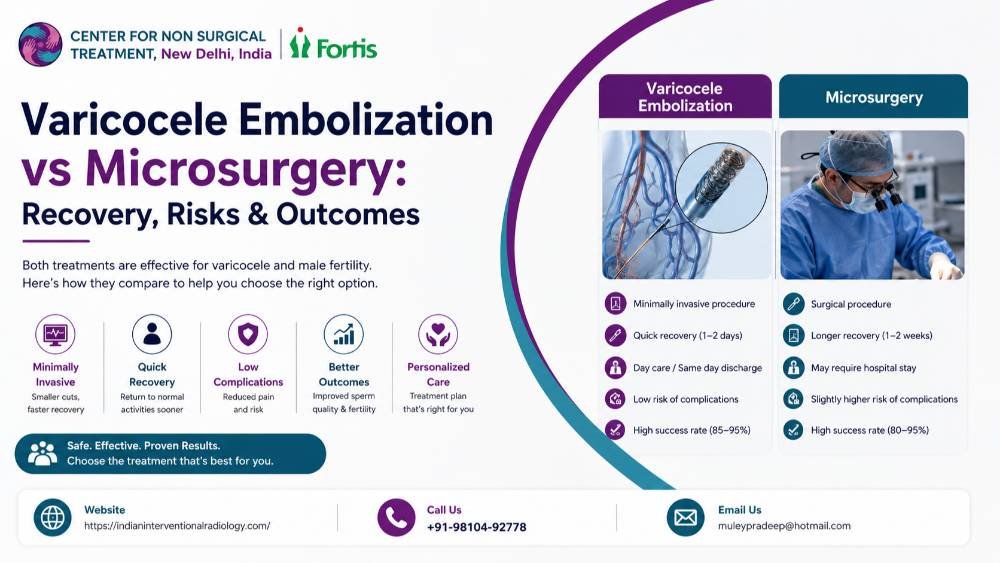
If you have been diagnosed with a varicocele, you are likely weighing your treatment options. Two of the most common and effective treatments are varicocele embolization and microsurgical varicocelectomy. Both aim to correct the same problem—dilated veins in the scrotum that can cause pain, infertility, or testicular discomfort—but they differ significantly in how they are performed, recovery time, outcomes, and overall suitability for different patients.
This guide provides a clear, evidence-based comparison to help you make an informed decision.
Why Trust This Guide?
| Trust Signal | Details |
|---|---|
| Updated for 2026 | Latest clinical guidelines and treatment evidence |
| Clinical Evidence | References to AUA/ASRM, EAU, network meta-analyses, systematic reviews |
| Specialist Reviewer | Reviewed by Dr. Pradeep Muley, Senior Consultant Interventional Radiologist |
| Evidence-Based | Includes data from 2025 network meta-analysis and systematic reviews |
| Practical Guidance | Provides clear comparisons and decision-making frameworks |
This guide is based on established clinical guidelines, peer-reviewed evidence, and practical experience in treating varicocele. It is written to help patients make informed decisions about their treatment options.
Last Reviewed: July 2026
Varicocele Embolization vs Microsurgery
Varicocele embolization and microsurgical varicocelectomy are both established treatments, but neither is universally better. For men attempting conception who have a palpable varicocele, infertility and abnormal semen parameters, AUA/ASRM guidance supports considering surgical varicocelectomy. Embolization is a minimally invasive catheter-based alternative that may be appropriate in selected patients, including some with recurrent varicocele. The choice depends on the clinical indication, varicocele characteristics, semen parameters, venous anatomy, previous treatment and patient preferences.
In Simple Terms
Choose the treatment based on the clinical situation—not simply on recovery time.
- Microsurgery: Strong guideline-supported role for appropriately selected infertile men with a palpable varicocele and abnormal semen parameters; generally low recurrence when performed by experienced surgeons.
- Embolization: Minimally invasive catheter-based option with faster recovery that may be suitable for selected patients, including some with recurrent varicocele.
- Neither: A subclinical varicocele or a varicocele in an infertile man with normal semen analysis generally should not be treated solely because it is present. The EAU guidelines provide strong recommendations against treating subclinical varicoceles or those with normal semen analysis.
Key Takeaways
- Embolization is a minimally invasive catheter-based treatment with a generally faster recovery.
- Microsurgical varicocelectomy is a surgical repair that generally has low recurrence rates when performed using microsurgical techniques by experienced surgeons.
- For men attempting conception with a palpable varicocele, infertility and abnormal semen parameters, AUA/ASRM guidance supports considering surgical varicocelectomy.
- Embolization may be appropriate for selected patients, including some with recurrent or persistent varicocele after previous surgery.
- Neither procedure is automatically right for every patient; the decision depends on symptoms, fertility goals, examination findings, anatomy and previous treatment.
- Treatment should be recommended only after appropriate clinical assessment and, when indicated, relevant investigations.
Varicocele Embolization vs Microsurgery at a Glance
| Factor | Embolization | Microsurgery |
|---|---|---|
| Treatment type | Catheter-based, minimally invasive | Microscope-assisted surgery |
| Specialist | Interventional radiologist | Urologist/andrologist trained in microsurgery |
| Skin incision | Small catheter access point | Small surgical incision |
| Anaesthesia | Local anaesthesia with sedation commonly used | Depends on surgical approach |
| Recovery | Usually faster | Usually longer |
| Recurrence | Varies by embolic material, technique and anatomy | Generally low with microsurgical techniques |
| Fertility | May improve in selected patients | Strong evidence in appropriately selected infertile men |
| Recurrent varicocele | May be useful in selected cases | Depends on previous repair and anatomy |
| Main advantage | Minimally invasive and rapid recovery | Durable surgical repair with low recurrence |
| Main limitation | Technical access can sometimes be difficult | Requires surgery and microsurgical expertise |
Embolization vs Microsurgery: Which Is Better?
There is no universally superior procedure. Microsurgical varicocelectomy has an established role for appropriately selected infertile men with a palpable varicocele and abnormal semen parameters, while embolization offers a minimally invasive alternative with faster recovery and may be useful in selected patients, including some with recurrent varicocele. The appropriate choice depends on the patient's clinical findings, fertility goals, venous anatomy and previous treatment.
A 2026 retrospective study published in BMC Urology evaluated microsurgical, laparoscopic and embolization approaches. All three groups showed postoperative improvements, but only eight patients underwent embolization, so embolization findings were reported descriptively rather than included in the primary comparative analysis. Microsurgery showed greater improvement in progressive sperm motility than laparoscopy and had a more favorable cost-effectiveness profile in that cohort. These findings should therefore not be interpreted as definitive evidence that microsurgery is superior to embolization.
Who Performs Varicocele Embolization and Microsurgery?
Varicocele embolization is performed by an interventional radiologist trained in image-guided vascular procedures. Microsurgical varicocelectomy is performed by a urologist or andrologist with appropriate microsurgical training.
Dr. Pradeep Muley is an interventional radiologist who performs image-guided minimally invasive procedures. He has performed more than 20,000 diagnostic and various interventional radiological procedures. Microsurgical varicocelectomy is performed by appropriately trained urologists or andrologists.
What Is a Varicocele?
A varicocele is an abnormal enlargement of the veins within the pampiniform plexus of the scrotum—similar to varicose veins in the legs. It occurs when the valves inside the veins don't function properly, causing blood to pool and the veins to dilate.
Varicocele is common, affecting approximately 15% of the general male population. Varicocele is reported in about 25% of men with abnormal semen analysis and approximately 35–40% of men presenting with infertility. The condition is often linked to infertility or reduced fertility and is the most common surgically reversible cause of male infertility.
Common Symptoms of Varicocele
- Dull, aching pain or a feeling of heaviness in the scrotum, especially after prolonged standing or physical activity
- Visible or palpable enlarged veins (described as feeling like a "bag of worms")
- Testicular atrophy (shrinkage of the affected testicle)
- Male infertility — varicoceles are one of the most common correctable causes of male factor infertility
- Discomfort that worsens as the day progresses
For more detailed information about the condition, visit the Varicocele treatment page.
Does Every Varicocele Need Treatment?
No. A varicocele does not automatically require treatment. Treatment decisions depend on symptoms, physical examination, fertility status, semen parameters, testicular development and the reason the varicocele was discovered.
Treatment is generally considered when there is a clinically palpable varicocele associated with infertility and abnormal semen parameters, persistent symptoms such as pain, or testicular growth problems in appropriately assessed adolescents.
A subclinical varicocele detected only on ultrasound generally does not require treatment solely because it is visible on imaging. The AUA explicitly states that clinicians should not recommend varicocelectomy for males with non-palpable varicoceles detected solely by imaging.
Who May Not Need Varicocele Treatment?
Not every varicocele requires treatment. Observation may be appropriate when the varicocele is subclinical, when an infertile man has normal semen analysis, or when there is no clinically meaningful symptom or testicular-development concern. Treatment decisions should be based on clinical examination, fertility evaluation and specialist assessment rather than ultrasound findings alone.
When Is Varicocele Treatment Recommended?
For fertility: The AUA/ASRM guideline recommends considering surgical varicocelectomy in men attempting to conceive who have a palpable varicocele, infertility and abnormal semen parameters, except men with azoospermia. This recommendation does not mean that every man with a varicocele requires treatment. The clinical indication, semen parameters, fertility history and other causes of infertility should be evaluated before intervention.
For other situations: Treatment may also be considered in selected patients with persistent varicocele-related pain or adolescent testicular growth abnormalities, based on specialist assessment and applicable clinical guidelines.
The EAU recommends against treating men with a subclinical varicocele and against varicocele repair in infertile men who have a normal semen analysis.
Treatment is generally considered when:
- A clinically palpable varicocele is present
- Infertility or difficulty conceiving is a concern
- Semen parameters are abnormal
- Other major causes of infertility have been appropriately evaluated
A varicocele found only on ultrasound without clinical findings generally should not automatically be treated.
How Is a Varicocele Diagnosed?
Diagnosis usually begins with a physical examination, including assessment while standing and during a Valsalva manoeuvre. Scrotal Doppler ultrasound may be used when the physical examination is inconclusive or when persistence or recurrence needs to be evaluated.
Varicocele Grades
| Grade | Description |
|---|---|
| Subclinical | Detected on imaging but not palpable |
| Grade 1 | Palpable during Valsalva |
| Grade 2 | Palpable at rest |
| Grade 3 | Visible and palpable at rest |
Common evaluation may include:
- Physical examination
- Scrotal Doppler ultrasound when indicated
- Semen analysis when infertility is a concern
- Testicular size assessment
- Reproductive history
- Assessment of pain and other scrotal symptoms
What Is Varicocele Embolization?
Varicocele embolization is an image-guided, minimally invasive procedure performed by an interventional radiologist. Instead of surgery, a thin catheter is inserted through a small entry point in the groin or neck and guided to the affected vein. Tiny coils or a sclerosing agent are used to block the abnormal veins, redirecting blood flow to healthier veins.
How Varicocele Embolization Works
- Preparation – You'll receive medication to help you relax and local anaesthesia at the access site.
- Catheter Insertion – The interventional radiologist makes a tiny puncture in the groin or neck and inserts a thin catheter into the vein.
- Guided Navigation – Using fluoroscopy (real-time X-ray imaging), the catheter is guided to the testicular vein.
- Embolization – Embolic agents such as coils are placed to prevent abnormal blood flow.
- Completion – The catheter is removed, and the puncture site is closed. Most patients go home the same day.
Benefits and Limitations of Embolization
Benefits:
- Minimally invasive — no conventional surgical incision; only a very small catheter access site is required
- Quick recovery — many patients can resume light daily activities within 24 hours
- Local anaesthesia with sedation is commonly used — the exact sedation or anaesthesia plan depends on the patient, procedure and treating centre
- Effective for recurrent varicocele after failed surgery
- Often performed as an outpatient procedure, with procedure duration varying according to venous anatomy, access route and technique
Limitations:
- Radiation exposure from fluoroscopy (X-ray imaging), though minimal
- Technical failure — in some cases, veins may not be accessible via catheter
- Higher recurrence rate compared to microsurgery in some studies
- Limited availability — requires skilled interventional radiologists and specialised facilities
- Pain outcomes vary between patients and studies, and the underlying cause of scrotal pain should be assessed before treatment
Evidence Summary
A systematic review of 23 retrospective and 7 prospective clinical studies with a total of 3,505 patients found that technical success rates appear to be above 90% for all embolic materials. Published recurrence rates for embolization vary substantially according to technique, embolic material and follow-up. Therefore, a single recurrence percentage should not be applied to every embolization procedure.
For those seeking varicocele embolization treatment in Delhi, Indian Interventional Radiology provides image-guided varicocele embolization under the care of an experienced interventional radiology team.
What Is Microsurgical Varicocelectomy?
Microsurgical varicocelectomy is a surgical procedure performed under a high-powered operating microscope. The surgeon makes a small incision in the groin or lower abdomen and meticulously ties off the dilated veins while preserving arteries, lymphatics, and the vas deferens.
How Microsurgical Varicocelectomy Works
- Anaesthesia – Anaesthesia varies according to the surgical approach, patient factors and treating centre.
- Incision – A small incision is made in the groin or lower abdomen.
- Microscope-assisted dissection – Under a high-powered microscope, the surgeon identifies and preserves the testicular artery and lymphatics while tying off the dilated veins.
- Closure – The incision is closed with sutures.
Benefits and Limitations of Microsurgery
Benefits:
- Low recurrence rate — microsurgical varicocelectomy is generally associated with low recurrence rates, although published rates vary according to surgical technique, surgeon experience, patient population and how recurrence is defined
- Established fertility treatment — microsurgical varicocelectomy has strong evidence for improving semen parameters in appropriately selected infertile men with a palpable varicocele
- Can provide substantial pain relief — varicocele repair can improve pain in appropriately selected patients, although outcomes vary
- Allows careful identification and preservation of the testicular artery and lymphatics, helping reduce complications such as hydrocele and arterial injury
- Long-lasting results
Limitations:
- Invasive — requires a small surgical incision
- Longer recovery time compared to embolisation
- Requires anaesthesia appropriate to surgical approach
- Technically demanding — requires specialised training and equipment
- Slightly higher complication risk compared to embolisation (though rare in expert hands)
Evidence Summary
- Recurrence/persistence: Microsurgical varicocelectomy generally has a low recurrence/persistence rate. A 2025 network meta-analysis of 13 RCTs and 24 cohort studies found that microsurgical subinguinal varicocelectomy (MSV) demonstrated the highest effectiveness in reducing postoperative recurrence rates.
- Hydrocele risk: Significantly lower with microsurgery compared to other surgical approaches.
- Pain relief: Pain relief after varicocele repair can be substantial, but outcomes vary according to patient selection and the cause of pain.
For those considering varicocele treatment in Delhi, consultation with an appropriately trained urologist or andrologist is appropriate.
Embolization vs Microsurgery: Technical Success, Recurrence & Clinical Outcomes
| Outcome | Embolization | Microsurgical Varicocelectomy |
|---|---|---|
| Technical success | Generally high, but depends on venous anatomy and technique | Generally high in experienced hands |
| Recurrence/persistence | Varies by embolic material, technique and anatomy | Generally low with microsurgical techniques |
| Recovery | Usually faster | Usually longer |
| Fertility evidence | May improve semen parameters in selected patients | Strong guideline-supported role in appropriately selected infertile men |
| Hydrocele | Generally uncommon | Low when lymphatics are preserved |
| Repeat treatment | Sometimes required | Sometimes required |
Published recurrence rates for embolization vary substantially according to technique, embolic material and follow-up. Microsurgical varicocelectomy generally has a low recurrence/persistence rate, particularly when a microsurgical subinguinal or inguinal approach is performed by an experienced surgeon, but reported rates vary between studies.
What Does "Success" Mean?
| Outcome | What it means |
|---|---|
| Technical success | The intended veins were successfully accessed and treated |
| Clinical improvement | Symptoms such as pain or heaviness improve |
| Semen improvement | One or more semen parameters improve |
| Fertility outcome | Natural or assisted conception occurs; this depends on both partners and other factors |
| Recurrence/persistence | Abnormal venous drainage remains or returns |
A technical success rate means the procedure was successfully completed. It does not mean that pain disappeared, sperm parameters improved, fertility was restored or recurrence was prevented.
Which Treatment Is Better for Fertility?
For an infertile man with a palpable varicocele and abnormal semen parameters, microsurgical varicocelectomy is a well-established treatment option and is supported by current AUA/ASRM guidance for appropriately selected patients.
Embolization can also be considered in selected patients, but current guideline recommendations and comparative evidence do not establish embolization as universally equivalent to microsurgical repair for fertility outcomes. A prospective comparative study found that microsurgical varicocelectomy was associated with better reproductive outcomes than percutaneous embolization in infertile men. The EAU currently states that microsurgical approaches appear most effective among varicocelectomy techniques, while also noting that evidence directly comparing surgical and radiological treatment remains inconclusive.
If fertility is the primary reason for treatment, the decision should be made with appropriate fertility evaluation rather than choosing a procedure solely on recovery time or reported technical success.
Which Treatment Is Better for Pain?
Pain relief after varicocele repair can be substantial, but outcomes vary according to patient selection and the cause of pain. Pain may have causes other than varicocele. Therefore, persistent scrotal pain should be evaluated carefully before intervention, particularly when pain is the only indication for treatment.
Embolization vs Microsurgery Recovery
Varicocele Embolization Recovery
- Same day: Discharged home after a few hours of observation
- Within 24 hours: Many patients can resume light daily activities, although the timing of exercise, heavy lifting and sexual activity should follow the treating team's instructions
- First week: Mild soreness, bruising, or pressure in the groin/neck typically improves within a few days
- Strenuous activity: Resume according to the treating team's instructions
Recovery instructions vary by patient and treating centre, particularly for strenuous exercise, heavy lifting and sexual activity.
Microsurgical Varicocelectomy Recovery
- First few days: Many patients can return to light or sedentary activities, depending on discomfort and their surgeon's instructions
- 1 week: Light activities can be resumed
- 1–3 weeks: Many patients return to light activities within several days, while recovery from strenuous exercise and heavier physical activity can take longer depending on the surgical approach and surgeon's instructions
- 3–6 months: Sperm quality improvement is assessed; semen analysis is generally reassessed several months after repair rather than immediately after surgery
Embolization for Recurrent Varicocele
Embolization can be considered in selected patients with persistent or recurrent varicocele after previous surgery. The best approach depends on the venous anatomy, the previous repair technique and where persistent abnormal venous drainage is identified.
Evidence for recurrent or persistent varicocele is less robust than for first-line treatment, so the choice of repeat intervention should be individualized according to venous anatomy and the previous treatment.
Which Varicocele Treatment May Be Considered?
Palpable varicocele?
- No → Usually no treatment solely because ultrasound shows a varicocele.
- Yes → Continue evaluation.
Infertility + abnormal semen parameters?
- Yes → Discuss varicocele repair; microsurgical repair has strong guideline-supported use.
- No → Continue evaluation.
Persistent pain attributable to varicocele?
- Yes → Specialist assessment before intervention.
Previous varicocele surgery with recurrence/persistence?
- Yes → Embolization may be considered depending on venous anatomy and previous repair.
Risks and Possible Complications
Both treatments are generally safe, but like any medical procedure, they carry some risks:
Embolization risks:
- Radiation exposure (minimal)
- Technical failure (veins may not be accessible)
- Allergic reaction to contrast dye
- Bleeding or infection at the access site
- Recurrence (varies by technique and study)
Microsurgery risks:
- Infection
- Bleeding
- Hydrocele formation (fluid collection around the testicle)
- Testicular atrophy (rare)
- Recurrence (generally low with microsurgical techniques)
A 2025 systematic review and meta-analysis found that sclero-embolization was associated with fewer overall complications and a lower hydrocele rate than surgical ligation, but recurrence was higher. These findings highlight the trade-off between minimally invasive treatment and durability and should not be generalized to every embolization or microsurgical technique.
Varicocele Embolization in Delhi: When to Consider It
Patients considering varicocele treatment in Delhi should first undergo a clinical assessment to determine whether treatment is necessary and which approach is appropriate.
Depending on the clinical situation, evaluation may include:
- Physical examination
- Varicocele grading
- Scrotal Doppler ultrasound when indicated
- Semen analysis when fertility is a concern
- Review of previous varicocele treatment
- Assessment of pain and reproductive goals
For patients travelling to Delhi for treatment, it is useful to bring previous ultrasound reports, semen analysis results, treatment records and medication information to the consultation.
What the Evidence Does—and Does Not—Tell Us
Studies comparing varicocele embolization and surgery use different patient populations, embolization materials, surgical techniques and follow-up periods. As a result, recurrence, pain and fertility outcomes cannot be reduced to a single success rate that applies to every patient. Guideline recommendations and individual clinical assessment remain important when choosing treatment.
A technical success rate means the procedure was successfully completed. It does not mean that pain disappeared, sperm parameters improved, fertility was restored or recurrence was prevented.
Evidence comparing embolization specifically with microsurgical varicocelectomy is more limited than evidence comparing different surgical techniques. Large prospective randomized controlled trials directly comparing embolization with microsurgical varicocelectomy are lacking.
What to Bring to a Varicocele Consultation in Delhi
Bring:
- Previous scrotal ultrasound/Doppler reports
- Recent semen analysis, if performed
- Previous varicocele treatment records
- Fertility evaluation reports
- Current medication list
- Details of previous surgeries
- A list of your symptoms and how long you've had them
About Dr. Pradeep Muley
Dr. Pradeep Muley is a Senior Consultant Interventional Radiologist in New Delhi with extensive experience in image-guided minimally invasive procedures. He is associated with Fortis Hospital, Vasant Kunj, New Delhi, and has performed more than 20,000 diagnostic and interventional radiological procedures.
Specialty: Interventional Radiology
Location: New Delhi
Hospital association: Fortis Hospital, Vasant Kunj
Clinical focus: Image-guided minimally invasive procedures
Experience: More than 20,000 diagnostic and interventional radiological procedures
A specialist consultation can help determine whether varicocele treatment is necessary and, if so, whether embolization is appropriate based on the patient's clinical findings and venous anatomy.
Contact Dr. Pradeep Muley to schedule a consultation and explore your treatment options. You can also schedule a consultancy for a professional evaluation.
Questions to Ask Your Specialist
- Is my varicocele clinically palpable?
- What grade is my varicocele?
- Do I actually need treatment?
- Is my pain definitely caused by the varicocele?
- Is my semen analysis abnormal?
- What does my Doppler ultrasound show?
- Am I a better candidate for embolization or microsurgery?
- What is the expected recurrence risk with the recommended approach?
- How long should I wait before repeating semen analysis?
- What happens if the varicocele recurs?
- How many procedures of this type does the specialist perform?
- What complications should I specifically consider in my case?
Discuss Your Varicocele Treatment Options
If you have been diagnosed with a varicocele and are unsure whether embolization or microsurgical repair is appropriate, discuss your examination findings, imaging, semen analysis and treatment goals with an appropriately trained specialist.
Schedule a Varicocele Consultation
Frequently Asked Questions (FAQs)
1. What is the difference between varicocele embolization and microsurgery?
Embolization is a minimally invasive catheter-based procedure performed by an interventional radiologist through a small entry point in the groin or neck. Microsurgery is a surgical procedure performed under a microscope through a small incision in the groin to tie off the dilated veins.
2. Which treatment has a higher success rate?
Microsurgical varicocelectomy generally has lower recurrence rates than embolization. A 2025 network meta-analysis found that microsurgical subinguinal varicocelectomy demonstrated the highest effectiveness in reducing postoperative recurrence rates.
3. How long does recovery take for each procedure?
Embolization recovery is quick — many patients can resume light daily activities within 24 hours. Microsurgery recovery varies: many patients return to light activities within several days, while recovery from strenuous exercise and heavier physical activity can take longer depending on the surgical approach and surgeon's instructions.
4. Which treatment is better for fertility improvement?
For men attempting conception who have a palpable varicocele, infertility and abnormal semen parameters, surgical varicocelectomy is specifically supported by the AUA/ASRM guideline. Embolization may also improve semen parameters in selected patients, but comparative fertility evidence varies between studies.
5. Is varicocele embolization painful?
Local anaesthesia and, commonly, sedation are used to improve comfort during embolization. You may feel pressure or brief discomfort during catheter placement, while soreness or scrotal discomfort can occur afterward.
6. Can varicoceles come back after treatment?
Yes, recurrence is possible with both treatments. Microsurgery generally has low recurrence rates when performed by experienced surgeons. Embolization recurrence varies by technique, embolic material and study.
7. Is embolization safe?
Varicocele embolization is generally considered a safe minimally invasive procedure when performed by an appropriately trained specialist, but it still carries risks such as bleeding, infection, contrast reaction, vascular injury and technical failure. Serious complications are uncommon.
8. How does pain relief compare between the two treatments?
Pain relief after varicocele repair can be substantial, but outcomes vary according to patient selection and the cause of pain. Persistent scrotal pain should be evaluated carefully before intervention.
9. How quickly do sperm parameters improve after treatment?
Sperm quality improvements are typically seen after 3–6 months. Semen analysis is usually repeated at this interval to assess the effectiveness of treatment.
10. Which treatment is right for me?
The best treatment depends on your individual condition, symptoms, fertility goals, and personal preferences. Consult with a specialist to discuss your options.
11. Does every varicocele need treatment?
No. Treatment depends on symptoms, clinical findings, fertility status, semen parameters and other patient-specific factors. A subclinical varicocele detected only on ultrasound generally does not require treatment.
12. Is embolization considered surgery?
No. It is generally classified as a minimally invasive catheter-based procedure rather than conventional open surgery, although it is still an invasive medical procedure.
13. Can I have embolization after failed varicocele surgery?
Yes, embolization may be an option for selected patients with persistent or recurrent varicocele after surgery, depending on venous anatomy and previous treatment.
14. Does varicocele embolization improve sperm quality?
It may. Studies report improvements in sperm concentration and motility after embolization, but fertility outcomes vary and should not be guaranteed.
15. Is varicocele embolization safer than microsurgery?
Both procedures have established safety profiles, but their risks differ. A 2025 meta-analysis found that sclero-embolization had lower overall complication rates and significantly reduced incidence of hydrocele compared to surgical ligation, but recurrence was higher.
16. Can varicocele embolization affect fertility?
Varicocele embolization is intended to treat abnormal venous blood flow and may improve semen parameters in selected men. Current evidence reports improvements in sperm concentration and motility after embolization, but fertility outcomes vary.
17. Can varicocele embolization fail?
Yes. Technical failure or persistent varicocele can occur when the abnormal veins cannot be successfully accessed or completely treated. Recurrence or persistence depends on venous anatomy, the embolization technique and the embolic material used.
18. What happens if a varicocele recurs after treatment?
If a varicocele recurs after embolization or surgery, repeat treatment may be considered. The choice of intervention depends on venous anatomy, previous procedure, symptoms and fertility status.
19. Can adolescents with varicocele be treated?
Treatment in adolescents may be considered in selected cases with testicular growth abnormalities or pain, but this should be determined by a specialist with appropriate paediatric/adolescent experience.
Conclusion
Varicocele embolization and microsurgical varicocelectomy are both established treatment options, but the right choice depends on why treatment is needed and the patient's clinical findings.
Microsurgical varicocelectomy generally offers very low recurrence and complication rates and has strong evidence for improving semen parameters in appropriately selected infertile men with a clinical varicocele.
Varicocele embolization is a minimally invasive alternative that avoids a conventional surgical incision and usually allows faster recovery. It may be particularly useful for selected patients who prefer a catheter-based treatment or those with recurrent varicocele after previous surgery.
Before choosing either treatment, discuss your physical examination findings, semen analysis, symptoms, imaging, fertility goals and previous treatment with an appropriately trained specialist.
If you are considering varicocele embolization in Delhi, a specialist consultation can help determine whether embolization is appropriate for your individual condition.
About Dr. Pradeep Muley
Dr. Pradeep Muley is a Senior Consultant Interventional Radiologist in New Delhi with extensive experience in image-guided minimally invasive procedures. He is a Senior Consultant in Interventional Radiology at Fortis Hospital, Vasant Kunj, New Delhi, offering consultation for varicocele, uterine fibroids, adenomyosis, and other conditions.
Contact Dr. Pradeep Muley to schedule a consultation and explore your treatment options.
Medical Disclaimer
This article provides general educational information and does not replace a medical examination, diagnosis or individualized treatment plan. Varicocele treatment should be recommended only after appropriate clinical assessment and, when indicated, relevant investigations.