
Can we talk honestly for a minute?
I know why you are here. Maybe you have been dealing with periods that just keep getting heavier. Maybe you feel a constant pressure down below that never quite goes away. Maybe you have been trying to start a family, and month after month, nothing happens. Or maybe you just found out you have fibroids and now you are scared, not knowing what comes next.
I want you to know something right from the start. Whatever you are feeling right now, it is valid. And you are not alone in this.
My name is Dr Pradeep Muley. For over thirty years, I have sat across from thousands of women right here in Delhi who walked into my clinic carrying the exact same fears you might be carrying right now. Fear of what is growing inside them. Fear of surgery. Fear of losing their ability to have children. Fear of the unknown.
Today, I want to talk to you like one human being to another. No fancy medical words. No trying to impress you. Just real talk about fibroids, about a surgery called myomectomy, about the doctors who can help, about what it actually costs, and about another way that might let you avoid surgery altogether.
Let Me Explain What Is Happening Inside You
Think of your uterus like a small room inside your body. Now imagine little growths, like small knots of muscle, starting to form in the walls of that room. Sometimes they grow on the inside, taking up space where something else might need to be. Sometimes they grow on the outside, pressing on things around them. Sometimes they grow right in the middle of the wall itself.
These growths are called fibroids. Here is the first thing that should give you some peace. They are almost never cancer. In all my years, I have seen thousands of them, and the vast majority are completely benign. They are just muscle cells that decided to grow when they should not have.
But here is the thing. Even though they are not cancer, they can make your life absolutely miserable. When they grow in certain places, they press on your bladder, making you feel like you need to pee all the time. They press on your bowel, causing constipation and discomfort. They make your periods so heavy that you become tired and weak from losing too much blood. They can make it harder to get pregnant because they change the shape of that room where a baby needs to grow.
Some women have fibroids and never know it. But if you are here, reading this, my guess is you know something is not right.
What Does Myomectomy Actually Mean
Let me break this down in plain language.
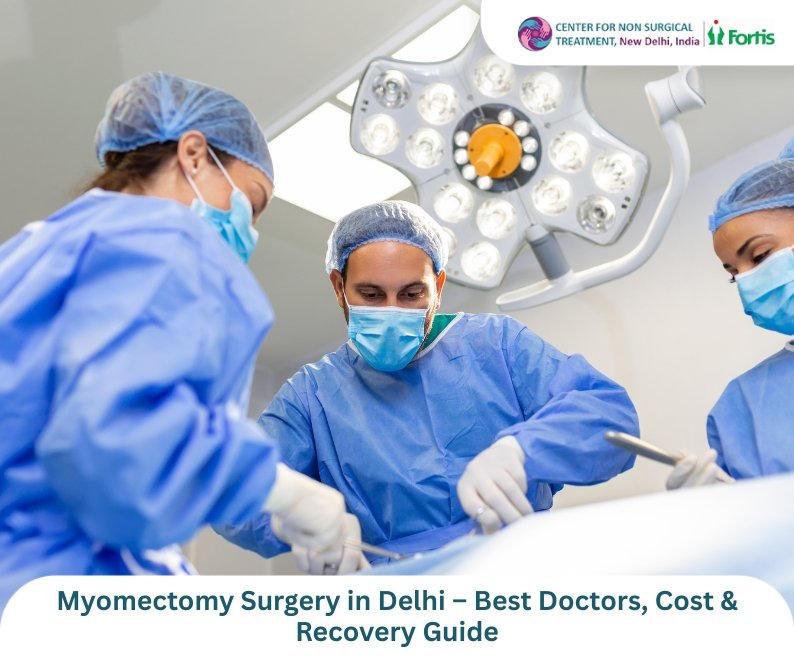
Myomectomy is a surgery where a doctor goes in and takes out the fibroids but leaves your uterus right where it is. This is different from hysterectomy, where they take the whole uterus out. For women who want to have children someday, or for women who just do not want to lose an organ that has been part of them their whole lives, this matters a lot.
There is not just one way to do this. The way the doctor goes in depends entirely on where your fibroids are hiding.
|
Type of Surgery |
How They Do It |
When It Makes Sense |
|
Hysteroscopic |
They go through your vagina, no cuts on your belly at all |
When fibroids are inside the cavity, hanging out where they do not belong |
|
Laparoscopic |
They make a few small cuts on your belly, put in a camera and tools |
When fibroids are on the outside or buried in the wall |
|
Open (Laparotomy) |
They make one larger cut on your lower belly |
When fibroids are really big or there are too many to handle through small cuts |
Each way has its place. A good doctor will not just do whatever they are most comfortable with. They will look at your scans, look at your body, and figure out what actually makes sense for you.
Finding A Doctor Who Will Actually Listen
I know what it feels like to search for a doctor in this city. You open your phone, type something into Google, and suddenly there are a hundred names staring back at you. Everyone has a fancy website. Everyone claims to be the best. Everyone has five-star reviews that may or may not be real.
How do you know who will actually sit with you, look you in the eye, and treat you like a human being?
Let me tell you about some doctors that women I know have trusted over the years. Women who came to me first for advice on who to see. Women who came back later and said, "Thank you, that doctor was wonderful."
Dr Shweta Raje at Fortis La Femme. Women tell me she is patient. She does not rush. She explains things in a way that makes sense. She does a lot of laparoscopic work, which means smaller cuts and faster healing for many women. If you want someone who will take time with you, she is worth considering.
Dr Anita Gupta at Sir Ganga Ram. This woman has been doing this work for over thirty-five years. That kind of experience means she has seen just about everything. Women say she is calm, steady, and does not get flustered. When you are nervous, that steadiness helps.
Dr Aruna Kalra at CK Birla in Gurgaon. She focuses a lot on women who want to have babies after surgery. If fertility is your main worry, if every decision you make is colored by the hope of holding a baby someday, she is someone who understands that deeply.
Dr Neha Bansal at Max Saket. She does robotic surgery, which is like laparoscopic but with even more precision. Women who have seen her say she is kind, she listens, and she does not make you feel like just another patient.
Dr Tanvi Gaba at PSRI. She handles a lot of complex cases. Women who have been told their fibroids are too difficult often end up with her. They say she is thorough and does not give up easily.
These are real doctors, practicing in real hospitals in Delhi. They are not perfect for everyone, but they are names that come up again and again when women talk about who helped them through a hard time.
Let Us Talk About Money, Honestly
I am not going to dance around this. You need to know what this costs, and there is no shame in asking.
For laparoscopic surgery, where they make small cuts, you are usually looking at somewhere between eighty thousand and one lakh eighty thousand rupees. That is a wide range because it depends on how many fibroids you have, how big they are, which hospital you choose, and how long you stay.
For open surgery, where they make one larger cut, it might be a bit less. Maybe seventy thousand to one lakh fifty thousand. But you pay for that lower cost with longer recovery time.
For hysteroscopic surgery, where there are no cuts at all, it is usually between fifty thousand and ninety thousand rupees.
If you end up needing robotic surgery, which is the most advanced, it can go up to three lakh fifty thousand or more. That is a lot of money, and you need to know that going in.
Here is something important that might give you some relief. Most health insurance companies will cover this if your doctor says it is medically necessary. If you are bleeding so heavy you cannot function, if you are in pain every day, that counts. The hospital staff deals with insurance paperwork every single day. They will help you. Do not let fear of money stop you from finding out what help is available.
What Recovery Actually Feels Like, Not What They Show In Brochures
I am not going to tell you this is easy, because it is not. But you deserve to know the truth so you can prepare.
If you have laparoscopic surgery, you will probably stay in the hospital one or two nights. When you get home, the first few days are rough. You are sore. Moving around helps, but you cannot do too much. Getting up from the couch, going to the bathroom, making a cup of tea, that is about your speed for the first week.
Most women can go back to a desk job after about two weeks. But feeling completely normal, like you could run or lift things or go to the gym, that takes about a month. Be patient with yourself.
If you have open surgery, it is harder. You stay in the hospital longer, maybe three or four days. At home, you need help. You cannot lift anything heavy, not even a bag of groceries, for weeks. Most women need a good six weeks before they feel like themselves again. Six weeks is a long time. You need to plan for it.
If you have hysteroscopic surgery, you might go home the same day. Recovery is quick. A few days of taking it easy and you are back. This is the easiest path, but it only works if your fibroids are in the right place.
Your body went through something major. Give it time. Do not rush. Do not listen to anyone who tells you to just get over it.
There Is Another Way, And I Want You To Know About It
Here is something I wish more women knew. Surgery is not your only option. It is not even necessarily your best option.
For over thirty years now, I have been doing a procedure called Uterine Fibroid Embolization. It is not surgery. There is no cutting. There are no stitches. There is no scar.
Here is how it works, in the simplest terms. I make a tiny puncture in your groin, so small you can barely see it after it heals. Through that little spot, I thread a thin tube into the arteries that are feeding your fibroids. I inject tiny particles that block those arteries. Without blood, the fibroids cannot survive. They starve. They shrink.
That is it. You stay in the hospital one night. You go home the next day. Most women are back to their normal lives within a week.
I have done this for over five thousand women. The success rate is high. The relief is real. And you keep your uterus, just like with myomectomy.
For some women, especially those with many fibroids or very large ones, this is a better path. For others, surgery makes more sense. The important thing is knowing you have a choice. Nobody should tell you there is only one way.
Stories From Real Women, Because Numbers Do Not Tell The Whole Story
I am not going to give you a bunch of statistics. I want you to hear what real women have said. Not because of me, but because it might help you understand what is possible.
There was a woman from South Delhi, a school teacher, who came to me with fibroids so large she looked several months pregnant. She was terrified of surgery. She was a teacher and could not afford weeks off work. Her students needed her. We did embolization on a Friday. She was back in her classroom on Monday. Three months later, her belly was flat and her periods were normal. She sent me a photo of herself standing in front of her class, smiling.
Another woman from Gurgaon came to me in tears. She was in her early thirties and had been told she needed a hysterectomy. That meant no children, ever. She was devastated. After embolization, her fibroids shrank enough that she could try for pregnancy. Today, she has a daughter. She sends me pictures every year on the girl's birthday.
A woman flew all the way from Iraq to see me. She had been told surgery was her only option. She had a small child at home and could not be away for weeks. We did embolization. She stayed two days and flew home. She sent me a message later saying she felt better than she had in years and was finally able to play with her child without pain.
These are real stories. Real women. Real relief. They are not exceptions. They are what happens when women get the right information and make the choice that fits their lives.
Questions Women Ask Me, Answered Honestly
1. Can you just tell me what myomectomy is, in plain words?
It is surgery to take out the fibroids while leaving your uterus right where it is. The doctor cuts the fibroids out, sews your uterus back together, and you keep all your parts.
2. Who are the best myomectomy doctors in Delhi?
Dr Shweta Raje at Fortis, Dr Anita Gupta at Sir Ganga Ram, Dr Aruna Kalra at CK Birla, and Dr Neha Bansal at Max are all names that come up again and again. The right one for you depends on your situation and where you feel comfortable.
3. How much does myomectomy surgery in Delhi cost?
For laparoscopic surgery, expect somewhere between eighty thousand and one lakh eighty thousand rupees. For open surgery, seventy thousand to one lakh fifty thousand. For hysteroscopic, fifty thousand to ninety thousand. The exact number depends on your case.
4. Will my insurance pay for this?
Yes, in most cases. If your fibroids are causing heavy bleeding or pain, insurance companies consider that medical need. The hospital staff will help you with the paperwork. Do not let insurance fears stop you.
5. Can I still have a baby after myomectomy?
That is the whole point for many women. Yes, you can. The surgery removes the fibroids that might be blocking the way. Many women go on to have healthy pregnancies.
6. How long until I feel normal again?
If you have laparoscopic surgery, give yourself a month. If you have open surgery, plan on six weeks. If you have hysteroscopic, just a few days. Listen to your body, not the calendar.
7. Is there any way to avoid surgery completely?
Yes. Uterine Fibroid Embolization is a non-surgical option I have been doing for over thirty years. It blocks the blood supply to fibroids so they shrink. Recovery is much faster and there are no cuts.
8. Will the fibroids grow back after surgery?
New ones can develop over time because your body has a tendency to make them. But the ones removed are gone. Regular checkups help catch any new ones early.
9. How do I choose between surgery and embolization?
That depends on your fibroids, whether you want children, and what feels right to you. Talk to both a surgeon and someone who does embolization. Get both sides before you decide.
10. What if I live in another city?
Many women come from outside Delhi. For surgery, plan to stay about one to two weeks total. For embolization, three to four days is usually enough.
11. Does this surgery hurt?
You are asleep during the surgery, so you feel nothing. Afterward, yes, there is pain. But medication helps. Laparoscopic surgery generally hurts less than open surgery.
12. How do I know which type of surgery I need?
Your doctor will do an ultrasound or MRI to see exactly where your fibroids are. That tells them which approach makes sense.
13. What if my fibroids are really big?
Skilled surgeons can remove quite large ones through small cuts, but if they are very large or there are many, open surgery might be safer. Do not let anyone push you into something you are not comfortable with.
14. How many days in the hospital?
Laparoscopic surgery usually means one or two nights. Open surgery means two to four nights. Hysteroscopic often means you go home the same day.
15. How do I book an appointment with you?
You can find me at Fortis Hospital in Vasant Kunj or at Indian Interventional Radiology. A quick search online will give you the number. My team will help you find a time that works.
A Few Last Words, From My Heart To Yours
I have been doing this work for over thirty years. That is a long time. Long enough to see patterns. Long enough to know that women suffer in silence way too often. Long enough to know that fear keeps people from getting help when help is right there.
I have seen thousands of women walk through my door with the same worries you probably have right now. Scared of what might be growing inside them. Scared of pain. Scared of losing something important. Scared of never having the family they dream of.
And I have seen the same women walk out after treatment with relief written all over their faces. Not just because their symptoms are gone. But because they finally did something. They stopped accepting that this was just how life had to be. They took control.
If your body is telling you something is wrong, please listen to it. Do not push it aside. Do not tell yourself this is normal. Do not wait until it gets worse.
There is help here. There are choices. There are doctors who will listen and care, not just rush you through.
Whether you choose myomectomy for fibroids surgery in delhi with one of the fine myomectomy doctors in delhi I mentioned, or whether you want to explore non-surgical options with me, the most important step is the first one.
Pick up the phone. Book that appointment. Come in and talk. Just talk. No pressure. No decisions required.
You deserve to feel better. You deserve to live without pain and worry hanging over you every single day. And with the right help, you absolutely can.