
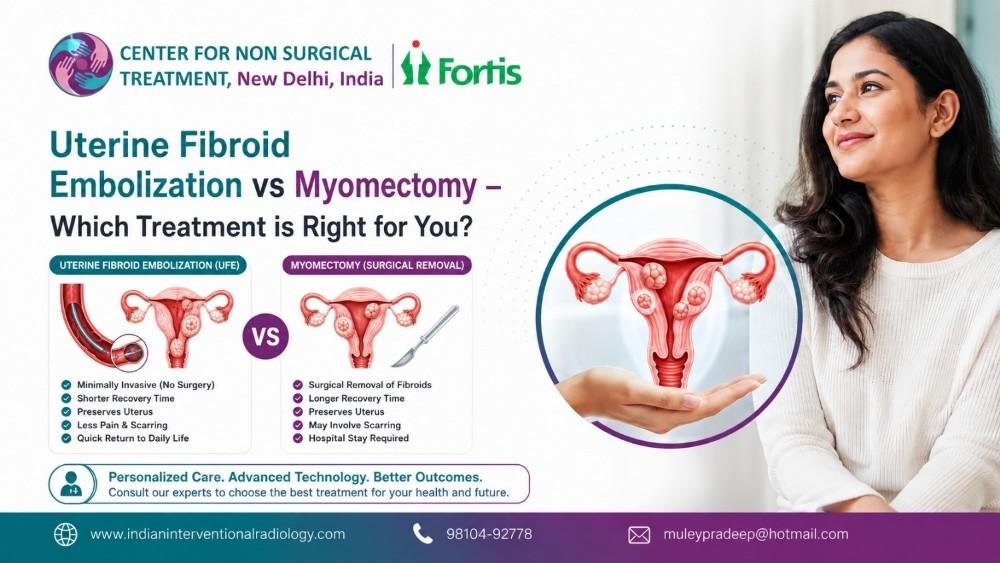
Uterine fibroids are one of the most common health concerns affecting women today. If you have been diagnosed with fibroids, you have probably experienced heavy bleeding, pelvic pain, or a constant feeling of pressure. These symptoms can disrupt your daily life, affect your work, and even impact your ability to plan a family.
The good news is that you have options. Two of the most effective treatments for uterine fibroids are Uterine Fibroid Embolization (UFE) and Myomectomy. Both procedures preserve the uterus, but they work very differently.
If you are searching for uterine fibroid embolization treatment in Delhi or myomectomy surgery in Delhi , this guide will help you understand the differences between these two approaches. By the end, you will know exactly what to expect from each procedure and how to make an informed decision with the help of a trusted specialist like Dr. Pradeep Muley .
What Are Uterine Fibroids?
Uterine fibroids, also known as myomas, leiomyomas, or fibromyomas, are non-cancerous growths that develop in or around the uterus. They are the most common tumours found in the female reproductive system. Around 20 to 40 percent of women in their childbearing years have fibroids.
Fibroids vary greatly in size. Some are as small as a pea, while others can grow as large as an orange or even bigger. In some cases, they can cause the uterus to enlarge to the size of a five-month pregnancy. Women between the ages of 30 and 50 are most prone to developing them.
Being overweight or obese further increases the likelihood of fibroids compared to women with a healthy body weight.
Types of Uterine Fibroids
Fibroids are named according to their location within the uterus:
| Type | Location | Common Symptoms |
|---|---|---|
| Intramural Fibroids | Within the wall of the uterus | Heavy bleeding with clots; may cause no symptoms if small |
| Subserosal Fibroids | On the outer surface of the uterus | Pressure on bladder and rectum; frequent urination; constipation; lower back pain |
| Submucosal Fibroids | Just below the uterine lining, extending into the cavity | Heavy bleeding; fertility difficulties even with small growths |
| Cervical Fibroids | In the wall of the cervix | Infertility; pain; bleeding; problems during vaginal delivery |
Symptoms of Uterine Fibroids
Not all women with fibroids experience symptoms. However, when symptoms do appear, they can be severe:
- Heavy, prolonged menstrual periods with clots that can lead to anaemia
- Lower abdomen, back, or leg pain
- Lower abdominal pressure or heaviness
- Frequent urination due to bladder pressure
- Constipation and bloating from pressure on the bowel
- Abnormally enlarged abdomen
- Pain during intercourse
- Problems with conceiving or pregnancy
Why Early Treatment Matters
Early diagnosis helps prevent complications, reduces symptoms, and improves quality of life with minimally invasive treatment options. If left untreated, fibroids can lead to anaemia from heavy bleeding, urinary tract infections, and fertility problems.
Two Uterus-Preserving Treatment Options
Both Uterine Fibroid Embolization (UFE) and Myomectomy preserve the uterus. This makes them excellent choices for women who want to avoid hysterectomy.
However, they are very different procedures. Let us look at each one in detail.
1. Uterine Fibroid Embolization (UFE)
Uterine Fibroid Embolization is a minimally invasive, non-surgical procedure performed by an interventional radiologist. It works by blocking the blood supply to the fibroids, causing them to shrink naturally over time.
How UFE Works
The procedure involves three main steps:
- A small catheter is inserted into an artery, typically in the wrist or the groin
- Microscopic particles are delivered through the catheter to the vessels that feed the fibroids
- Blood flow to the fibroids is blocked, causing them to shrink
The uterus remains intact throughout the procedure. Dr. Pradeep Muley is a pioneer in Uterine Fibroid Embolization, offering a non-surgical alternative to myomectomy that shrinks fibroids without cutting.
Benefits of UFE
UFE offers several compelling advantages:
- Non-surgical – no incisions, no cuts
- No removal of the uterus – the uterus is preserved
- Short hospital stay – often just one day
- Faster recovery compared to surgery
- Significant reduction in pain and bleeding
- Preserves future treatment options
- No general anaesthesia and no surgical scar
- Treats all fibroids in one treatment
Success Rates
UFE has an excellent track record. The technical success rate is very high, exceeding 95 percent. Approximately nine out of ten patients who undergo UFE experience significant improvement, or their symptoms go away completely.
The procedure leads to a measurable elimination of abnormal uterine bleeding in over 90 percent of treated women, with an 80 to 90 percent satisfaction rate. UFE has comparable long-term outcomes to more invasive procedures like myomectomy, with the advantage of a speedier recovery.
Recovery from UFE
Recovery from UFE is relatively quick. Most patients can return to normal activities within a week to ten days. Some sources note that full recovery can take two to three months, during which time the benefits of the procedure become increasingly clear.
Considerations
- Some women experience cramping and pain for a few days after the procedure
- Your first period after the procedure may be heavier or more uncomfortable than usual
- Pregnancy after UFE is possible, but there is less evidence compared to myomectomy
2. Myomectomy
Myomectomy is a surgical procedure that removes uterine fibroids while leaving the uterus in place. Unlike hysterectomy, myomectomy does not remove the uterus, making it a preferred choice for women who want to preserve fertility.
When Is Myomectomy Advised?
Myomectomy is typically recommended when fibroids:
- Cause excessive or long-term menstrual bleeding
- Cause pelvic pain or pressure
- Affect fertility or pregnancy
- Grow at a rapid pace or become symptomatic
- Do not respond to medication
The nature of myomectomy depends on the size, quantity, and location of fibroids, coupled with the patient's overall health and reproductive aspirations.
Types of Myomectomy
There are two main approaches to myomectomy:
Laparoscopic Myomectomy
This is a minimally invasive procedure performed through small incisions in the abdomen using a camera and specialised instruments.
Advantages of Laparoscopic Myomectomy:
- Less extensive injuries and scarring
- Reduced blood loss
- Shorter hospital stay
- Rapid healing compared to open surgery
- Less post-operative pain
This is the best method for women with moderate-sized fibroids.
Open (Abdominal) Myomectomy
An open surgical procedure may be necessary when fibroids are very large, numerous, or deep-seated. This procedure allows the surgeon to access the uterus directly and remove the fibroids completely.
Although recovery takes longer compared to laparoscopic surgery, open myomectomy remains a safe alternative when clinically necessary.
Success Rates and Recurrence
Myomectomy is highly effective at relieving symptoms. However, fibroids can regrow, or new ones can form. The recurrence rate for myomectomy is estimated at 10 to 27 percent. Recurrence depends more on your body's tendency to form fibroids rather than the method of removal.
Recovery from Myomectomy
Recovery time depends on the type of procedure:
- Laparoscopic myomectomy: Faster recovery, less pain, shorter hospital stay
- Open myomectomy: Longer recovery, more pain, bigger scar
Comparison Table: UFE vs Myomectomy
| Feature | Uterine Fibroid Embolization (UFE) | Myomectomy |
|---|---|---|
| Procedure Type | Non-surgical, minimally invasive | Surgical (laparoscopic or open) |
| How It Works | Blocks blood supply to fibroids, causing them to shrink | Physically removes fibroids from the uterus |
| Incision | No incisions | Small incisions (laparoscopic) or large incision (open) |
| Anaesthesia | Local anaesthesia, no general anaesthesia | General anaesthesia |
| Hospital Stay | Usually 1 day | 1-3 days (laparoscopic) or longer (open) |
| Recovery Time | 1-2 weeks | 2-6 weeks depending on type |
| Return to Normal Activities | 1-2 weeks | 2-6 weeks |
| Fibroid Recurrence | Lower recurrence rate | 10-27% recurrence rate |
| Fertility | Possible but less evidence | Preferred for women planning pregnancy |
| Treats | All fibroids in one treatment | Individual fibroids removed |
| Scarring | None | Small scars or larger scar |
Which Treatment is Right for You?
Choosing between UFE and Myomectomy depends on several personal factors. Here are some general guidelines:
Choose UFE If:
- You want a non-surgical, minimally invasive option
- You want to avoid general anaesthesia and surgical incisions
- You want a faster recovery and shorter hospital stay
- You have multiple fibroids that would be difficult to remove surgically
- You are not planning a pregnancy in the near future (though pregnancy is possible)
- You want to treat all fibroids in one procedure
Choose Myomectomy If:
- You are planning a pregnancy and want the most established fertility-preserving option
- You have a single, large fibroid that can be easily removed
- You prefer to have the fibroids physically removed rather than shrunk
- You are comfortable with surgery and the associated recovery time
- You want the lowest risk of needing another procedure
The Best Approach
Dr. Pradeep Muley believes in informed and balanced treatment planning. Patients considering myomectomy are also screened for the possibility of non-surgical options like UFE. The right choice depends on your specific condition, symptoms, age, and future fertility goals.
At Indian Interventional Radiology , the team works closely with expert gynaecologists to ensure the most appropriate care, whether through embolization or surgical intervention.
Why Choose Dr. Pradeep Muley for Fibroid Treatment in Delhi?
When it comes to uterine fibroid embolization treatment in Delhi or myomectomy surgery in Delhi , choosing the right doctor is crucial. Dr. Pradeep Muley is a highly experienced Senior Consultant Interventional Radiologist with an outstanding reputation.
Pioneer in Uterine Fibroid Embolization
Dr. Pradeep Muley is a pioneer in Uterine Fibroid Embolization (UFE) , offering a non-surgical alternative to myomectomy that shrinks fibroids without cutting. He has performed more than 20,000 diagnostic and interventional radiological procedures and has helped over 2,350,000 happy patients.
Unmatched Qualifications
Dr. Pradeep Muley's academic qualifications include:
- Fellow Interventional Radiology, Singapore General Hospital, Singapore
- Visiting Associate, Neurointerventional Radiology, Iowa University Hospitals, USA
- Visiting Fellow, Neurointerventional Radiology, Johns Hopkins Medical Institutions, USA
- Lecturer, Vascular & Interventional Radiology, KEM Hospital, Mumbai, India
- Neuroradiology, All India Institute of Medical Sciences (AIIMS), New Delhi, India
- Consultant Interventional Radiologist, KIMS Hospital, Trivandrum, Kerala, India
Advanced Technology and Facilities
The Department of Interventional Radiology, established by Dr. Pradeep Muley, is specifically designed with two well-equipped and modern Cath-labs for all diagnostic and interventional procedures. He is assisted by a team of trained nurses and practicing radiologists and personally participates in all interventional procedures.
Patient-Centric Care
At Indian Interventional Radiology , the focus is on providing safe, effective, and long-term relief. The team offers customized therapies and treatments based on fibroid size, location, symptoms, age, and future fertility goals.
You can schedule a consultation or contact us to begin your journey toward relief.
Frequently Asked Questions (FAQs)
1. What is the main difference between UFE and Myomectomy?
UFE is a non-surgical procedure that blocks blood supply to fibroids, causing them to shrink. Myomectomy is a surgical procedure that physically removes fibroids from the uterus. Both preserve the uterus, but UFE has no incisions and a faster recovery.
2. Which treatment is better for fertility – UFE or Myomectomy?
Myomectomy is generally considered the preferred option for women planning a future pregnancy. While pregnancy after UFE is possible, there is less evidence available. Studies show that pregnancy rates are similar between UFE and myomectomy, though there may be a trend toward delayed time to pregnancy following UFE.
3. How long does recovery take after UFE?
Most patients can return to normal activities within one to two weeks. Full recovery typically takes about two to three months, during which time the benefits of the procedure become increasingly clear.
4. How long does recovery take after Myomectomy?
Recovery depends on the type of procedure. Laparoscopic myomectomy offers faster recovery with less pain. Open myomectomy requires a longer recovery with more pain and a bigger scar.
5. Do fibroids come back after treatment?
Fibroids can regrow or new ones can form after both treatments. However, UFE has a lower recurrence rate compared to myomectomy. Myomectomy has a recurrence rate of 10 to 27 percent. Recurrence depends more on your body's tendency to form fibroids rather than the treatment method.
6. Is UFE painful?
UFE is performed under local anaesthesia, so you will not feel pain during the procedure. After the procedure, some women experience cramping and pain for a few days, which is managed with medication.
7. Does UFE require a hospital stay?
UFE usually requires a hospital stay of just one day. Many patients go home the next day.
8. Can I get pregnant after UFE?
Yes, pregnancy after UFE is possible. However, there is insufficient evidence to advocate for UFE over myomectomy for women who want to preserve fertility. Healthy pregnancies following UFE have been reported, but the actual fertility rate remains uncertain.
9. Which treatment has a higher re-intervention rate?
Myomectomy results in a significant reduction in re-intervention rate compared to UFE. This means women who undergo myomectomy are less likely to need additional treatment later.
10. Why should I choose Dr. Pradeep Muley for fibroid treatment?
Dr. Pradeep Muley is a pioneer in Uterine Fibroid Embolization with over 20,000 procedures performed. He has trained at prestigious institutions including Johns Hopkins and AIIMS. He offers advanced, personalized care with a focus on non-surgical, uterus-preserving solutions.
Final Thoughts
Uterine fibroids are a common condition that affects millions of women. The good news is that you have effective, uterus-preserving treatment options. Both Uterine Fibroid Embolization and Myomectomy can provide significant relief from symptoms.
- UFE offers a non-surgical approach with no incisions, no general anaesthesia, faster recovery, and a lower recurrence rate
- Myomectomy offers the most established fertility-preserving option with a lower re-intervention rate
The best treatment for you depends on your specific condition, symptoms, age, and future fertility goals. The right choice comes from a thorough evaluation and expert guidance.
If you are in Delhi or the NCR region and looking for uterine fibroid embolization treatment in Delhi or myomectomy for fibroids surgery in Delhi , Dr. Pradeep Muley at Indian Interventional Radiology is your trusted partner in fibroid care. With decades of experience, advanced technology, and a patient-first approach, he provides world-class care that is tailored to your needs.
Don't wait for your condition to worsen. Book a consultation today and take the first step toward relief.
Contact Information
Dr. Pradeep Muley
Senior Consultant Interventional Radiologist
Indian Interventional Radiology
Fortis
Hospital, Vasant Kunj, New Delhi, India
Phone: +91-98104-92778
Email: muleypradeep@hotmail.com
Contact Us for more information or to schedule your appointment.