
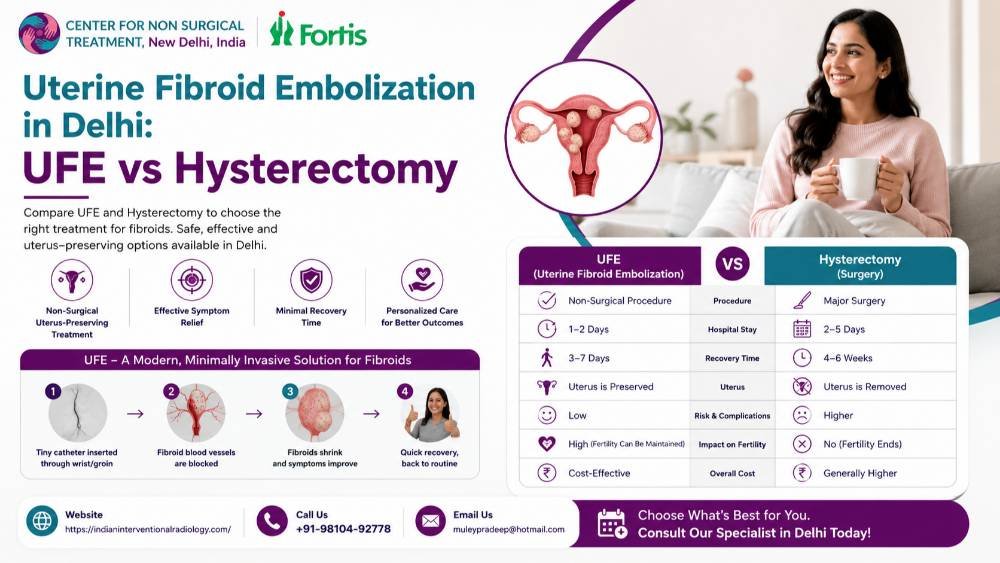
If you've been told you need a hysterectomy for uterine fibroids, you may be wondering if there's another way. Uterine Fibroid Embolization (UFE) — also called Uterine Artery Embolization (UAE) — is a minimally invasive treatment that reduces blood flow to fibroids so they shrink over time. It preserves the uterus and can relieve symptoms such as heavy menstrual bleeding, pelvic pressure and pain. For appropriately selected women, UFE can be an alternative to hysterectomy, although the best treatment depends on fibroid characteristics, symptoms and reproductive goals.
Why Trust This Guide?
| Trust Signal | Details |
|---|---|
| Updated for 2026 | Latest clinical guidelines and treatment evidence |
| Clinical Evidence | References to ACOG, RadiologyInfo, established guidelines |
| Specialist Reviewer | Reviewed by Dr. Pradeep Muley, Senior Consultant Interventional Radiologist |
| Evidence-Based | Includes ACOG guidance on UFE and fertility considerations |
| Practical Guidance | Provides clear comparisons and decision-making frameworks |
This guide is based on established clinical guidelines, peer-reviewed evidence, and practical experience in treating uterine fibroids. It is written to help patients make informed decisions about their treatment options.
Last Reviewed: July 2026
Can UFE Be an Alternative to Hysterectomy?
What is Uterine Fibroid Embolization?
Uterine Fibroid Embolization (UFE) is a minimally invasive procedure that treats uterine fibroids by blocking their blood supply. An interventional radiologist inserts a tiny catheter into an artery in the groin or wrist and guides it to the uterine arteries. Small particles called embolic agents are then injected to block the blood flow to the fibroids. Without blood supply, the fibroids shrink and symptoms improve over time.
Can UFE Be an Alternative to Hysterectomy?
Yes. Uterine Fibroid Embolization (UFE) can be an alternative to hysterectomy for some women with symptomatic uterine fibroids. UFE blocks the blood supply to fibroids so they shrink, while the uterus remains in place. It is minimally invasive and generally has a shorter recovery than hysterectomy. However, UFE is not appropriate for every patient, and women who want future pregnancy should receive individualized counseling because reproductive outcomes after UFE remain uncertain.
UFE is performed without a major surgical incision or removal of the uterus. Local anaesthesia with sedation is commonly used, although the exact anaesthesia and sedation plan varies by patient and treatment centre. Most patients go home the same day or after an overnight stay and return to normal activities within about 1–2 weeks.
UFE at a Glance
| Question | Answer |
|---|---|
| What is UFE? | A minimally invasive catheter-based treatment for symptomatic uterine fibroids |
| Does it remove the uterus? | No |
| Does it remove the fibroids? | No; it blocks their blood supply so they shrink |
| Who performs it? | Usually an interventional radiologist |
| Is general anesthesia always required? | No; local anesthesia with sedation is commonly used |
| Hospital stay | Often same-day discharge or overnight observation |
| Recovery | Many patients return to normal activities within about 1–2 weeks |
| When do symptoms improve? | Improvement may occur over weeks; some symptoms can take 2–3 months to improve |
| Is fertility guaranteed? | No; effects on future pregnancy remain uncertain |
| Can fibroid symptoms return? | Yes; some patients require additional treatment |
Key Takeaways
- Uterine Fibroid Embolization is a minimally invasive, uterus-preserving treatment for fibroids.
- UFE is performed by an interventional radiologist through a tiny catheter, without major incisions.
- The American College of Obstetricians and Gynecologists (ACOG) states that uterine artery embolization (UAE) can be used instead of hysterectomy or myomectomy for some women with symptomatic fibroids who want to retain their uterus. ACOG also notes that some women may require additional treatment and that the effects on future pregnancy are not clear.
- Many women can return to normal activities within about 1–2 weeks, although pelvic discomfort or fatigue may continue for longer. Symptom improvement from the fibroids themselves can take several weeks to months.
- The uterus is preserved, making UFE a valuable option for women who want to avoid hysterectomy.
- UFE may be considered for women who want to avoid hysterectomy and preserve their uterus. Women who may want future pregnancy should receive individualized counseling because reproductive outcomes after UFE remain uncertain.
When to Speak With a Specialist
If you have symptomatic fibroids and have been advised to undergo hysterectomy, ask whether UFE, myomectomy or another uterus-preserving option is appropriate for your specific fibroid pattern and reproductive goals.
What Are Uterine Fibroids?
Uterine fibroids are non-cancerous growths that develop in or on the uterus. They are extremely common — affecting many women by age 50. While many women have fibroids without symptoms, others experience:
- Heavy or prolonged menstrual bleeding
- Pelvic pain or pressure
- Frequent urination
- Constipation or bloating
- Pain during intercourse
- Enlarged abdomen
Fibroids range in size from tiny seedlings to large masses that can distort the shape of the uterus. The symptoms depend on the size, number, and location of the fibroids.
Why Consider Uterine Fibroid Embolization?
UFE offers several advantages over hysterectomy and other surgical treatments. The American College of Obstetricians and Gynecologists (ACOG) states that uterine artery embolization (UAE) can be used instead of hysterectomy or myomectomy for some women with symptomatic fibroids who want to retain their uterus. ACOG also notes that some women may require additional treatment and that the effects on future pregnancy are not clear.
Key Benefits of UFE
Uterus Preservation – UFE treats fibroids without removing the uterus. This may be important for women who want to preserve their uterus, avoid hysterectomy, or maintain the possibility of future pregnancy. UFE does not remove the ovaries, although ovarian function can rarely be affected.
Minimally Invasive – No large incisions. The procedure is performed through a tiny puncture in the groin or wrist. Recovery is much faster than major surgery.
Quick Recovery – Many women can return to normal activities within about 1–2 weeks, although pelvic discomfort or fatigue may continue for longer. Symptom improvement from the fibroids themselves can take several weeks to months.
High Symptom-Relief Rate – UFE provides substantial symptom improvement for many appropriately selected patients. RadiologyInfo reports that nearly 90% of patients experience relief from fibroid-related symptoms after UFE. Individual outcomes vary, and some women require additional treatment.
Often Performed Without General Anaesthesia – UFE commonly uses local anaesthesia with sedation rather than general anaesthesia. The exact anaesthesia or sedation plan depends on the patient, hospital and treating team.
Preserves Uterus – UFE preserves the uterus, but preservation of the uterus does not mean fertility is preserved or guaranteed. Women who want future pregnancy should discuss UFE and myomectomy with a gynecologist and interventional radiologist before treatment.
UFE vs Hysterectomy: The Main Difference
The fundamental difference is what happens to the uterus. UFE treats the fibroids while leaving the uterus in place. Hysterectomy removes the uterus. UFE is therefore a uterus-preserving treatment, while hysterectomy is a definitive surgical treatment that eliminates the possibility of future pregnancy.
UFE may be considered when symptomatic fibroids are suitable for embolization and the patient wants to avoid hysterectomy. However, hysterectomy may remain appropriate when definitive uterine removal is medically indicated or when other treatments are unsuitable.
UFE vs Hysterectomy: At a Glance
| Factor | UFE | Hysterectomy |
|---|---|---|
| Uterus | Preserved | Removed |
| Procedure | Catheter-based embolization | Surgical removal of uterus |
| Major abdominal incision | No | Depends on surgical route |
| General anesthesia | Often not required; sedation/local anesthesia may be used | Depends on surgical approach |
| Hospital stay | Often same day or overnight | Depends on surgical route and recovery |
| Recovery | Usually shorter than hysterectomy, although recovery varies | Generally longer than minimally invasive UFE |
| Fibroids | Shrink over time | Removed with the uterus |
| Future pregnancy | Effect remains uncertain | Pregnancy is not possible after uterus removal |
| Fibroid-related symptoms after treatment | Can recur; additional treatment may sometimes be needed | Fibroids in the removed uterus cannot recur |
| Additional treatment | Some patients may need further treatment | Usually definitive for fibroids in the removed uterus |
When May Hysterectomy Be More Appropriate?
Hysterectomy may be considered when a definitive treatment is preferred, other treatments have failed or are unsuitable, fibroids are very large, cause significant symptoms, or other treatments are unsuitable based on the individual clinical situation. Hysterectomy eliminates the possibility of future pregnancy because the uterus is removed. The surgical approach and recovery depend on whether the procedure is abdominal, laparoscopic or vaginal.
UFE vs Myomectomy vs Hysterectomy
| Feature | UFE | Myomectomy | Hysterectomy |
|---|---|---|---|
| Uterus preserved | Yes | Yes | No |
| Fibroids physically removed | No | Yes | Yes, with uterus |
| Minimally invasive option | Yes | Sometimes | Sometimes |
| Future pregnancy | Evidence remains uncertain | Often considered when fertility preservation is a priority | Not possible |
| Fibroid recurrence | Possible | Possible | Fibroids in removed uterus cannot recur |
| Main purpose | Shrink fibroids and control symptoms | Remove selected fibroids | Definitive removal of uterus |
Which Has a Faster Recovery: UFE or Hysterectomy?
UFE generally has a shorter recovery than hysterectomy because it is performed through a small catheter access site rather than surgically removing the uterus. Many women return to normal activities within about 1–2 weeks after UFE, although recovery varies. Hysterectomy recovery depends on the surgical approach and may take longer.
UFE vs Myomectomy for Future Pregnancy
If having a future pregnancy is a major priority, the decision between UFE and myomectomy requires individualized counseling. Myomectomy physically removes fibroids while preserving the uterus and is commonly considered when future pregnancy is a major treatment goal, particularly when fibroids distort the uterine cavity. UFE also preserves the uterus, but reproductive outcomes after UFE remain less certain. The choice should be individualized based on fibroid size, number, location, uterine anatomy and reproductive goals.
Does UFE Remove Fibroids?
No. UFE does not physically remove fibroids. It blocks their blood supply, causing the treated fibroids to shrink over time. Symptoms such as heavy bleeding, pelvic pressure and pain may improve as the fibroids decrease in size.
Hysterectomy removes the uterus, while myomectomy surgically removes individual fibroids. UFE works differently by reducing blood flow to the fibroids.
Is UFE Considered Non-Surgical?
UFE is commonly described as a non-surgical or minimally invasive treatment because it does not involve open surgery or removal of the uterus. However, it remains an invasive medical procedure because a catheter is introduced through a blood vessel under image guidance.
How Much Do Fibroids Shrink After UFE?
Fibroids shrink gradually after UFE rather than disappearing immediately. RadiologyInfo reports that fibroids shrink to about half their original volume on average following UFE, although the amount of shrinkage varies by patient and fibroid characteristics. Symptom improvement does not necessarily depend on complete disappearance of the fibroid.
How Uterine Fibroid Embolization Works
The Procedure Step by Step
- Preparation – You'll receive medication to help you relax and local anaesthesia at the access site.
- Catheter Insertion – The interventional radiologist makes a tiny puncture in the groin or wrist and inserts a thin catheter into the artery.
- Guided Navigation – Using fluoroscopy (real-time X-ray imaging), the catheter is guided to the uterine arteries.
- Embolization – Tiny particles (embolic agents) are injected into the uterine arteries, blocking the blood supply to the fibroids.
- Completion – The catheter is removed, and the puncture site is closed. Most patients go home the same day or after an overnight stay.
What Happens to the Fibroids?
Without a blood supply, the fibroids shrink over time. Most women notice significant improvement in their symptoms within days to weeks. The fibroids continue to shrink over several months. RadiologyInfo explains that the fibroids shrink and symptoms improve as the blood supply is cut off.
Who May Be a Good Candidate for UFE?
UFE may be a good option for women who:
- Have symptomatic uterine fibroids causing heavy bleeding, pain, or pressure
- Want to avoid hysterectomy
- Wish to preserve their uterus
- Have discussed their reproductive goals and the potential fertility implications of UFE with their doctor
- Are in good overall health
- Have fibroids that are suitable for embolization
Fertility Considerations
UFE preserves the uterus, but its effect on future fertility and pregnancy remains uncertain. Women who actively wish to become pregnant should discuss UFE, myomectomy and other options with a gynecologist and interventional radiologist before choosing treatment. ACOG states that women should be counseled on the limited available data for reproductive outcomes.
For women whose primary goal is future pregnancy, myomectomy may be preferred in some circumstances. The appropriate treatment depends on fibroid size, number, location and reproductive goals.
When UFE May Not Be the Best Option
UFE may not be the preferred treatment when:
- Future pregnancy is a major treatment priority and fertility-preserving surgical options are more appropriate
- The diagnosis is uncertain
- Imaging suggests another condition requiring a different treatment
- The fibroid characteristics make embolization unsuitable
- There is a suspected gynecologic malignancy
- Another treatment is more appropriate for the patient's symptoms or treatment goals
Important: UFE is a treatment for appropriately diagnosed uterine fibroids, not a treatment for suspected uterine cancer. Rare uterine malignancies can sometimes be mistaken for fibroids, which is why appropriate clinical assessment and imaging are important before UFE. RadiologyInfo notes that UFE should not be performed when cancer is a possibility. If cancer is suspected, the patient should be evaluated by the appropriate gynecologic oncology team.
What Tests Are Needed Before UFE?
Before UFE, your doctor may recommend pelvic imaging such as ultrasound or MRI to evaluate the number, size and location of fibroids and assess whether embolization is appropriate. Depending on symptoms and medical history, additional evaluation may include blood tests, assessment for anemia and evaluation of the uterine lining when clinically indicated. The exact evaluation depends on your age, symptoms, bleeding pattern, medical history and imaging findings. RadiologyInfo says MRI or ultrasound is used to determine whether a patient is a candidate.
Does Fibroid Location Affect Whether UFE Is Appropriate?
Yes. Fibroid location can influence treatment planning. Fibroids may be described as submucosal, intramural or subserosal depending on where they develop in relation to the uterine wall. Their size, number, location, blood supply and relationship with the uterine cavity all help determine whether UFE, myomectomy, hysterectomy or another treatment is appropriate.
- Submucosal fibroids grow toward the uterine cavity.
- Intramural fibroids develop within the muscular wall of the uterus.
- Subserosal fibroids grow toward the outside of the uterus.
Location can affect symptoms and treatment selection.
What to Expect During Recovery
First 24–48 Hours
- Pelvic cramping is common.
- Pain medication may be required.
- Mild fever, nausea or fatigue may occur.
- Some patients go home the same day; others remain overnight.
First Week
- Cramping generally improves.
- Walking and light activity are encouraged as instructed.
- Avoid strenuous activity until your medical team clears you.
Around 1–2 Weeks
- Many women can return to normal activities within about 1–2 weeks, although fatigue or intermittent pelvic discomfort may continue for longer. Your treating team will advise when it is appropriate to resume strenuous exercise, heavy lifting and other activities.
Following Weeks and Months
- Fibroids shrink gradually rather than disappearing immediately. Symptom improvement may take several weeks to months. ACOG notes that changes in symptoms may take 2–3 months, while fibroids can continue shrinking for a year or longer.
Long-Term Results
- Most women experience significant improvement in symptoms.
- In one retrospective case series study of women who underwent UFE before age 40, freedom from recurrent symptoms was 95.8% at 1 year, 67.6% at 5 years and 50.7% at 10 years. Because this was a specific study population and study design, these figures should not be interpreted as an individual patient's expected outcome.
- Some women may require additional treatment if symptoms persist or recur.
Risks and Possible Complications
UFE is generally safe, but like any medical procedure, it carries some risks:
Common side effects:
- Post-embolization syndrome (pain, cramping, fever, nausea) — typically resolves within a week
- Vaginal discharge
- Fatigue
Less common risks:
- Infection
- Bleeding
- Damage to surrounding organs (rare)
- Allergic reaction to contrast dye
- Ovarian function can occasionally be affected after UFE, and the risk of ovarian dysfunction or premature menopause appears to be higher in women aged 45 years and older
Important: UFE does not eliminate the risks associated with fibroids. Some women may require additional treatment if symptoms persist or recur.
When Should You Seek Urgent Medical Care?
Seek urgent medical attention for very heavy or uncontrolled bleeding, severe or rapidly worsening pelvic pain, fainting, high fever, persistent vomiting, or other symptoms that concern you. If you have already undergone UFE, contact your treating team promptly if pain is not controlled by prescribed medication, you develop significant fever, persistent vomiting, unusual bleeding, or concerning changes at the catheter-access site.
Can Fibroids Return After UFE?
Treated fibroids generally shrink after UFE, but fibroid-related symptoms can return over time. New fibroids may also develop, and some patients may eventually need additional treatment.
Uterine Fibroid Embolization in Delhi: What Patients Should Know
Women considering uterine fibroid embolization in Delhi should first undergo an appropriate clinical assessment and imaging review. The goal is not simply to determine whether a fibroid can be embolized, but whether UFE is the most appropriate treatment for the patient's symptoms, fibroid characteristics, reproductive plans and overall health.
An interventional radiologist can review ultrasound or MRI findings, explain how UFE compares with myomectomy and hysterectomy, discuss expected recovery and identify situations where another treatment may be more appropriate.
Before choosing UFE in Delhi, patients should bring their latest ultrasound or MRI reports, previous gynecology records and relevant blood-test results to the consultation. The specialist can then assess fibroid size, number, location, uterine anatomy and treatment goals before recommending UFE or another option.
Dr. Pradeep Muley: Interventional Radiology Consultation in Delhi
Dr. Pradeep Muley is a Senior Consultant Interventional Radiologist in New Delhi with more than 30 years of experience in diagnostic and interventional radiology. His practice includes image-guided minimally invasive treatments for selected uterine fibroid and adenomyosis cases.
UFE suitability depends on diagnosis, imaging findings, symptoms and individual treatment goals. A consultation can help determine whether embolization or another treatment is appropriate.
Contact Dr. Pradeep Muley to schedule a consultation and discuss your treatment options.
Uterine Fibroid Treatment Options in Delhi
If you are considering uterine fibroid treatment in Delhi, several options are available. Dr. Pradeep Muley offers guidance on whether UFE or another treatment is right for you.
If adenomyosis is also suspected, ask your specialist whether uterine artery embolization or another treatment may be appropriate. For more information, visit adenomyosis treatment in Delhi.
Questions to Ask Before Choosing UFE
- Am I a good candidate for UFE?
- What are the risks and benefits of UFE compared with hysterectomy?
- Will I need to stay in the hospital?
- How long will recovery take?
- Can I become pregnant after UFE?
- What happens if my symptoms return?
- How many UFE procedures has the doctor performed?
Not Sure Whether UFE or Hysterectomy Is Right for You?
If you have symptomatic uterine fibroids and have been advised to consider hysterectomy, an interventional radiology consultation can help you understand whether UFE is an appropriate alternative.
Bring to your consultation:
- Ultrasound reports
- MRI reports, if available
- Previous gynecology records
- Blood-test reports
- Current medication list
- Previous fibroid treatments
- Questions about fertility or uterus preservation
Request a UFE Consultation in Delhi
Frequently Asked Questions (FAQs)
1. What is Uterine Fibroid Embolization (UFE)?
UFE is a minimally invasive procedure that treats uterine fibroids by blocking their blood supply. An interventional radiologist inserts a tiny catheter into an artery in the groin or wrist and injects small particles to cut off blood flow to the fibroids. The fibroids shrink and symptoms improve over time.
2. Is UFE painful?
You will receive medication to help you relax and local anaesthesia at the access site. During the procedure, you should not feel pain. After the procedure, you may experience cramping and discomfort, which can be managed with pain medication.
3. How long does UFE recovery take?
Most women return to normal activities within about 1–2 weeks. Recovery varies between patients, and your treating team will advise when it is appropriate to resume strenuous exercise, heavy lifting and other activities.
4. Does UFE preserve fertility?
UFE preserves the uterus, but its effect on future fertility and pregnancy remains uncertain. ACOG states that women should be counseled on the limited available data for reproductive outcomes. Women who actively wish to become pregnant should discuss UFE, myomectomy and other options with their doctor.
5. Can I get pregnant after UFE?
Pregnancy after UFE is possible, but its effect on future pregnancy is not fully established. Women who wish to have children should discuss their options with their doctor before proceeding with UFE.
6. Does UFE affect my hormones or cause menopause?
UFE does not remove the ovaries, but ovarian function can occasionally be affected. Most women continue to have menstrual cycles after UFE, although menstrual changes can occur. The risk of ovarian dysfunction increases with age.
7. How successful is UFE?
UFE provides substantial symptom improvement for many appropriately selected patients. RadiologyInfo reports that nearly 90% of patients experience relief from fibroid-related symptoms after UFE, although individual outcomes vary and some patients may require additional treatment.
8. Can UFE be repeated?
Repeat embolization may be possible in selected patients if symptoms persist or recur, but the appropriate next treatment depends on the cause of the symptoms and the findings on follow-up assessment.
9. How do I know if UFE is right for me?
The best way to determine if UFE is right for you is to consult with an experienced interventional radiologist. Dr. Pradeep Muley can evaluate your condition, discuss your options, and help you make an informed decision.
10. Is UFE safe?
UFE is generally safe when performed by an experienced interventional radiologist. The most common side effect is post-embolization syndrome, which resolves within a week.
11. How long does the UFE procedure take?
The procedure time varies depending on your anatomy, fibroid characteristics and the complexity of embolization. Your interventional radiologist can explain what to expect before treatment.
12. Can UFE treat large fibroids?
Large fibroids do not automatically rule out UFE. Treatment suitability depends on the number, location and vascular supply of the fibroids, uterine anatomy, symptoms and imaging findings. MRI or ultrasound can help the treating team determine whether embolization is technically and clinically appropriate.
13. Is UFE a permanent treatment for fibroids?
UFE can provide long-term symptom relief, but it is not possible to guarantee that fibroid-related symptoms will never return. Some women require additional treatment after UAE.
14. Does UFE shrink the uterus?
UFE primarily reduces the size and blood supply of treated fibroids. The overall uterine size may also decrease when fibroids shrink, depending on the individual case.
15. How quickly do fibroids shrink after UFE?
Fibroids do not disappear immediately. They shrink gradually after their blood supply is reduced. Symptom improvement may occur over weeks to months, and fibroids may continue to shrink for a year or longer.
16. Is UFE better than hysterectomy?
Neither treatment is universally better. UFE preserves the uterus and avoids major surgery, while hysterectomy definitively removes the uterus and eliminates the possibility of future fibroids in the removed uterus. The appropriate treatment depends on the patient's diagnosis, symptoms, reproductive goals and medical circumstances.
Bottom Line
Uterine Fibroid Embolization is a minimally invasive treatment option for appropriately selected women with symptomatic uterine fibroids and can provide an alternative to hysterectomy for some patients. It offers the benefits of uterus preservation, faster recovery, and high symptom-relief rates — all without major surgery.
If you are considering uterine fibroid embolization in Delhi, Dr. Pradeep Muley provides consultation with over 30 years of experience in interventional radiology.
About Dr. Pradeep Muley
Dr. Pradeep Muley is a Senior Consultant Interventional Radiologist in New Delhi with more than 30 years of experience in image-guided minimally invasive procedures. He is a Senior Consultant in Interventional Radiology at Fortis Hospital, Vasant Kunj, New Delhi, offering consultation for uterine fibroids, adenomyosis, and other uterine conditions.
Contact Dr. Pradeep Muley to schedule a consultation and explore your uterine fibroid treatment options.
Medical Disclaimer
This article is for general educational purposes and does not replace a medical consultation, diagnosis or individualized treatment plan. Treatment decisions for uterine fibroids should be based on clinical assessment and, when indicated, appropriate imaging such as ultrasound or MRI.