
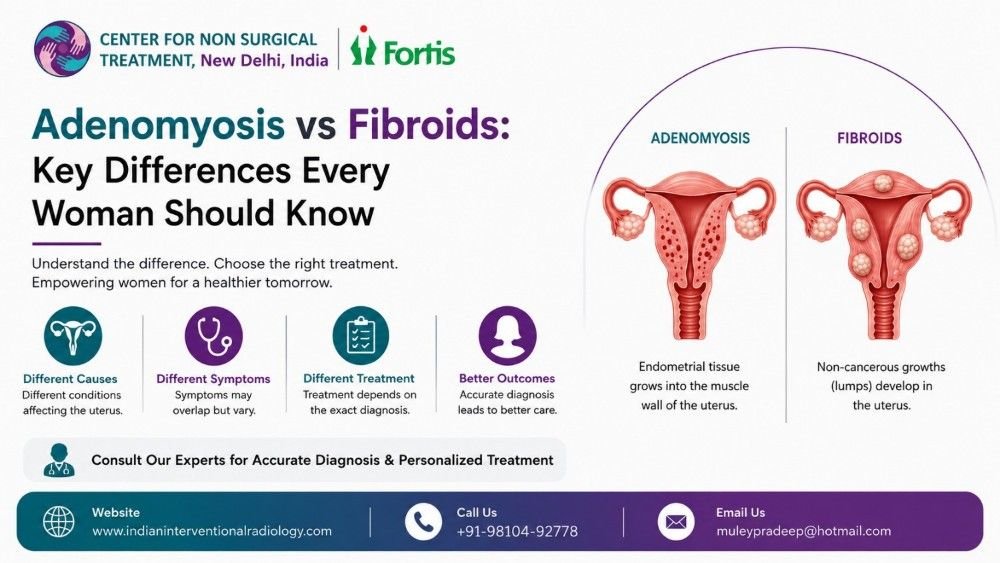
You have been dealing with heavy periods, relentless pelvic pain, and a feeling that something is just not right. You go to the doctor, and they mention two words that sound similar: adenomyosis and fibroids. Maybe you have been told you have one, only to wonder if it could be the other. Perhaps you have even been misdiagnosed.
This confusion is incredibly common. Both conditions affect the uterus, both cause heavy bleeding and pain, and both can significantly impact your quality of life. But they are very different in how they develop, how they are diagnosed, and how they are treated.
If you are looking for the best gynecologist for adenomyosis treatment in Delhi or the best uterine fibroids in Delhi , understanding the difference is the first step toward getting the right care. Let me break it down for you in simple, clear terms.
What Is the Difference Between Adenomyosis and Fibroids?
Let us start with the most basic question: what exactly are these two conditions?
Uterine Fibroids: The Lumps
Uterine fibroids (myomas, leiomyomas, or fibromyomas) are the most frequent tumour found in the female reproductive system. Think of them as little lumps or balls of muscle and fibrous tissue that grow in or on the uterus.
They can be as small as a seed or grow as large as an orange or even bigger. Some women have just one, while others develop many. Around 20 to 40% of women in their childbearing age have fibroids. Women between the ages of 30 and 50 are most prone to developing them.
For professional medical information on fibroids, visit Merck Manual – Uterine Fibroids .
Fibroids are classified by where they grow:
- Intramural fibroids – grow within the wall of the uterus (the most common type)
- Subserosal fibroids – develop on the outer surface of the uterus
- Submucosal fibroids – form within the muscle just below the uterine lining, extending into the cavity
- Cervical fibroids – arise in the wall of the cervix
Adenomyosis: The Invasion
Adenomyosis is different. Adenomyosis is a non-cancerous disease of the uterus where symptoms and signs are similar to uterine fibroids. In this condition, the tissue that normally lines the inside of your uterus—the endometrium—grows into the muscle wall of the uterus.
Imagine the lining of your uterus deciding to burrow into the muscle. This causes the uterus to become thicker, heavier, and enlarged. The trapped tissue bleeds every month along with your normal period, but because it is inside the muscle, the blood has nowhere to go. This causes inflammation, pain, and more bleeding.
Adenomyosis is a common yet often underdiagnosed uterine condition. It mainly affects women aged 35 to 50, especially those who have had children. It can be:
- Diffuse – spread throughout the entire muscle wall (the most common type)
- Focal – grouped into one specific spot
For professional medical information on adenomyosis, visit Merck Manual – Uterine Adenomyosis .
The Key Difference in One Sentence
Fibroids are tumors of the muscle. Adenomyosis is the lining inside the muscle.
Adenomyosis vs Fibroids: Comparison Table
Here is a quick side-by-side comparison to help you see the differences at a glance:
| Feature | Adenomyosis | Uterine Fibroids |
|---|---|---|
| What It Is | Endometrial tissue grows into the uterine muscle wall. | Non-cancerous growths (tumors) of muscle and fibrous tissue. |
| Location | Inside the uterine muscle wall itself. | In, on, or within the uterine wall (intramural, submucosal, subserosal, cervical). |
| Appearance | Diffuse thickening of the uterine wall, no distinct mass. | Round or oval-shaped masses with distinct borders. |
| Bleeding | Heavy, prolonged menstrual bleeding. | Heavy menstrual bleeding, often with clots. |
| Pain | Severe, cramping pain that worsens with age. | Cramping, pelvic pressure, lower back pain. |
| Pressure Symptoms | Feeling of pressure on the bladder and rectum. | Frequent urination, constipation, bloating. |
| Uterus | Becomes bulky, heavy, tender, and diffusely enlarged. | May become enlarged; shape may become irregular. |
| Effect on Fertility | Can affect fertility and pregnancy outcomes. | Can cause infertility, pregnancy, and labor complications. |
| Age Group | Most commonly diagnosed in women 35–50. | Most common in women 30–50. |
| Can They Co-exist? | Yes – many women have both conditions at the same time. | Yes – many women have both conditions at the same time. |
Symptoms: How to Tell Them Apart
Both conditions share many symptoms, which is why they are so often confused. But there are some key differences.
Similar Symptoms (Both Conditions)
- Heavy menstrual bleeding that can lead to anemia
- Painful periods with severe cramping
- Pelvic pain or pressure
- Pain during sexual intercourse
- Abdominal bloating or swelling
Symptoms More Common in Adenomyosis
If you have adenomyosis, you are more likely to experience:
- Extensive or excessive menstrual bleeding
- Severe menstrual cramps that worsen with age
- Chronic pelvic pain – pain that persists even when you are not on your period
- Pain during intercourse
- Feeling bloated or heavy in the abdomen
- Fatigue and anaemia
- Infertility among a few women
For a detailed overview of adenomyosis symptoms and causes, visit Mayo Clinic – Adenomyosis Overview .
Symptoms More Common in Fibroids
If you have fibroids, you are more likely to experience:
- Heavy, prolonged menstrual periods and unusual bleeding with clots that can lead to anaemia
- Lower abdomen, back or leg pain
- Lower abdominal pressure or heaviness
- Bladder pressure leads to an urge to urinate
- Pressure on bowel, leading to constipation and bloating
- Abnormally enlarged abdomen
The Pain Difference
Here is a simple way to remember it: Fibroids may not hurt at all. Many women have fibroids without any pain. But when fibroids do cause pain, it is usually from pressure on other organs.
Adenomyosis almost always causes pain – and often severe pain. The pain is directly from the tissue inside the muscle trying to bleed every month.
Diagnosis: Why Getting It Right Matters
This is where things get tricky – and where many women get misled.
The Problem with Ultrasound
Ultrasound is the most common first test. A wand is placed inside the vagina, and sound waves create pictures of your uterus.
But here is the problem: adenomyosis is frequently misdiagnosed as fibroids on ultrasound. On an ultrasound:
- Fibroids appear as round or oval-shaped masses with distinct borders
- Adenomyosis often appears as diffuse thickening of the uterine wall, with no distinct mass
Due to the similarity of its symptoms with fibroids or endometriosis, adenomyosis is often underdiagnosed. It is necessary to consult a specialist in uterine adenomyosis in Delhi to detect it in time and manage it.
Why MRI Is the Gold Standard
An MRI gives a much clearer picture and can usually tell the difference between adenomyosis and fibroids.
On MRI:
- Adenomyosis shows as thickening of the junctional zone
- Fibroids appear as well-defined masses with clear borders
Undergoing an MRI before beginning any treatment is generally recommended, as it helps to diagnose location and number of fibroids to plan line of treatment. These imaging tests also act as a reference point for follow-up evaluations.
The Bottom Line on Diagnosis
If you have been diagnosed with fibroids but your symptoms are not improving with treatment, or if you have severe pain that keeps getting worse, ask your doctor for an MRI. It could be adenomyosis instead – or in addition to – fibroids.
For expert insights on fibroid diagnosis and treatment, visit Hopkins Medicine – Uterine Fibroids .
Treatment Options: Different Conditions, Different Approaches
Because adenomyosis and fibroids are different conditions, they are treated differently. The right treatment depends on your symptoms, your age, and whether you want to preserve your fertility.
Treatment for Uterine Fibroids
For fibroids, treatment options include:
Non-Surgical Options:
- Uterine Fibroid Embolization (UFE) – a minimally invasive procedure performed by an interventional radiologist. It works by blocking blood supply to fibroids, causing them to shrink naturally over time, while preserving the uterus
- Hormonal medications – birth control pills, GnRH agonists to shrink fibroids temporarily
- Tranexamic acid – to reduce heavy bleeding
- NSAIDs – for pain relief
Surgical Options:
- Myomectomy – surgical removal of fibroids while preserving the uterus
- Hysterectomy – removal of the entire uterus (for women who have completed childbearing)
If you are looking for uterine fibroid embolization treatment in Delhi or uterine fibroids surgery in Delhi , these options are available with the right specialist. For comprehensive information on fibroid symptoms and treatment, visit Mayo Clinic – Uterine Fibroids Overview .
Treatment for Adenomyosis
Adenomyosis is harder to treat definitively without removing the uterus.
Non-Surgical Options:
- Uterine Artery Embolization (UAE) – this is a game-changer for adenomyosis. It is a minimally invasive procedure conducted by a specialist in uterine adenomyosis in Delhi. It decreases blood circulation to the adenomyotic tissue and results in the improvement of the symptoms with time
- Hormonal medications – birth control pills, progestins, GnRH agonists
- Levonorgestrel-releasing IUD – can help relieve symptoms
- NSAIDs – for pain relief
- Tranexamic acid – to reduce bleeding
Surgical Options:
- Hysterectomy – removal of the uterus. This is the only definitive cure for adenomyosis
At Indian Interventional Radiology, surgery is only an option after trying the non-surgical alternatives first.
The UAE Option for Both
Uterine Artery Embolization (UAE) is a remarkable treatment that works for both conditions. It is a minimally invasive, non-surgical procedure that blocks blood supply to the affected tissue, causing it to shrink.
For adenomyosis, UAE offers a way to avoid hysterectomy while preserving the uterus. It offers several compelling benefits:
- No large incisions
- Short hospital stay
- Faster recovery compared to surgery
- Significant reduction in pain and bleeding
- Preserves future treatment options
This approach has shown excellent results in women seeking long-term relief without hysterectomy.
Dr. Pradeep Muley is a pioneer in this field. His department has performed the maximum numbers of uterine artery embolization for fibroids and uterine adenomyosis in the country.
Why Choose Dr. Pradeep Muley for Adenomyosis and Fibroid Treatment in Delhi?
When it comes to best adenomyosis treatment doctors Delhi or best uterine fibroids in Delhi , choosing the right doctor makes all the difference.
Pioneer in Uterine Artery Embolization
Dr. Pradeep Muley is a pioneer in Delhi & NCR for non-surgical treatments. He is a Senior Consultant Interventional Radiologist with an outstanding reputation:
- Performed more than 20,000 diagnostic and interventional radiological procedures
- Performed the maximum numbers of uterine artery embolization for fibroids and uterine adenomyosis in the country
- Established India's 1st Uterine 'FIBROID CLUB' for non-surgical treatment of uterine fibroids
World-Class Training
Dr. Pradeep Muley's qualifications are truly impressive:
- Fellow Interventional Radiology, Singapore General Hospital, Singapore
- Visiting Associate, Neurointerventional Radiology, Iowa University Hospitals, USA
- Visiting Fellow, Neurointerventional Radiology, Johns Hopkins Medical Institutions, USA
- Lecturer, Vascular & Interventional Radiology, KEM Hospital, Mumbai, India
- Neuroradiology, All India Institute of Medical Sciences (AIIMS), New Delhi, India
- Consultant Interventional Radiologist, KIMS hospital, Trivandrum, Kerala, India
Advanced Facilities
The Department of Interventional Radiology, established by Dr. Pradeep Muley, is specifically designed with two well-equipped and modern Cath-labs for all diagnostic and interventional procedures. He is assisted by a team of trained nurses and practicing radiologists and personally participates in all interventional procedures.
Patient-Centric Care
At Indian Interventional Radiology , the focus is on providing safe, effective, and long-term relief. The team offers customized treatment plans based on your specific symptoms and needs.
The hospital offers tertiary care in 42 Super-Specialties supported by a large and competent team of doctors, nurses, technicians and paramedical staff.
You can schedule a consultation or contact us to begin your journey toward relief.
Frequently Asked Questions (FAQs)
1. What is the main difference between adenomyosis and fibroids?
Adenomyosis is when the uterine lining (endometrium) grows into the muscle wall of the uterus. Fibroids are non-cancerous lumps (tumors) that grow from the muscle tissue of the uterus. Think of it this way: fibroids are lumps of the muscle; adenomyosis is the lining inside the muscle.
2. Can you have both adenomyosis and fibroids at the same time?
Yes. Adenomyosis is a non-cancerous disease of the uterus where symptoms and signs are similar to uterine fibroids. It is very common to have both conditions in the same uterus.
3. Which is more painful – adenomyosis or fibroids?
Adenomyosis is generally more painful. Fibroids may not cause any pain at all. When fibroids do cause pain, it is usually from pressure. Adenomyosis, on the other hand, causes severe cramping pain that often worsens with age, as the tissue inside the muscle tries to bleed every month.
4. How are adenomyosis and fibroids diagnosed?
Both are diagnosed through pelvic exam and imaging. Ultrasound is the first test, but MRI is often recommended as it provides a detailed diagnosis. On ultrasound, fibroids appear as round masses with distinct borders, while adenomyosis appears as diffuse thickening of the uterine wall.
5. Why are adenomyosis and fibroids often misdiagnosed?
Adenomyosis is frequently misdiagnosed as fibroids on ultrasound because the two conditions can look similar. Due to the similarity of its symptoms with fibroids or endometriosis, adenomyosis is often underdiagnosed. This is why many doctors recommend an MRI for a clear diagnosis.
6. Can adenomyosis be treated without hysterectomy?
Yes. Uterine Artery Embolization (UAE) is a highly effective, non-surgical treatment that preserves the uterus. This approach has shown excellent results in women seeking long-term relief without hysterectomy. Other options include hormonal medications, IUDs, and pain relievers.
7. What is the best treatment for fibroids without surgery?
Uterine Fibroid Embolization (UFE) is an excellent non-surgical option for fibroids. It blocks the blood supply to the fibroids, causing them to shrink naturally over time, while preserving the uterus. Hormonal medications and tranexamic acid can also help manage symptoms.
8. Can fibroids or adenomyosis affect fertility?
Yes, both can affect fertility. Fibroids – especially submucosal fibroids – can cause infertility and pregnancy complications. Adenomyosis can also affect fertility and pregnancy outcomes.
9. Who is the best doctor for adenomyosis treatment in Delhi?
Dr. Pradeep Muley is a pioneer in Uterine Artery Embolization with over 20,000 procedures performed. His department has performed the maximum numbers of uterine artery embolization for fibroids and uterine adenomyosis in the country. He has trained at prestigious institutions including Johns Hopkins and AIIMS.
10. Which treatment is right for me – UAE, myomectomy, or hysterectomy?
The right treatment depends on your specific condition, symptoms, age, and fertility goals:
- UAE – best for women who want a non-surgical option and wish to preserve their uterus
- Myomectomy – best for women who want fibroids removed but still want to preserve fertility
- Hysterectomy – only recommended for women who have completed childbearing and have severe symptoms
The best gynecologist for adenomyosis treatment in Delhi or best uterine fibroids in Delhi can help you make the right choice.
Final Thoughts
Adenomyosis and fibroids are two different conditions that cause similar symptoms. Getting the right diagnosis is the first – and most important – step toward getting the right treatment.
If you have been told you have fibroids but your symptoms are not improving, or if you have severe pain that keeps getting worse, ask your doctor for an MRI. It could be adenomyosis instead – or in addition to – fibroids.
If you are in Delhi or the NCR region and looking for the best adenomyosis doctors in Delhi or best uterine fibroids in Delhi , Dr. Pradeep Muley at Indian Interventional Radiology is your trusted partner. With decades of experience, advanced technology, and a patient-first approach, he provides world-class care tailored to your needs.
Don't suffer in silence. Don't accept a misdiagnosis. Book a consultation today and take the first step toward relief.
Contact Information
Dr. Pradeep Muley
Senior Consultant Interventional Radiologist
Indian Interventional Radiology
Fortis Hospital, Vasant Kunj, New Delhi, India
Phone: +91-98104-92778
Email: muleypradeep@hotmail.com
Contact Us for more information or to schedule your appointment.