
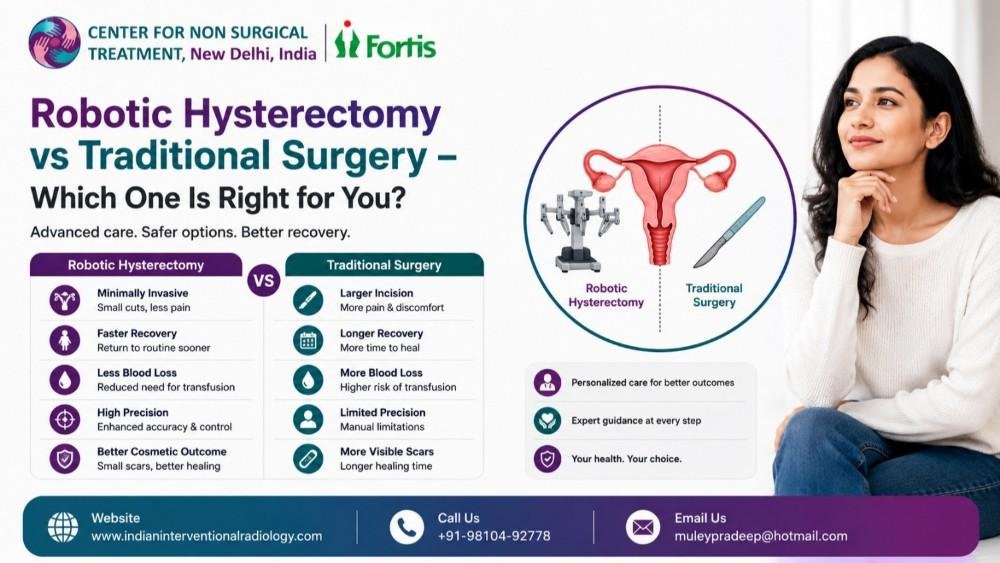
Robotic Hysterectomy vs Traditional Surgery – Which One Is Right for You?
You have been told you need a hysterectomy. Removal of the uterus. It sounds scary, overwhelming, and you probably have a hundred questions running through your mind. Will it hurt? How long will I be in the hospital? When can I get back to normal life? What is the difference between all these options my doctor mentioned?
If you are searching for robotic hysterectomy in Delhi or hysterectomy surgery in Delhi, you have come to the right place. Let me explain everything in simple, easy-to-understand language so you can make an informed decision.
What Is a Hysterectomy?
A hysterectomy is a surgical procedure to remove the uterus. It is one of the most common gynecological surgeries performed worldwide. In the United States alone, more than 500,000 hysterectomies are performed annually.
A hysterectomy may be recommended for various conditions when other treatments have failed:
| Condition | Why Hysterectomy Helps |
|---|---|
| Large fibroids | Uterus is enlarged, causing pressure and bleeding |
| Severe adenomyosis | Uterus muscle is thick and painful |
| Endometriosis | When pain is severe and other treatments have failed |
| Uterine prolapse | Uterus falls down into vagina |
| Abnormal bleeding | When no other treatment stops the bleeding |
| Cancer (uterine, cervical, ovarian) | Life-saving treatment |
There are different ways to perform a hysterectomy. The three main approaches are:
- Robotic hysterectomy – minimally invasive, using robotic arms
- Laparoscopic hysterectomy – minimally invasive, using small instruments
- Abdominal (open) hysterectomy – traditional surgery with a large incision
- Vaginal hysterectomy – through the vagina, no abdominal cuts
Robotic Hysterectomy – What Is It?
Robotic hysterectomy is an advanced minimally invasive surgery. The surgeon sits at a console and controls robotic arms that hold tiny instruments. These instruments go through small cuts in your belly.
Think of it like this: the robot gives the surgeon better vision (3D, 10x magnification) and better control (wristed instruments that bend like human hands). The result is a surgery that is more precise, with less damage to your body.
Robotic assistance in gynecology combines the established benefits of minimally invasive surgery – such as reduced blood loss, faster recovery, and shorter hospital stays – with robot-specific advantages including improved ergonomics, natural movements, and enhanced dexterity through articulated instruments.
The surgeon controls every movement. The robot does nothing on its own. It is a tool – a very advanced tool.
A real-world study from India involving 113 patients who underwent robotic-assisted benign hysterectomy found a mean operating room time of 178.41 minutes, estimated blood loss of 23.85 mL, and a length of hospital stay of 2.86 days. There were only three post-operative complications (2.65%).
Traditional Open Hysterectomy – What Is It?
Traditional open hysterectomy involves a single large incision in your abdomen, typically 5 to 10 centimeters long. The surgeon makes this cut to access and remove the uterus.
This is the oldest method and is still used today, especially for very large uteri or complex cases. However, it comes with significantly longer recovery time, more pain, and a larger scar compared to minimally invasive options.
According to MedlinePlus, after open abdominal surgery, most people need around 4 to 6 weeks to recover fully. The hospital stay for open hysterectomy is typically 3-7 days.
Robotic vs Traditional – Complete Comparison
Here is a clear side-by-side comparison so you can see the difference at a glance:
| Factor | Robotic Hysterectomy | Laparoscopic Hysterectomy | Open (Traditional) Hysterectomy |
|---|---|---|---|
| Number of cuts | 4-5 small (1 cm each) | 3-4 small (1 cm each) | One large (5-10 cm) |
| Scarring | Very small scars | Small scars | Large visible scar |
| Hospital stay | 1-3 nights | 1-3 nights | 3-7 nights |
| Return to work | 2-3 weeks | 3-4 weeks | 6-8 weeks |
| Blood loss | 24-88 mL | 100-200 mL | 300-800 mL |
| Pain level | Lower | Moderate | Higher |
| Infection risk | Low | Low | Moderate |
The data speaks for itself. Robotic hysterectomy offers the fastest recovery, the least pain, and the least blood loss.
What Does the Research Say?
Multiple studies have compared robotic hysterectomy with traditional approaches. Here is what the evidence shows:
Robotic vs Traditional Open Surgery
A study comparing robotic and open hysterectomy for very large uteri (weighing more than 1000 g) found that the robotic approach allowed for a shorter hospital stay (1.6 vs 3.8 days) and resulted in a lower overall cost despite higher operating room costs.
The study concluded that robotic hysterectomy for uteri weighing more than 1000 g is comparable with open hysterectomy in terms of complications, and that the robotic approach allows for a shorter hospital stay, which leads to a lower overall cost.
Another study found that women recovered to their preoperative level on the fifth postoperative day with robotic hysterectomy, compared to 28 days with abdominal hysterectomy.
Robotic vs Laparoscopic Surgery
Based on the highest level of evidence exclusively from randomized trials, robotic and conventional laparoscopic hysterectomy demonstrate comparable operative outcomes for benign disease, with the robotic approach offering modestly shorter hospitalization.
Robotic assistance was linked to longer operating times but similar blood loss compared to conventional laparoscopy.
What About Operating Time?
A study comparing robotic and open hysterectomy for very large uteri found that mean operative time was longer in the robotic group (217 vs 124 minutes). However, many patients are willing to accept longer operating time in exchange for faster recovery.
The Bottom Line from Research
Both robotic and conventional approaches are safe and effective. However, robotic surgery offers advantages in:
- Shorter hospital stays
- Less blood loss
- Lower complication rates (especially for complex cases)
- Faster recovery
As research suggests, the choice of approach may depend on patient factors such as BMI, uterine size, obstetric history, and prior surgeries.
Benefits of Robotic Hysterectomy
Here is what robotic hysterectomy means for you:
| Benefit | What It Means for You |
|---|---|
| Smaller cuts | Only 4-5 cuts of 1 cm each. No large scar. |
| Less pain | Most women need only mild painkillers for 2-3 days. |
| Less blood loss | Blood transfusion almost never needed. |
| Shorter hospital stay | Go home in 1-3 days instead of 3-7 days. |
| Faster recovery | Back to work in 2-3 weeks instead of 6-8 weeks. |
| Better vision for surgeon | 3D, 10x magnification. Less chance of injury to bladder or ureters. |
| Less risk of infection | Smaller cuts mean lower infection risk. |
| Less risk of hernia | No large cut means no hernia risk. |
Robotics is increasingly adopted in gynecology surgery, combining the established benefits of minimally invasive surgery with robot-specific advantages.
When Is Robotic Hysterectomy Better?
The answer depends on your specific situation:
| Your Situation | Robotic Better? | Why |
|---|---|---|
| Large uterus (>12 weeks size) | YES | Robotic gives better vision and control for difficult cases |
| Many fibroids | YES | Easier to remove uterus with fibroids |
| Endometriosis | YES | Robotic helps see and remove scar tissue better |
| Obesity (BMI >35) | YES | Robotic works better through thick belly wall |
| Previous abdominal surgery | YES | Scar tissue makes laparoscopic difficult; robotic helps |
| Cancer | YES | More precise removal, better lymph node sampling |
| Simple, small uterus | Maybe | Laparoscopic is similar and cheaper |
| Very tight budget | No | Open or laparoscopic costs less |
Verdict: For complex cases (large uterus, many fibroids, endometriosis, obesity, previous surgery), robotic is clearly better. For simple cases, laparoscopic is similar.
What Traditional Open Hysterectomy Recovery Feels Like
Many women still get open hysterectomy in India. Here is what that recovery looks like:
| Recovery Milestone | Open Hysterectomy |
|---|---|
| Hospital stay | 3-7 nights |
| Walk without help | Day 3-4 |
| Shower alone | Day 5-7 |
| Climb stairs | 2-3 weeks |
| Drive a car | 4-6 weeks |
| Return to office job | 6-8 weeks |
| Lift heavy items | 10-12 weeks |
| Full recovery | 3-4 months |
One large cut. Significant pain. Long recovery. Many women suffer needlessly because they did not know about better options.
According to the NHS, recovery time for open hysterectomy is typically 6 to 8 weeks. Most women go home 2-3 days after an abdominal hysterectomy, but complete recovery takes 6-8 weeks.
Why Choose Dr. Pradeep Muley for Robotic Hysterectomy in Delhi?
When it comes to robotic hysterectomy treatment in Delhi or finding the best vaginal hysterectomy doctors Delhi, choosing the right specialist makes all the difference.
Expert in Minimally Invasive Surgery
Dr. Pradeep Muley is a Senior Consultant Interventional Radiologist with decades of experience in minimally invasive procedures. With training from prestigious institutions including Johns Hopkins and AIIMS, he offers world-class care.
World-Class Training
Dr. Pradeep Muley's qualifications are truly impressive:
- Fellow Interventional Radiology, Singapore General Hospital, Singapore
- Visiting Associate, Neurointerventional Radiology, Iowa University Hospitals, USA
- Visiting Fellow, Neurointerventional Radiology, Johns Hopkins Medical Institutions, USA
- Lecturer, Vascular & Interventional Radiology, KEM Hospital, Mumbai, India
- Neuroradiology, All India Institute of Medical Sciences (AIIMS), New Delhi, India
- Consultant Interventional Radiologist, KIMS hospital, Trivandrum, Kerala, India
Advanced Facilities
The Department of Interventional Radiology, established by Dr. Pradeep Muley, is equipped with modern facilities for all diagnostic and interventional procedures.
Patient-Centric Care
At Indian Interventional Radiology, the focus is on providing safe, effective, and long-term relief. Using modern minimally invasive techniques, Dr. Muley focuses on reducing recovery time, minimizing pain, and ensuring faster healing.
You can schedule a consultation or contact us to begin your journey toward relief.
Frequently Asked Questions (FAQs)
1. What is the difference between robotic and traditional hysterectomy?
Robotic hysterectomy is a minimally invasive surgery where the surgeon uses robotic arms through small cuts. Traditional open hysterectomy involves a single large incision in the abdomen. Robotic offers faster recovery, less pain, and smaller scars.
2. Which is better – robotic or laparoscopic hysterectomy?
Both are minimally invasive and safe. Robotic surgery offers better 3D vision, wristed instruments, and tremor filtration, which can be helpful for complex cases. Based on randomized trial evidence, robotic and conventional laparoscopic hysterectomy demonstrate comparable operative outcomes, with the robotic approach offering modestly shorter hospitalization.
3. How long does recovery take after robotic hysterectomy?
Most women can return to work in 2-3 weeks and recover fully in about 3-4 weeks. A real-world study from India found a mean hospital stay of 2.86 days for robotic hysterectomy.
4. Is robotic hysterectomy painful?
Robotic hysterectomy has lower pain scores compared to open surgery. Most women need only mild painkillers for 2-3 days. The mean pain score with robotic surgery is around 3.9 out of 10.
5. How long is the hospital stay for robotic hysterectomy?
Most patients stay in the hospital for 1-3 days, compared to 3-7 days for open hysterectomy.
6. Does robotic hysterectomy leave scars?
Robotic hysterectomy uses 4-5 small cuts of about 1 cm each, leaving very small scars that fade over time. Traditional open hysterectomy leaves a large visible scar.
7. Is robotic hysterectomy safe?
Yes. Robotic hysterectomy is FDA-approved and considered very safe. Studies show it has lower complication rates than open surgery, especially for complex cases. An Indian study found only 2.65% post-operative complications with robotic hysterectomy.
8. Can robotic hysterectomy be done for large uteri?
Yes. Studies have shown that robotic hysterectomy for uteri weighing more than 1000 g is safe and comparable to open surgery in terms of complications, with the added benefit of a shorter hospital stay. The study concluded that robotic hysterectomy for large uteri is safe and that surgical proficiency improves significantly after 20 cases.
9. Who is the best doctor for robotic hysterectomy in Delhi?
Dr. Pradeep Muley is a Senior Consultant Interventional Radiologist with decades of experience in minimally invasive procedures. He has trained at prestigious institutions including Johns Hopkins and AIIMS.
10. Is robotic hysterectomy more expensive than traditional surgery?
Robotic hysterectomy has higher initial costs due to the technology. However, studies have shown that when you factor in the shorter hospital stay and faster recovery, the overall cost can be lower than open surgery. A study found that for large uteri, the robotic approach led to a lower global cost (€8211 vs €10,901 for open surgery).
Final Thoughts
Choosing between robotic hysterectomy and traditional surgery is a personal decision. But the evidence is clear: robotic hysterectomy offers faster recovery, less pain, smaller scars, and lower complication rates compared to traditional open surgery.
If you are in Delhi or the NCR region and looking for the best hysterectomy doctors in Delhi or robotic hysterectomy treatment in Delhi, Dr. Pradeep Muley at Indian Interventional Radiology is your trusted partner. With decades of experience, advanced technology, and a patient-first approach, he provides world-class care tailored to your needs.
Don't suffer needlessly with a long, painful recovery. Book a consultation today and take the first step toward a faster, less painful recovery.
Contact Information
Dr. Pradeep Muley
Senior Consultant Interventional Radiologist
Indian Interventional Radiology
Fortis Hospital, Vasant Kunj, New Delhi, India
Phone: +91-98104-92778
Email: muleypradeep@hotmail.com
Contact Us for more information or to schedule your appointment.